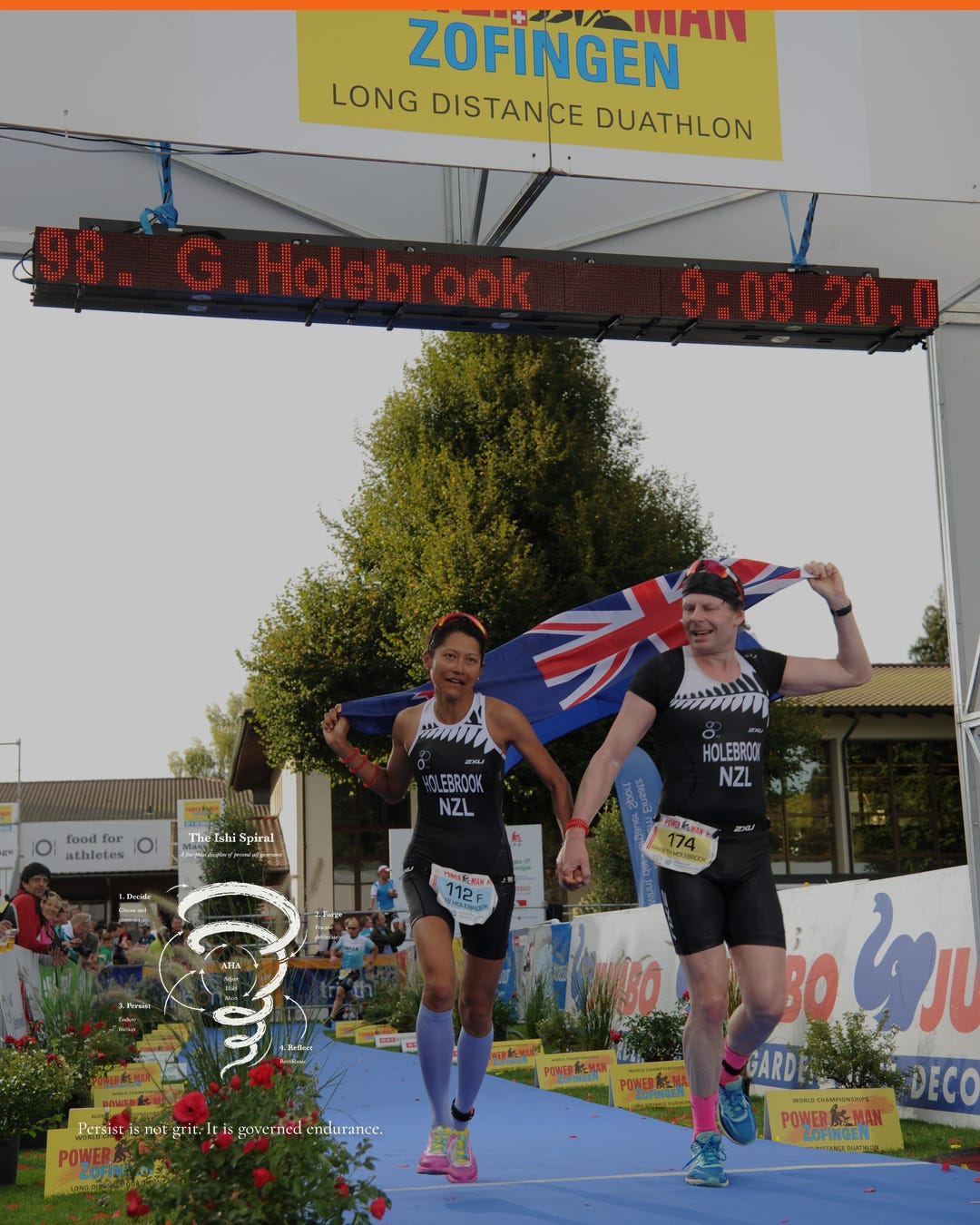
The story of my pinnacle year, between Powerman Zofingen in Switzerland in September 2017 and Challenge Roth in Germany in July 2018, needs to be prefaced with a story 6 months earlier in the second transition tent at Ironman New Zealand, after my DNF. I ordered a big breakfast at a café near the race start, went to the motel to change out of my trisuit and returned to the race venue. Thiri is often a volunteer doctor at the finish line when she doesn’t race. Having an inside track, I volunteered to help the second transition, T2, as the athletes changed from cycling to running.
I had nothing planned for the day given I had pulled out at 8:30 a.m. Many who knew me were surprised to see me, having given me a ‘good luck’ tap at the lakefront 7 hours earlier. I was present, neither racing nor recovering. I checked athletes coming through. Dehydration and cold in equal measure on a windy day. I watched others complete what I could not. It was a place to stand and reflect on what happened that morning.
Not long after, I spoke with my father. I told him I was disappointed, more unsettled than angry. He didn’t analyse it or soften it. He said I would bounce back and that I would have no problem doing it again. He had watched enough cycles in my life to recognise where I was on this one. I took him at his word and began acting as if that outcome was already decided. I also decided that day that I would overcome my sea sickness, my Achilles’ heel. I resolved to swim Cook Strait. That Ishi remains open. Maybe one day.
The first fixed point I locked in was Powerman Zofingen later that year. It would be my third outing to Switzerland for the Long Distance Duathlon World Championships. I signed up and trained consistently. I didn’t chase marginal gains or new experiments. I leaned on work I trusted because it had held up before. Running and riding done honestly, repeated often, without needing reassurance from novelty. The calendar began to take shape around that decision. It also began to look like I was a full-time triathlete. Contracting work was sparse in 2017, so I took advantage.
In September 2017, Powerman delivered exactly what it always does. Ten kilometres of race-pace running before the 150-kilometre bike with hills that you climb before your legs are ready and a final 30-kilometre run that exposes anything you tried to bluff earlier. The women started an hour before the men. Thiri was racing that year, and I assumed I would catch her on the bike. I was surprised not to have seen her by the time I got to T2, and then on my first lap of the 4-lap run saw that she was 20 minutes ahead of me.
During the run I could measure the gap between us closing by roughly 5 minutes each lap. I was doing the maths in my head while managing the effort, aware of her presence without seeing her. On the final lap I saw the black suit with the Silver Fern ahead of me. She knew what was happening and pushed harder. I pushed harder still. We entered the finishing chute side by side after 9 hours of racing and crossed the line together.
It remains the high point of my competitive life. The time at 9:08 was a personal best on that course, positioning me in the top 10. What made it the pinnacle was that after 9 hours of work, neither of us yielded. Two New Zealanders finishing together at the ITU World Long Distance Duathlon Championships. Endurance shared rather than solitary. Two weeks later, we raced the ITU Triathlon World Championships in Rotterdam. The legs were heavy and the recovery imperfect, but the posture was right. We both raced well and confirmed that Powerman hadn’t been a fluke. The work was holding. It was on the flight back from Europe that I learned about Xtreme Triathlon (XTri).
December brought Ironman Western Australia again, my 4th outing there in the Australian summer heat. I had raced there the prior year and set a personal best. I returned to better it and keep accumulating finishes towards my Kona Legacy qualification.
Race morning delivered another lesson in uncertainty. A shark sighting caused the lifeguards to cancel the swim. We stood on the beach for over an hour before starting the bike, already heating up under the sun. The race became a long grind. Everyone paid for the delay. Thiri watched the live feed and later told me that athletes were hobbling off the bike in T2 across the board. I finished battered but intact. A satisfying race under difficult conditions, short of a breakthrough.
A week later we were back in New Zealand for the Taupo 70.3. The lake was closed due to toxic algae, and the swim was cancelled again, replaced by a 5-kilometre run at the start. Two duathlons in 2 weeks. I found it absurd enough to be funny. I raced anyway and finished close to my personal best, feeling the fatigue..
March 2018 brought Ironman New Zealand. By then the season had momentum. Just direction, without the excitement. I raced in my Love the Pain suit as part of Team Mojo and delivered a personal best on that course. Thiri raced the 70.3 the same day and finished in the top 10 for her age group, qualifying for the World Championships later that year in Port Elizabeth, South Africa.
Three weeks later, I lined up for the Kiwiman XTri for the first time. It was raw and brutal. It required patience and attention rather than brute force. I finished 6th. By then the season had already exceeded anything I could have planned in the aftermath of the DNF. But there was still Roth.
Back in September 2017, Thiri had decided she wanted to attend another training camp with John Newsom in Germany in July 2018, aligned with Challenge Roth. We had been on several camps with John over the years. This one was attractive because it was a closing arc rather than a build. We booked it early, knowing the season would take us there. Training in Germany brought together threads that had been running for years. John’s calm precision. Sessions shared with Scott Molina and Erin Baker, whose presence alone gave me a boost. Work done properly in good company, with legends of the sport.
Challenge Roth itself remains unmatched. The Solarer berg climb is a narrow funnel of noise and humanity. Tens of thousands of spectators pressing in, cheering so loudly that it vibrates through the frame of the bike. It feels less like a race and more like being lifted uphill by sound. I rode through it steady and upright, aware that moments like that are earned slowly and remembered forever. There was a photographer on a gantry above the crowds and the image of me with a broad grin in the middle of the crowd is one I still look back on fondly.
The race cost me on the run. I blew late and accepted it. Thiri ended up with a faster run split, posting her own personal best with an overall time of 12:15 and going faster in the second half of the run than the first, which is testament to her self-governance. I finished around 11:40, consistent rather than exceptional. It was the final flourish of a long season, and it landed exactly where it needed to.
Earlier that year, at Ironman New Zealand, I had secured my Kona slot. I needed 12 finishes to qualify through the legacy programme, and that completed the set. When I spoke with my father after qualifying, I was more flat than triumphant. I told him I wasn’t sure I even wanted to go. I was tired and still had Roth ahead of me.
He told me I probably would do it and that I just needed a rest. That conversation took place on April 22, 2018. It was the last time we spoke. He died suddenly 3 days later from a pre-existing condition. At least he died knowing I had qualified. In 2017, after the DNF, he had told me I would be back and that I would have no problem doing it again. He was right, 5 times over in 12 months.
Later that year we travelled to South Africa where I watched Thiri race the 70.3 World Championships in Port Elizabeth. Standing on the sidelines was unfamiliar but fitting. The season had come full circle through continuity rather than dominance or reinvention.