Long efforts tend to fail in ways that feel personal. Months of planning end without a start. A busy year moves the work an inch. The project is dropped at month 9, or driven into the ground past the signals to stop. Wins pile up and teach you little. Each feels like a flaw in you, and each follows a pattern that can be named and fixed.
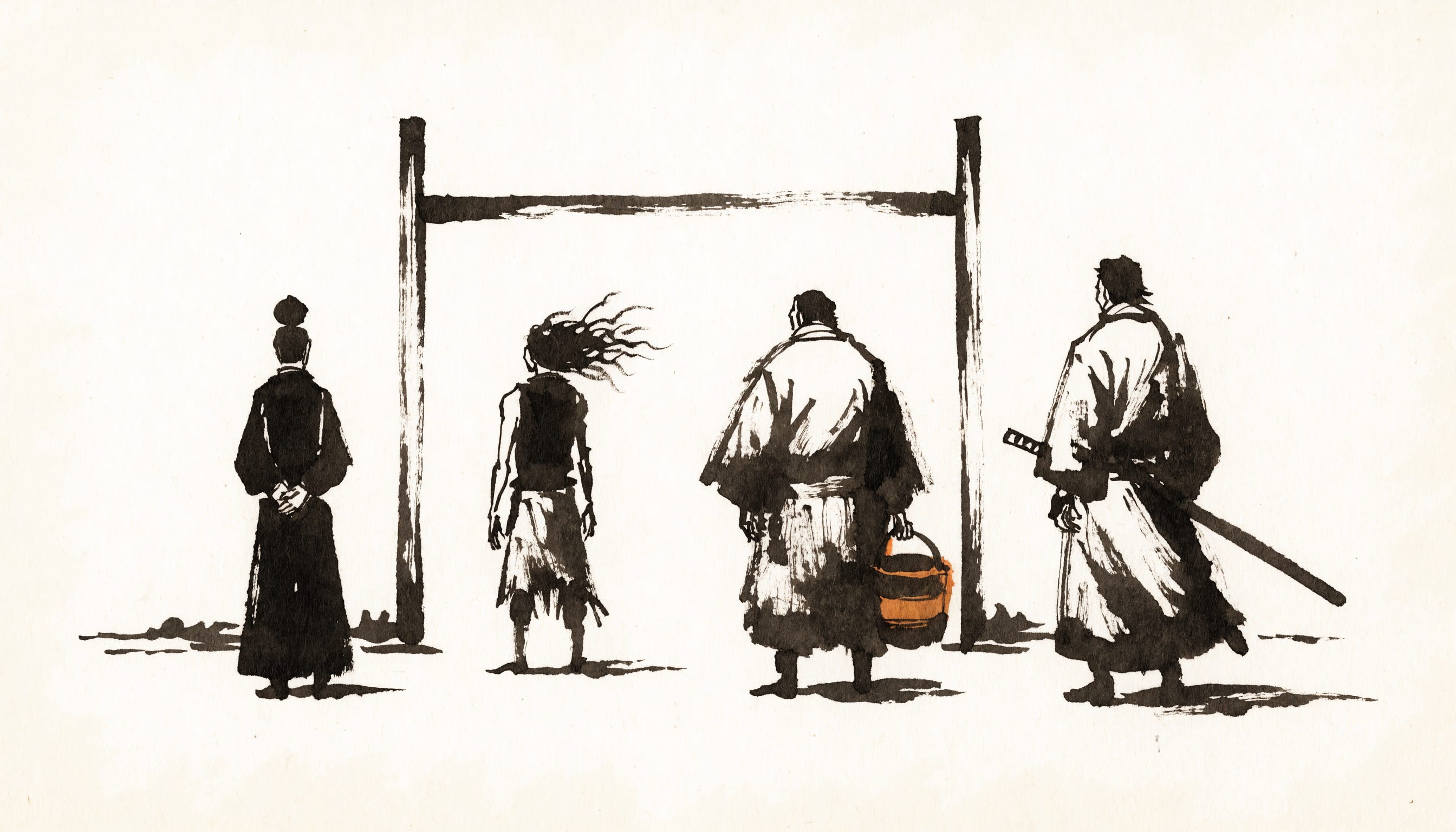
Four samurai trained in the same dojo. Each was capable, each failed, and no 2 failed the same way. I have had these 4 men with me for a while, because every one is a version of a mistake I have made myself, and because setting the failures beside one another shows something a single story cannot.
What it shows is a shape. Take a discipline that holds a person steady under load, remove one part of it, and a particular failure walks in and settles where the missing part used to be. The failure is predictable. Predictability is the useful part, because it makes the problem addressable instead of a question of character.
The system is the Ishi Spiral, and it has 4 phases. Decide, Forge, Persist and Reflect. In Japanese, Ishi (意志), Shugyo (修行), Gaman (我慢) and Hansei (反省). I use the Japanese where English runs short of precision, and I will say the English aloud so nothing rests on your pronunciation.
Decide sets the commitment. It names what you are doing, the horizon you are doing it over, and the conditions under which it ends. Forge turns that intent into capability through corrected, repeated practice, most of it unglamorous. Persist holds the line when conditions deteriorate, and it has its own governor, 3 responses set in advance: Adjust, Hold, Abort. Reflect closes the cycle by separating the quality of a decision from the quality of its outcome, which is harder than it sounds, because a win will hide a bad decision for years.
The word spiral is doing work. These 4 phases run together rather than in single file, and none is ever finished with. Persist is continued Forge under worse conditions, governed by the decision you already made. Authority alternates as you go: Decide and Reflect are where you think, Forge and Persist are where you work, and the discipline is knowing which phase has the floor right now.
Remove any one phase and the whole thing degrades in a specific, nameable way. That is what these 4 men are. Each has 3 phases running well and one absent, and each shows you the price of the absence.
Yuki: The Samurai Who Never Began
He decided everything and crossed nothing. The first failure of the Spiral is a decision that never becomes practice.
Yuki dreamed in detail. He read the old manuals, studied the forms and spoke like a scholar. He could recite the strategies of every general and the counsel of a hundred teachers. His sword was perfect, polished daily, balanced and ready, and it never left its scabbard.
Each morning he sat by the fire and told himself he was preparing. He was refining the plan, waiting for the right moment, sharpening mind and blade together. His peers rose in the dark to train in the mist. Yuki stayed behind, certain his discipline of thought stood higher than the sweat of the others. He saw himself as patient, deliberate and wise, and he was frozen.
His sensei, tired of words, drew 2 circles in the dirt. “This is your thought,” he said. “And this is your action. Between the pair runs a river. You admire it every day, and you never cross.” Yuki listened, and nodded, and did not move.
When sparring day came, Yuki came in his finest robes, his sword immaculate. He pictured the opening, the counter and the win. When the strike came he hesitated, and the wooden blade touched his brow. “That,” said the sensei, “is the sound of a plan that never left your head.”
Decide without Forge
A great many capable people live the way Yuki lived, in permanent rehearsal. Each mistakes planning for progress and understanding for execution. I see it in young athletes who love the gear more than the grind, and in leaders who spend months designing strategies that never touch the ground. Thought without motion decays.
The Ishi Spiral has 4 phases: Decide, Forge, Persist, Reflect. Ishi (意志), Shugyo (修行), Gaman (我慢), Hansei (反省). Each does distinct work, and the discipline holds only when all 4 run together. Yuki has the first and not the second, an Ishi that is intact and a Shugyo that is absent. The intent never becomes capability, because the bounded, repeatable practice that would turn intent into capability is never installed.
Shugyo is where intent becomes visible. It is the first repetition, the early draft, the imperfect start. Without it, Ishi is theatre, and there is no growth without friction and no skill without collision. Yuki’s sword gleamed and never found its work.
The Decide is the easier half, and admitting that is the start of the cure. A clear decision is satisfying, and it brings the feeling of progress without the cost of it. Crossing into practice asks the practitioner to give up the imagined version of the work in exchange for the real one, and the real one is harder to love.
The river
The sensei’s image holds the whole parable. Two circles in the dirt, thought and action, and between the pair a river the apprentice admires daily and never crosses. The river is narrow, the current is slow, and Yuki is fully able to cross it. The reason he stays is internal.
To cross would commit him to action that the imagined version of himself does not need to take. Standing on the bank of thought protects that imagined version. Crossing ends it.
Call it laziness and you misread it. What holds Yuki still is the defence of an inner picture at the expense of the outer work. The picture is of a man preparing so thoroughly that when he begins, he will begin perfectly, and that picture cannot survive the clumsy first repetition that Shugyo demands. So the first repetition never happens, the picture is kept whole, and the work stays unborn.
The river is the easiest crossing in the world. It is also the crossing the largest number of able people spend an entire career admiring. Yuki is only the clearest case of it.
Where this shows up
Yuki is rarely dramatic. He looks responsible. He is the side project planned for 2 years and never started, the training programme designed 3 times and run none, the skill studied without being practised, the move prepared for so long that the preparing has slowly become the substitute for the move.
In my own field the pattern is easy to find. The athlete with the immaculate plan and no logged sessions. The leader with the strategy deck that never reaches a single customer. The writer who has read more about writing than he has written. Each has decided, and none has forged.
The recognition is the first move, and it is the cheapest move available. After that the corrective is plain. The first repetition that the imagined version has been preventing, done badly, today, on the real side of the river. At some point the river has to be crossed, and the only way across is to get wet.
Yuki had the decision and never crossed into the work. Hayato is the same failure inverted. All the work, and nothing steering it.
Hayato: The Samurai Who Mistook Movement for Progress
He never stopped moving, and never asked where to. The second failure of the Spiral is speed with no direction.
Hayato’s energy had no equal. He woke before dawn, moved fast and struck first. His sword was always in motion, cutting air, carving the practice dummies, flashing in the sun. He fed on noise and activity, and stillness made him restless.
When his commander gave orders, Hayato rarely waited for the whole instruction. He held that a real warrior acts on instinct. He charged into battles half understood, often won the first exchange and lost the longer fight, and the pattern repeated until the victories rang hollow.
After another failed patrol, his general took him aside. The old man set a rock and a feather on the ground and asked which moved first. “The feather,” said Hayato. The general asked which one returned to its place, and Hay…