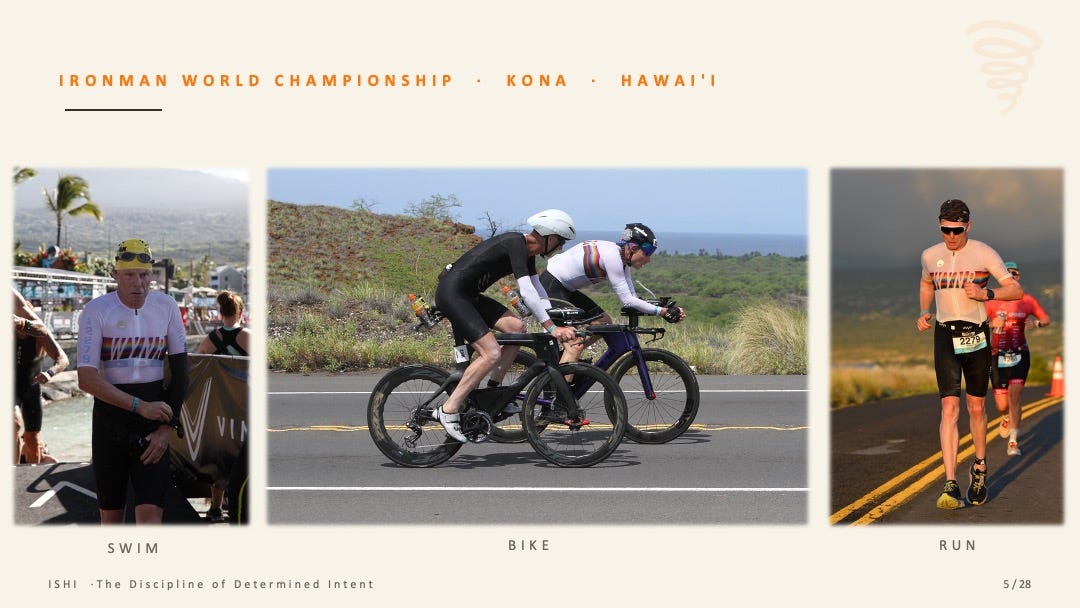
Perhaps you have pushed on with something long after the signs said stop, and called it determination. In the moment it feels like strength. Looking back, the plan you trusted was vague where it counted, and it held no rule for when to stop.
Kailua-Kona, Hawaii, October 2022
I’d swum 3.8 kilometres, without getting seasick, faster than any of my training swims. I had biked 180 kilometres almost exactly to plan in 5 hours and 50 minutes. Now I was 35 kilometres into the marathon at the Ironman World Championships. The course ran through the infamous ‘Energy Lab’, a brutal lava field where the afternoon sun claims professionals and age-groupers alike. No shade or mercy from the elements, just lava radiating heat that exposes every gap in your preparation. With 2 small climbs before the long descent to the finish line, I could already hear Mike Reilly, the voice of Ironman, in my head saying, ‘Gareth Holebrook, you are an Ironman!’ for the 10th and last time as I crossed the famous finish line on Ali’i Drive.
In Kona, my big dream turned into a nightmare. My race had been on point for 25 kilometres of the run. I was about 10 hours into the race before I noticed I was starting to struggle. Then, at 35 kilometres (22 miles), I was on the ground.
I was never fast enough to qualify outright for the World Championships. Instead, I secured a Kona slot through the Ironman Legacy programme in 2018, which rewards persistence over podiums. It was a one-time opportunity: no second attempt, no redemption if it went wrong. After deferrals due to the COVID-19 pandemic, the race finally happened in 2022.
When I finally toed that start line on Thursday 6 October 2022, 18 years of preparation were about to culminate in around 12 hours of racing. With only 7 kilometres (4 miles) of the run remaining, however, I found myself on the ground, curled into the foetal position, cramping and in tears. I’d lost consciousness only for a moment, but it was enough to make me realise I was done. Even writing about it now, I’m welling up. I can feel the heat of the black tarmac, the dizziness, the way the world narrowed. Strangely, I also remember feeling cold and starting to shiver.
A few athletes, each closing in on a personal dream, had stopped to help. Once an ambulance was called, I told the athletes to finish the race. One athlete reminded me that the tagline for that year’s race was ‘Ku like’, Hawaiian for ‘We’re in this together’. While I lay on the ground, half-delirious, I came up with the perfect title for the closing chapter of the book I was already wanting to write: ‘I’ve Found My Limit.’
This was supposed to be my lifetime goal, my Everest. I’d set myself a time target of 11 hours and 20 minutes: a 1:15 swim, under 6 hours on the bike and a 4-hour run. All doable. However, when I checked my watch as I lay on the ground, I saw my finish time tick past. I couldn’t stand. I had taken months off work, focused entirely on training that year and even spent a month acclimatising in Hawaii. I’d given this race everything, and here I was on the asphalt. It was over. I told those around me: ‘I give up. I’m done.’
A paramedic arrived on a scooter. I asked him to radio the finish line. My wife Thiri was volunteering as a race doctor, and I didn’t want her to see my tracker frozen and start to panic. ‘Tell her I’m pulling out,’ I said.
The course doctor stopped briefly and told me another athlete was down behind me and to sit tight. I drank water and waited. Brad, a sponsor and spectator, arrived on his bike. ‘How much salt have you taken?’ he asked. I thought I’d managed about a gram per hour, 8 tablets in total, half on the bike, half on the run. But I’d dropped a few in the wind and couldn’t keep the Gatorade down.
‘Not nearly enough!’ said Brad. He handed me a 500 ml bottle with a 1.5 g sodium tab dissolved in it. I downed it, added my last gel (30 g of carbohydrates) and sat still.
Thirty minutes later, I was upright again. When the doctor came back, he checked my eyes to see if I could focus, checked my heart rate and asked my date of birth and race number. All fine. I told him I’d walk to the next aid station. I walked one, jogged the next, then ran the rest.
Crossing that finish line wasn’t exactly graceful, but it was memorable. Mike Reilly’s voice did indeed call out ‘Gareth Holebrook, you are an Ironman!’ I’d done it. Thiri was there ready to hand me to the medics for an IV of saline. One looked me over and smiled: ‘You look fine to me.’
This experience taught me more than any theory I’ve read. How to decide, how to persist and how to stand up again when everything in you says stay down. Ishi: The Discipline of Determined Intent has its origins in how I have learned to operate under sustained load. Across endurance sport, leadership work and long technical projects, the same failure modes kept reappearing: effort without boundaries, persistence without review and decisions made too late to matter. The discipline described here emerged from trying to correct those patterns in practice, not from studying theory alone.
I’ve spent years trying to understand why some people stay steady while others fold. I now know that stability in life comes from maintaining determined intent under pressure, not luck or talent. It’s choosing to keep going when the outcome is still in fog. For me, Ishi started as a compass before turning into a discipline and crystallising as the Ishi Spiral, which has 4 phases: Decide, Forge, Persist and Reflect. The Spiral keeps purpose alive when noise and fatigue set in; it is not a loop of productivity.
A few days after the race, Brad sought me out on Facebook. Here is what he said:
‘Just wanted to congratulate you on finishing your race in Kona. I was the guy on the bike who saw you lying on the road with a few athletes around you. I saw you later on in the run and you were back with the athletes. It was amazing to see you back up on your feet so quickly.’
On reflection, I can see exactly where my system and plan had disintegrated. I had prepared with clinical specificity: to finish inside 11 hours and 20 minutes. I had specific splits for each leg. I had a carefully written nutrition plan taped to my bike: 30 g gel every 30 minutes, slow-release starch drink and energy bar at the halfway turnaround, drink to thirst and at least 1 litre per hour. But my planning was flawed. Sodium intake was listed as ‘about a gram per hour’. No exact protocol, no boundary, just an approximation that encouraged in-flight interpretation. In the end I didn’t even take that much, taking a salt tablet only at times when I was sheltered from crosswinds allowing me to take one out of my food storage bag. That single omission added 2 hours to my ultimate finish time.
I had prepared for the distances more than the conditions. Winter in New Zealand did nothing to prepare my body for Hawaiian heat and humidity. Even with a month of acclimatisation, I still had gaps in my armour. I practised my hydration plan but never truly tested it under real race conditions until the day itself.
The gap between what I thought I knew and what the race demanded only became visible when it was too late to close it. I’d been repeatedly told about the heat, but I had previously excelled in races in Western Australia, known for dry heat in the 30°C range, and thought that I’d be fine. I had also learned over the years to ignore horror stories of races, which are usually overstated. The heat and humidity in Hawaii, however, are an exception: even the top athletes suffer.
As I lay crumpled on the roadside at the 22-mile marker, my persistence had evaporated. If Thiri had been there instead of volunteering at the finish line, she would have pulled me from the race immediately. Three years later, in 2025, both leading women, Lucy Charles-Barclay (LCB) and Taylor Knibb, succumbed to the same conditions. LCB’s husband was on hand to withdraw her when she was doggedly trying to continue even though it was clear it wasn’t s…