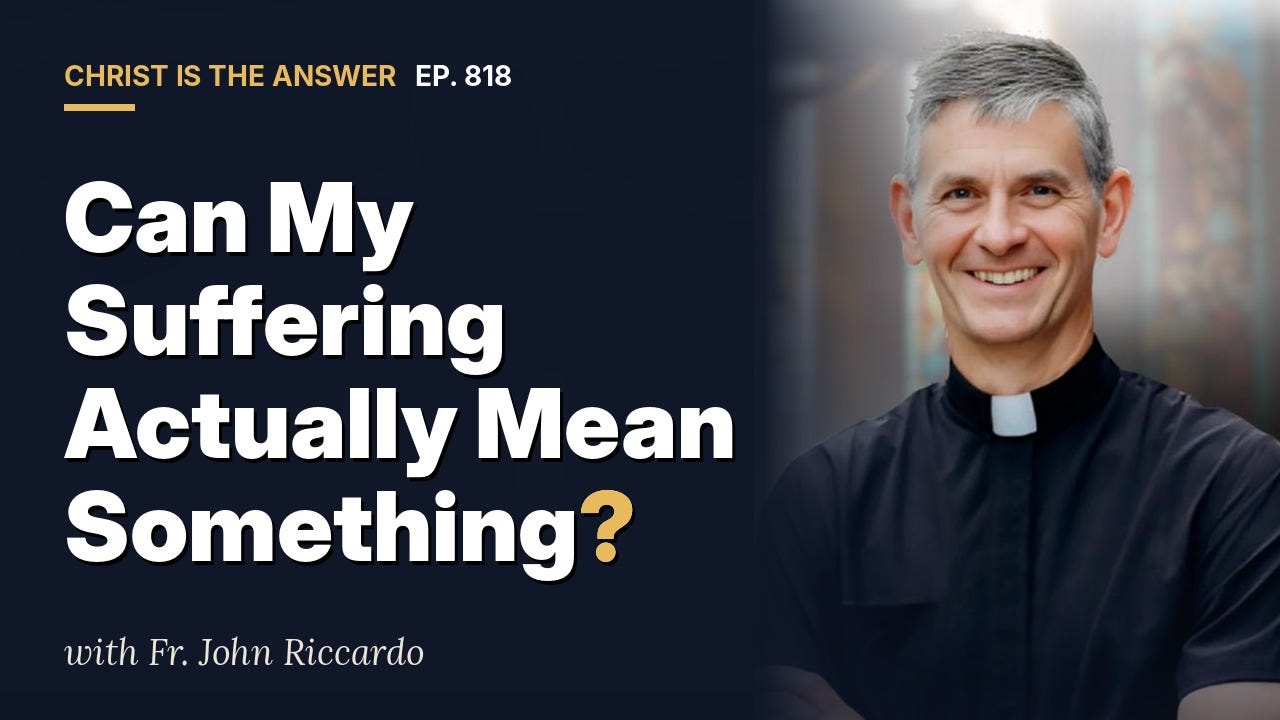
Episode 818 · No Greater Love, Part 4
Most of us treat pain as something to get through, or something that proves God has walked away. In part four of his Lenten mission, Fr. John Riccardo explains what the Church means by redemptive suffering and what Paul means by 'completing what is lacking' in Christ's sufferings. He shows why the sick and the housebound may be doing some of the most important work in the Church.
This episode helps answer: Can My Suffering Actually Mean Something?
In this episode
* Jesus did not suffer so that we would not; he invites us to share his cross, and suffering is neither proof of weak faith nor always punishment for sin.
* Suffering is not a good in itself, but Christ has forever joined suffering to love; his hours on the cross were his most active, freely chosen act.
* Christ's sacrifice is complete; we are invited to participate in it, as we participate in his sonship and priesthood (Colossians 1:24).
* 'Offer it up' should not be passive: unite your pain to the cross for a specific person by name.
* John Paul II (Salvifici Doloris): suffering is a vocation, and those who feel useless in a hospital bed give the Church an irreplaceable service.
* Voluntary penance in Lent works the same way, as an act of love for others, like waves eroding a cliff; the Church is the body of Christ still in travail.
Timestamps
* 4:15 – Jesus embraces the cross and climbs onto it himself
* 8:20 – Three false ideas about suffering (no pain, weak faith, personal punishment)
* 15:38 – Physical and moral suffering, and asking 'why' while looking at the crucifix
* 24:59 – Colossians 1:24 and what it means to participate in Christ's work
* 30:24 – 'Suffer well': unite your pain to Christ's cross for someone by name
* 35:37 – Reading Salvifici Doloris: suffering as a vocation
* 45:06 – Q&A: penance, Christ still suffering in his body, and the crucifix
Scripture
John 10:17-18, John 15:18-20, James 1:2-4, Sirach 2:1, Colossians 1:24, Hebrews 2:9-10, Philippians 3:10, Romans 8:22
Also mentioned
Salvifici Doloris (St. John Paul II); To Know Christ Jesus (Frank Sheed); Fulton Sheen on suffering; The Passion of the Christ (film, 2004); Book of Job
“Christ does not explain in the abstract the reasons for suffering; before all else he says, follow me.” – Fr. John Riccardo
Description: Instruction on the Catechism of the Catholic Church and other topics critical to those seeking answers to life’s greatest questions