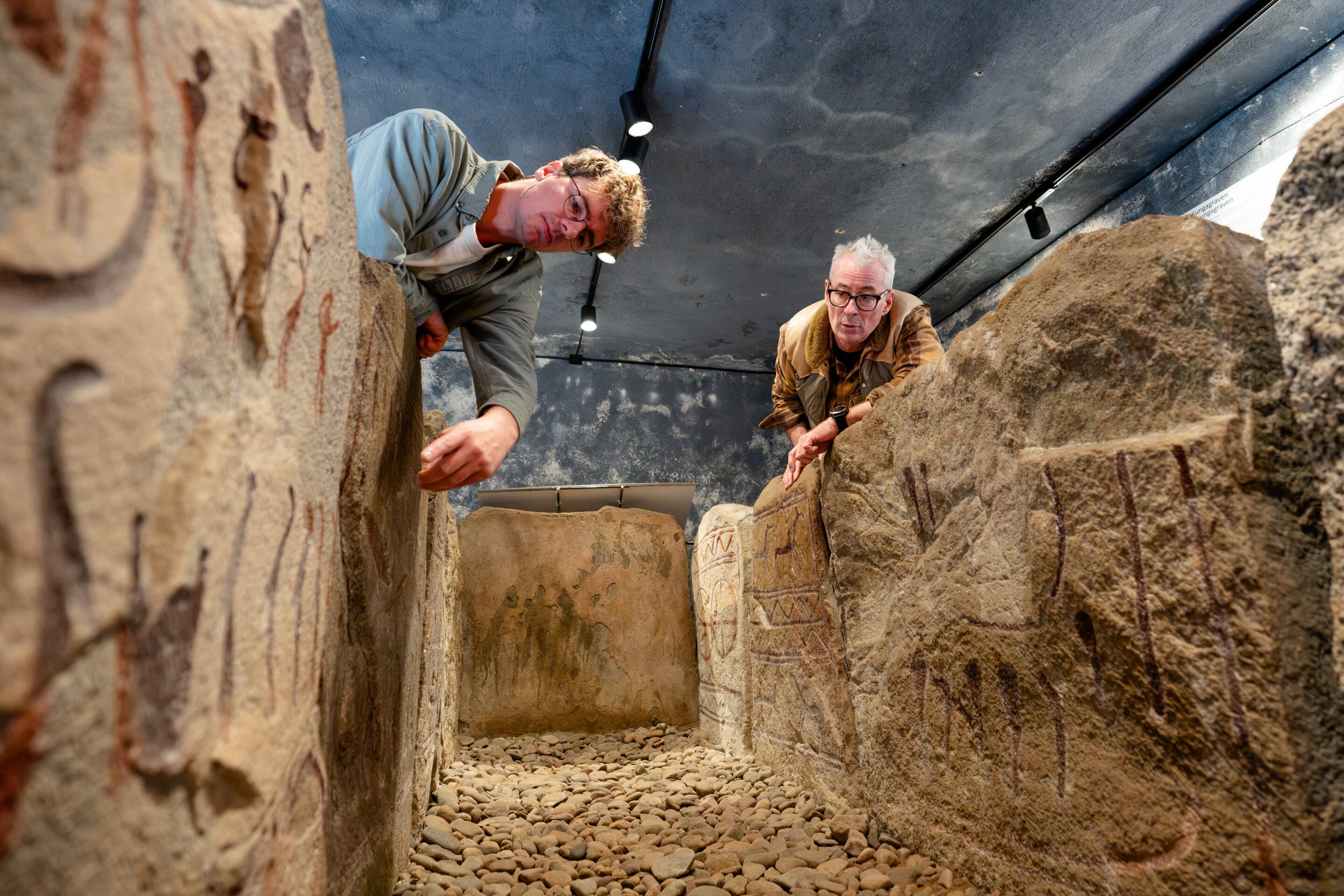
On the Danish islands, the local ancestry that had been widespread between about 2200 and 1600 BP had essentially disappeared by 1250 BP, roughly a century before the Viking Age. (BP means calibrated years before present, with the present fixed at 1950 CE.) In its place, the Scandinavian-related ancestry of most individuals is best modelled by an Iron Age source from northern Germany or southern Jutland. That is the central finding on Viking ancestry in a new ancient DNA study of how the Germanic languages spread. It was published with a companion paper that applies the same data to the origin of the Celtic languages.
The usual picture has Viking Age Danes and Swedes descending from people settled in southern Scandinavia since the Bronze Age, speaking a language that developed in place. Earlier genetic studies detected southern ancestry arriving but, the authors note, generally assumed local continuity. The new work says that continuity broke in Denmark and southern Sweden during the Migration Period (1575 to 1375 BP), when Old Norse, the language of the Vikings, took shape.
Both papers appear in Nature. Hugh McColl is first author on both, sharing that position with the linguist Guus Kroonen on the Celtic paper, and Eske Willerslev is last author. The team sequenced 712 new ancient genomes and combined them with published data into a working set of 4,587 individuals spanning roughly 5,000 years. The Germanic paper proposes that a population it calls Eastern Scandinavian, linked to the northeastern Baltic, reached Sweden by about 4000 BP and carried the earliest form of Germanic. That is some 800 years after the Corded Ware groups traditionally credited with bringing it. The paper also traces most of the Scandinavian-related ancestry of the Anglo-Saxons, Frisians and Langobards to Jutland and northern Germany.
The companion paper tests four competing models for how Celtic reached an Iron Age range that ran from Iberia to the Balkans. It detects three large movements of people between 4400 and 2800 BP. It judges the last of them to be the most parsimonious vector for Celtic, meaning the one that needs the fewest extra assumptions: a westward spread from eastern central Europe between 3200 and 2800 BP, associated with the cremation-dominated Urnfield Culture. That puts the paper behind the longstanding Celtic-from-the-East model. In both papers the most important conclusion sits beside the largest gap in the sampling, and that shapes how far I would trust each one.
How does ancient DNA trace the spread of a language?
DNA cannot show what anyone spoke, as both papers acknowledge, but it does show who descended from whom. The method uses identity-by-descent (IBD) segments, which are stretches of chromosome that two people share because they inherited them from a common ancestor. Recombination shortens these stretches every generation, so long segments mark recent relatives and short ones deeper links. Many genomes here are thin, down to 0.1× coverage, meaning only about one position in ten was read even once. The team filled in the missing genotypes by imputation from a reference panel of present-day genomes.
In IBD mixture modelling, each individual gets a palette recording how much DNA they share with each of 386 genetic clusters. A target’s palette is then fitted as a blend of the palettes of chosen source groups. Because every palette draws on the whole dataset, a Viking Age Dane can be linked to an Iron Age source population even when the two share few segments directly.
Applied to Scandinavians older than 2800 BP, the method finds three clusters. The Eastern Scandinavian one carries extra hunter-gatherer ancestry best matched by hunter-gatherers from Latvia and Lithuania. The authors attribute it to an unsampled population between Finland and northeastern Sweden; no genomes yet exist from that region and period. Between about 3200 and 2450 BP, early Germanic took loanwords from Celtic to the south and lent words to Finno-Saamic languages to the east. Neither of the other clusters reached both contact zones, so the authors call Eastern Scandinavian ancestry the most parsimonious vector.
Tracking later movements is harder, because everyone who postdates the arrival of Steppe ancestry in Europe is so closely related. The Celtic paper’s solution, which I think is the smartest move in either study, is to follow which regional variety of older Neolithic farmer ancestry people carried. Bell Beaker groups absorbed different local farmers in different places, so a source of confusion becomes a regional tag. In England, ancestry tied to Neolithic farmers of Iberia and France overtakes local farmer ancestry between 3800 and 3200 BP. That matches an earlier report of large-scale migration into Britain (Patterson and colleagues, 2022). Between 3200 and 2800 BP, ancestry tied to Bronze Age Hungary and Serbia rises in England, becoming widespread by at least 2600 BP.
Iberian individuals from Urnfield contexts carry that eastern ancestry by 3150 BP. The authors use ancestry related to the Knovíz Culture of the Czech Republic as a stand-in for Urnfield populations generally. By 2800 BP it is common across former Urnfield regions, though its effect weakens westward and the older Bell Beaker-related ancestry still dominates in Iron Age England. The authors then checked each movement against published linguistic dates. These covered the formation of Proto-Celtic, the undocumented ancestor of all Celtic languages, and the later split between its Brittonic branch (including Welsh) and Goidelic branch (including Irish). Only the third movement fit most estimates on every count.
Why does cremation leave gaps in the ancient DNA record?
What I most want readers to notice is where the missing genomes fall. Both papers place their most consequential change in centuries when most people were cremated, and cremation destroys DNA. For the Celtic paper this is the Urnfield period of 3200 to 2800 BP. The authors say the timing of the transition in France cannot be measured directly for lack of Late Bronze Age samples, so they infer it from Britain and Iberia.
For the Germanic paper, the gap runs from 1575 to 1200 BP, when Old Norse formed. I counted the individuals in the paper’s ancestry plot for Denmark and Sweden (Extended Data Fig. 13). The panel for 1575 to 1230 BP holds 15 people, against roughly 200 on each side, and only four are Danish genomes older than 1250 BP. Because hundreds of genomes anchor each end, I accept that the population of the Danish islands changed, but the genomes cannot say when within the window. The paper’s date, probably 1550 to 1450 BP, comes from non-genetic evidence, including tree rings from 654 Danish oak samples.
Norway is the result I think historical linguists should weigh most. Old Norse took shape there too, yet the paper finds genetic continuity in Norway from the Iron Age to the Viking Age. The authors conclude that demographic and cultural mechanisms combined to drive the language. They also observe that the later boundary between East Norse and West Norse dialects roughly follows the boundary between the newcomers’ ancestry and Norwegian Iron Age ancestry, even in Viking areas of Britain. That is a firmer link between genes and language, because it concerns a split inside a language rather than its birth. The authors also suggest the expansion through Denmark may partly explain why Old Norse speakers called their language dǫnsk tunga, the Danish tongue.