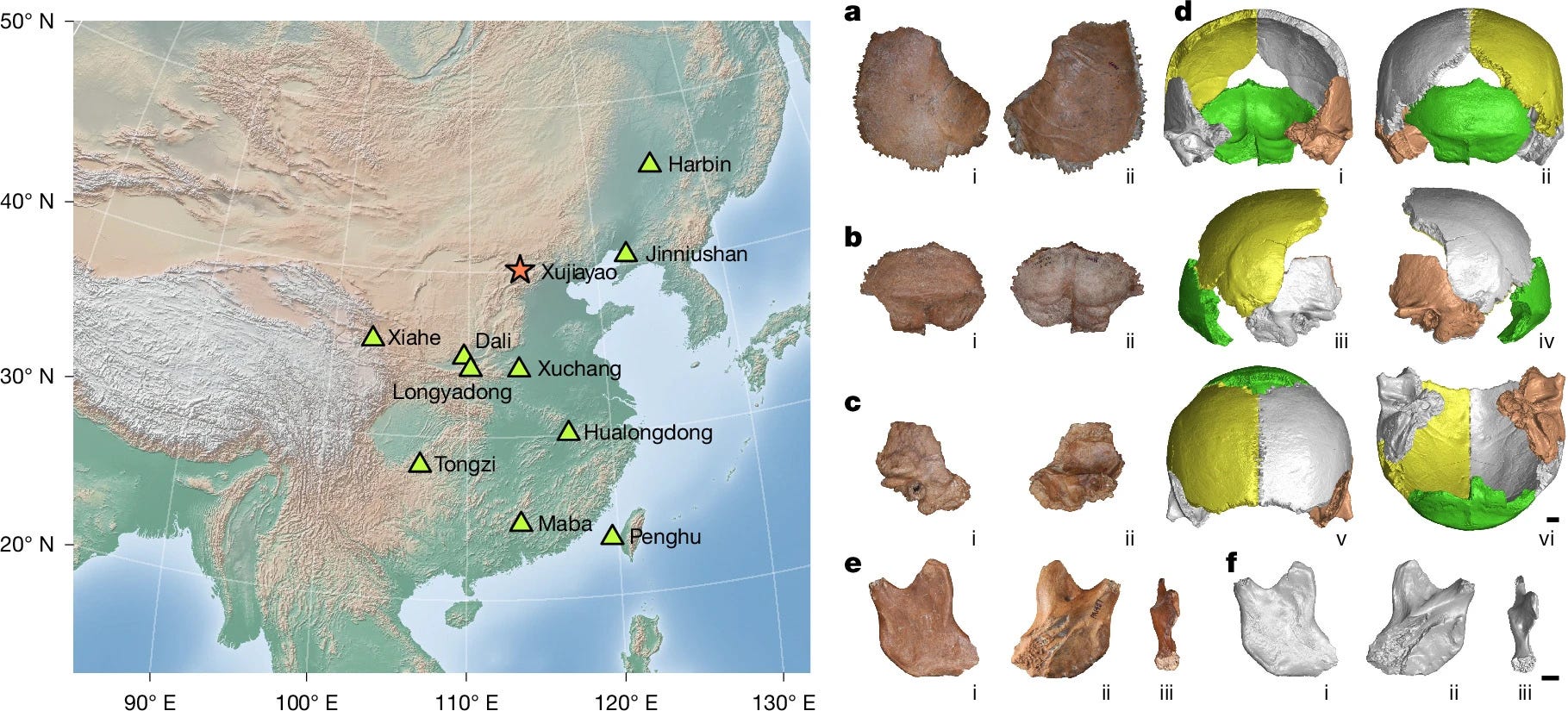
At position 996 of a collagen chain called COL1A2, the protein extracted from a right parietal bone from Xujiayao, a Middle Pleistocene site in the Nihewan Basin of northern China, carries lysine in 57 distinct peptides and arginine in one. The second Xujiayao specimen sampled, a mandibular ramus, gives 61 lysine-bearing peptides against a single arginine one. Every Denisovan with protein or genome data carries lysine at that position, while Neanderthals and modern humans carry arginine, and those two bones are the main reason the Xujiayao hominins are now being called Denisovan.
Since the fossils came out of the ground between 1976 and 1979, Xujiayao has been filed as Homo sapiens neanderthalensis, as early H. sapiens, as archaic H. sapiens, and, to avoid the argument, as archaic Homo. Most recently it became the holotype of Homo juluensis, a species proposed partly on the 1,700 ml endocranial capacity of the Xujiayao 6 cranium (Wu et al., Journal of Human Evolution, 2022). If you follow East Asian Middle Pleistocene hominins, you probably carry a picture of Dali, Jinniushan and Hualongdong as archaic humans with unsettled names, and of Denisovans as a lineage known from a genome plus a few molecularly confirmed jaws and one cranium.
The paper appeared in Nature on 21 October 2026. Song Xing, Zhongyou Wu, Qingfeng Shao and Junyi Ge are the equal-contribution first authors, and Qiaomei Fu of the Institute of Vertebrate Paleontology and Paleoanthropology in Beijing is the corresponding author. The team sampled two of the 20 Xujiayao cranial, mandibular and dental fossils, recovered 18 endogenous ancient proteins, and concluded that the assemblage belongs to a late Middle Pleistocene East Asian Denisovan population. They then compared skull and jaw anatomy across East Asian archaic Homo and argued that most of those fossils, Dali, Jinniushan and Hualongdong included, are Denisovan as well, and that the size gap behind H. juluensis is variation within one population. This post is about how much of that sweeping reclassification two bones and one amino acid can carry.
How do researchers know the proteins are ancient?
The sampling was minimal. The team CT-scanned both specimens first (37.56 μm resolution), then drilled a small hole in each in a dedicated clean room, shielding the surrounding bone with aluminium foil. They dissolved the powder, split the proteins into fractions, and digested them with trypsin, an enzyme that cuts proteins into short peptides. A mass spectrometer then reads the mass of each peptide fragment, which allows the amino acid sequence to be inferred. The runs were done in two independent laboratories, one at Capital Medical University and one at Fudan University, and the data were searched with two software packages, PEAKS Online and MaxQuant. Extraction blanks were processed alongside the samples, and a modern camel bone served as a positive control.
The hard part with any ancient protein is separating the real thing from modern contamination, and the authors lean on deamidation. Over long burial, the amino acids asparagine and glutamine slowly lose an amine group, so ancient proteins show high deamidation and fresh contaminants show little. In specimen PA1490 (the parietal), the main bone collagens had asparagine deamidation of 61.4 to 94.7% and glutamine deamidation of 44.9 to 92.6%, while keratins and trypsin, the usual contaminants, sat at 0.0 to 5.3% and 0.0 to 7.7%. PA1497 (the mandible) looks similar. After that filter, plus removal of peptides that could not be tied to a single gene, anything seen in the blanks, and anything MaxQuant could not confirm, 18 endogenous proteins remained: 13 for PA1490 and 15 for PA1497. Figure 2b gives the endogenous share of peptides as 91.4% for PA1490 and 94.1% for PA1497, and the extraction blank scores 0.0.
The taxonomic call comes in two steps. Searches against a mammalian type I collagen database placed both samples in the genus Homo, and the team then looked at single amino acid polymorphisms (SAPs), positions where sequences differ between lineages. The informative one is COL1A2-996. The paper’s Figure 3 shows the supporting peptides, 207 peptide-spectrum matches (individual spectra assigned to a peptide) for PA1490 and 244 for PA1497. The lysine peptides also show elevated deamidation at nearby residues (Asn977 at 69.2% and 69.4%, Gln1002 at 100% in both), which argues that they are genuinely ancient. The authors also built a Bayesian tree from 2,074 amino acid positions in eight proteins, with Denisova3, the Altai and Vindija 33.19 Neanderthals, 50 present-day humans from the Human Genome Diversity Project, and a chimpanzee (Pan troglodytes) as outgroup. Xujiayao and the Denisovans form a clade with posterior probability above 99%.
Within that clade the tree gives nothing: individuals fall into unstable arrangements with posterior probabilities below 50%, because no variant other than COL1A2-996K is shared. That is why the authors say only that Xujiayao is Denisovan in a general sense, without placing it relative to Xiahe, Penghu, Harbin or Denisova Cave. The dating, for what it is worth, is 199 to 138 ka from combined uranium-series and electron-spin-resonance methods (Shao et al., Quaternary Science Reviews, 2026), which makes Xujiayao about contemporary with the earliest confirmed Denisovans from northeastern China and southern Siberia.
Does skull shape make Dali and Jinniushan Denisovan too?
This is where I slow down, because the molecular result covers two bones and the morphological claim covers most of East Asia. With Xujiayao and Harbin both classed as Denisovan, the authors characterize a Denisovan skull. It has erectus-like traits (a low, wide neurocranium; a vault 7.7 mm thick at bregma and 12.0 mm at the parietal tubercle on Xujiayao 6), derived traits shared with later Homo (a strongly arched temporal squama), and a combination found in neither H. erectus nor modern humans: a low profile with near-parallel lateral walls, a nearly vertical but non-rounded occipital, and a mandible with a depression in the planum triangulare. They then check whether Dali, Jinniushan, Hualongdong and Xuchang show the same suite, and conclude that they do.
I find the Xujiayao assignment far stronger than that extension, for a reason the paper concedes itself: the suite “does not appear simultaneously in individual specimens but manifests in different forms or combinations across various specimens.” A definition that tolerates different combinations in different fossils is hard to falsify, and the definition was built from Xujiayao an…