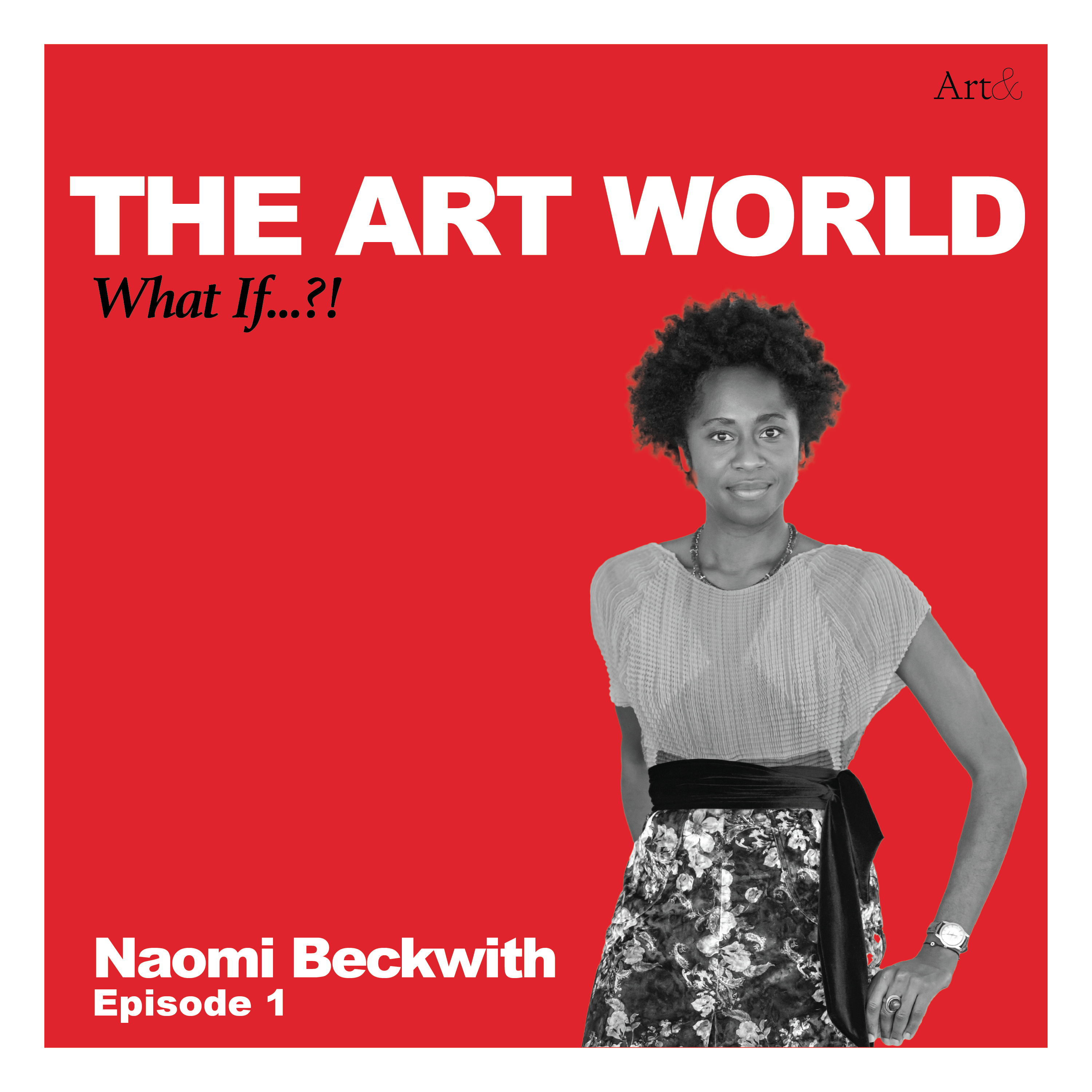
“Not just what if—but what are we missing?” In the first episode of this new podcast, host Charlotte Burns is joined by Naomi Beckwith, the deputy director and Jennifer and David Stockman chief curator of the Solomon R. Guggenheim Museum. Someone actively working to recalibrate the field in the most exciting and dynamic ways, Naomi starts this episode with science before moving on to museums—and how we can create change. What if our textbooks were Black? What if we decentered the Western world in conversations about art? Tune in for more.
Charlotte Burns:
Hello and welcome to The Art World: What If…?!
I’m your host, art journalist Charlotte Burns, and this is a series all about imagining different futures. We’ll talk about how we navigate the churn and change currently shaping culture. What are some of the biggest shifts that need to happen for art to stay relevant in a changing world?
In each episode, we’ll be talking to some of the most interesting people in the art world, asking them ‘what if’?
[Audio of guests]
In this episode, we welcome Naomi Beckwith, the deputy director and Jennifer and David Stockman chief curator of the Solomon R. Guggenheim Museum.
Over the years, I’ve been a journalist, if ever I have something difficult to think about, Naomi is someone I like to try to talk to because she is such a precise and a completely independent thinker. Naomi is not someone who says what everyone else does, instead, she approaches art and the industry on her own rigorous terms.
Naomi and I began our conversation with something that inspired her from an early age—the link between science and art…
[Music break]
Charlotte Burns:
Naomi, thank you so much for joining me today.
Naomi Beckwith:
Hi, Charlotte, you're very welcome. I'm thrilled to be here.
Charlotte Burns:
So, I wanted to start in a slightly unusual place, which is in the world of science, because you didn't intend to be an art person. You initially trained as a scientist. And prepping for this conversation, I watched a PBS interview with you. You were talking about how you'd written a paper on the Italian scientist Enrico Fermi, who came to America to work on the Manhattan Project. And then later, you realized there was a monument to that process in Chicago's Hyde Park by the artist Henry Moore. And you talked about how the sculpture [Nuclear Energy (1963-67)] represented the new possibilities and the shiny new world of this tech—but also meant that something we didn't know was coming.
And that seems like an apt place to start this interview amidst great change, great potential and, also deep uncertainty.
Naomi Beckwith:
You're right, it actually is an interesting crossover from the world of science into art for me because both, essentially, if they're doing their work right, are dealing with questions of the unknown. And I think that's perfectly appropriate for a podcast called, What If?!
Essentially, I grew up in this neighborhood with this monument, and it was something quite different from many of the other monument-like things that I'd seen around. There were plenty of Grecian figures in and around the South Side of Chicago. There were men on horses—of course, as usual—roaming around the city. But here, outside the Library at the University of Chicago, was a sculpture that was completely abstract.
But if you can imagine it, Henry Moore loved the idea, as did the rest of the St. Ives group, of a kind of abstract language that was fielded through the forms one could conceive of in nature. Biomorphic forms that looked a little bit, in this case, like maybe a knuckle, a bone structure, something that had a big rounded top, and then an overall rectangular form with a void in between.
And it was this shape that, on the one hand, reminded me of the mushroom cloud. I am a child of the ‘80s. I grew up in utter terror of nuclear annihilation. I’m sad that we find ourselves pondering these questions again. But I was also a child that knew that the more that you began to play with forms, the more that you could neutralize it.
And I think this is what Henry Moore was doing—trying to give us the sense of the shape of a nuclear reaction, but also understanding that if you harness it in the correct way, you could do something with this great power. This great potential. This thing that could, of course, destroy us, but could also give us endless energy. That could also be a sign of our intelligence and our curiosity. And that could also lead us into a future that we couldn't imagine before.
What on earth are we going to do with the knowledge that comes after that? And what on earth are we going to do with the power that we still hold?
Charlotte Burns:
Well, they're great questions, indeed. What are we going to do?
I'm going to bring it slightly into a more prosaic space by asking how you bring that to bear, your scientific background. As the oceans rise and temperatures increase, what can the art world what can museums learn from the scientists? You're at the head of leadership now in a major institution. How much is this spoken about?
Naomi Beckwith:
If anything, there's been sort of two divergent conversations around this. Really, you know, our survival as a species, and then the role of art institutions inside of those conversations.
The first conversation is really how do we, as museums, just do better as global citizens? How do we reduce our carbon footprint? How do we recycle the majority of our materials? These are things that have been coming to us, both in terms of municipal pressure but also been long-standing conversations internally.
We've been working very deliberately and diligently with external groups and are part of a consortium of museums answering this very question. You don't hear about it because it's not sexy, right? It's not sexy to talk about the cardboard we use. It's not sexy to talk about our waste management systems. Nobody wants to hear that. The mundanity of it isn't dazzling. And that's okay. Because, in many ways, it is our mundane actions and our carelessness in our mundanity that has gotten us to this current crisis.
On the other hand, there is a very public sort of conversation that we're seeing, which is this series of protests that you see with, for instance, [Just] Stop Oil and tomato soup going on a Van Gogh. I forget at which museum people were gluing themselves to the surfaces of framing. This is another kind of forced conversation that we have, but it's a conversation that really asks, I think, a very key question around this climate crisis, which is where do we turn our attentions? And where do we turn our resources as a society?
Obviously, I agree that we are well within, I think, a decade of sheer, irreversible terror in terms of the way the Earth will or will not function. And while I very much agree that we need almost a kind of desperate stunt to call people's attention to it, I don't agree that it's a zero-sum game between culture and climate. Thinking about it as either the arts or the climate, thinking about Van Gogh's sunflowers or mashed potatoes, I think, lacks; lacks serious imagination. We have all the resources and power to do both. And we shouldn't be pitting one against the other.
Charlotte Burns:
An interesting thing related to this in terms of museums is, of course, museums preserve the past and in very specific climate-controlled conditions. And what we've experienced over the past several decades is this boom in museum building, and in terms of our travel around the globe as a kind of community, but also the expansion of museums domestically. When we think about that—this idea of phenomenal growth of institutions that have gone from, you know, maybe 30 or so people inside an institution, like the Guggenheim, to now corporations spanning the globe, like the Guggenheim—how do we think about collections?
And this is a kind of two-pronged question because, on the one hand, there's always the imperative to grow more. And right now, we can discuss…