Please note that a small portion of the text of this podcast is taken from an Eating in America Note, published on EatingInAmerica.co this week.
I propose a new, simple definition for highly- and ultra-processed food, the definition of which shouldn’t be, but nonetheless has become, perhaps the most important nutrition issue of 2026. It has been made an issue as a tactic of delay by the Big Food lobby, which will exploit any opening to postpone the possibility of regulation of highly- and ultra-processed food.
You haven’t heard from me as much as usual lately because I have been working on this definition intensely over the last few weeks. My hope is to provide a fresh perspective that provides a framework for the clearest, simplest, most durable way forward.
Highly-processed food = ultra-processed food
Highly-processed food and ultra-processed food are two terms for the same thing. This is supported by the new Dietary Guidelines, which uses the term highly-processed instead of ultra-processed. I will use the abbreviation HUPF, standing for highly- and ultra-processed food.
HUPF and disease
HUPF has been linked to many chronic diseases, including obesity, heart disease, cancer, diabetes, and dementia.
The Tobacco Playbook: the chapter about delay.
Big Food knows HUPF as a category is bad for our health and that it will be increasingly regulated at various levels of government. But Big Food has had close ties to the tobacco industry, so, like Big Tobacco, they have learned all the tricks and moves to fight regulation, including those in the chapter about delay in the mythical but often cited Tobacco Playbook. This is the set of schemes and strategies that has been used not only by Big Food, but the alcohol industry and opioid manufacturers, and is being employed now by the gambling industry.
To interfere with the growing momentum toward regulation, the question of a viable definition of ultra-processed food has been pushed by the HUPF food lobby, America’s biggest. RFK, Jr.’s Health and Human Services department and the USDA have been struggling to settle on a definition of ultraprocessed food that can be used for writing policy and regulations. Kennedy says the definition is finished and is awaiting the approval of Trump now. This holding pattern means Big Food is not done lobbying on the issue.
A simple definition of HUPF is needed
I predict the Trump administration will come out with a not-simple, maybe even tricky, definition that is as favorable as possible to Big Food while maintaining the appearance of addressing the concern with HUPF that is a core issue of Trump’s important constituency, the Make America Healthy Again movement.
The Big Food lobby and HUPF
However, what Americans actually need is a clear and simple definition of HUPF that can’t be corrupted by Big Food.
I can ‘t know for sure that the federal HUPF definition will be compromised by Big Food’s influence but, given the record of this administration and the record of success and power of the Big Food lobby, it is a safe bet that industry profit will be considered at least equally with public health in the forthcoming Health and Human Services and USDA definition.
For examples of the power of Big Food, their lobby got the word “ultra-processed” taken out of this year’s Dietary Guidelines, even though RFK, Jr. is an avowed enemy of HUPF. And the Make America Healthy Again Strategy Report, of September 2025, mentioned ultraprocessed only once, in the context of the need for a definition.
Before RFK, Jr. and the USDA issue their Big Food-compromised definition, I have a proposal.
First, some background.
Carlos Monteiro, the scientist who invented and popularized the term “ultraprocessed food,” did the world a huge service in identifying how the food we are eating is industrial, formulated to be addictive, heavily marketed, all about profitability, and not healthy. Monteiro defined ultraprocessed as generally bad and not ultraprocessed as where the good lies, which is all true. But his definition of ultra-processed was too inclusive and not simple and clean enough to be used for policymaking.
Clarity from an unlikely source
I respectfully offer a simpler way to view what has happened to our food environment and how it happened, a clear dichotomy that was popularized in the late 1960s by none other than the Hippies.
Without the benefit of science or research, the love-beaded, bell-bottomed folks of the Counterculture Revolution intuited that the direction the food environment had gone was all wrong. They understood American diets were being co-opted by the marketing and lab-created, unnatural products of Big Food. They said, “What was the matter with the way we were eating before?”
The natural food movement blossoms
And so the natural food movement was born in earnest. In the words of Crosby, Stills, Nash, and Young from 1969’s Woodstock, “…we’ve got to get ourselves back to the garden.”
Suddenly un-sugared granola and un-sugared plain yogurt were to be found in small urban food co-ops along with raw milk, whole grains, nuts, honey, molasses, organic vegetables, lentils, brown rice, tofu, and sprouted beans. Highly- and ultra-processed food were rejected. To the youth of the Counterculture, this was an entirely new way of eating, but to the grandparents of those Hippies and their grandparents and their grandparents, this was just the way food was supposed to be. Except for the tofu, of course, which was “far out, man.”
The end of World War II and the beginning of the HUPF Era
These twenty-somethings had been born in the years surrounding the dropping of the first nuclear bombs in 1945, ending World War II and beginning the Atomic Age, and the Anthropocene Epoch proclaiming the most pronounced human impact on our planet, and, not coincidentally, the HUPF era.
It is no coincidence that the HUPF era directly follows World War II. The needs of the Allied war machine had driven both the development of new HUPF food products for our soldiers and chemical design and manufacturing that fueled the rapid rise of commercial HUPF after the war.
HUPF harms? We happily swallowed the problem.
Why did it take until the early 21st century, 60 years after the start of the HUPF era, for concern about the radical change in our food environment to come to the forefront in American society? Money, marketing, and our indulgence and belief in the delightful wonders of HUPF, perhaps. You could say we swallowed the problem. Fortunately, the now almost extinct human subspecies called Hippies – I say that with love and peace – seems to have been created on earth to detect the unnatural change in our food that had occurred and to call out the alarm.
The Hippies’ natural foods is now a commercial sector
We are five plus decades beyond the start of the “back to natural foods” movement. That movement is now a fully commercialized sector of our food system with 557 Whole Foods stores globally. And despite the array of HUPF products in Whole Foods stores, the Hippies did start us on a healthy way forward.
The stark division identified by the Counterculture between new food and natural food is the true way to think about ultra- and non-ultra-processed food and the best starting point for a definition of HUPF.
A new proposed definition
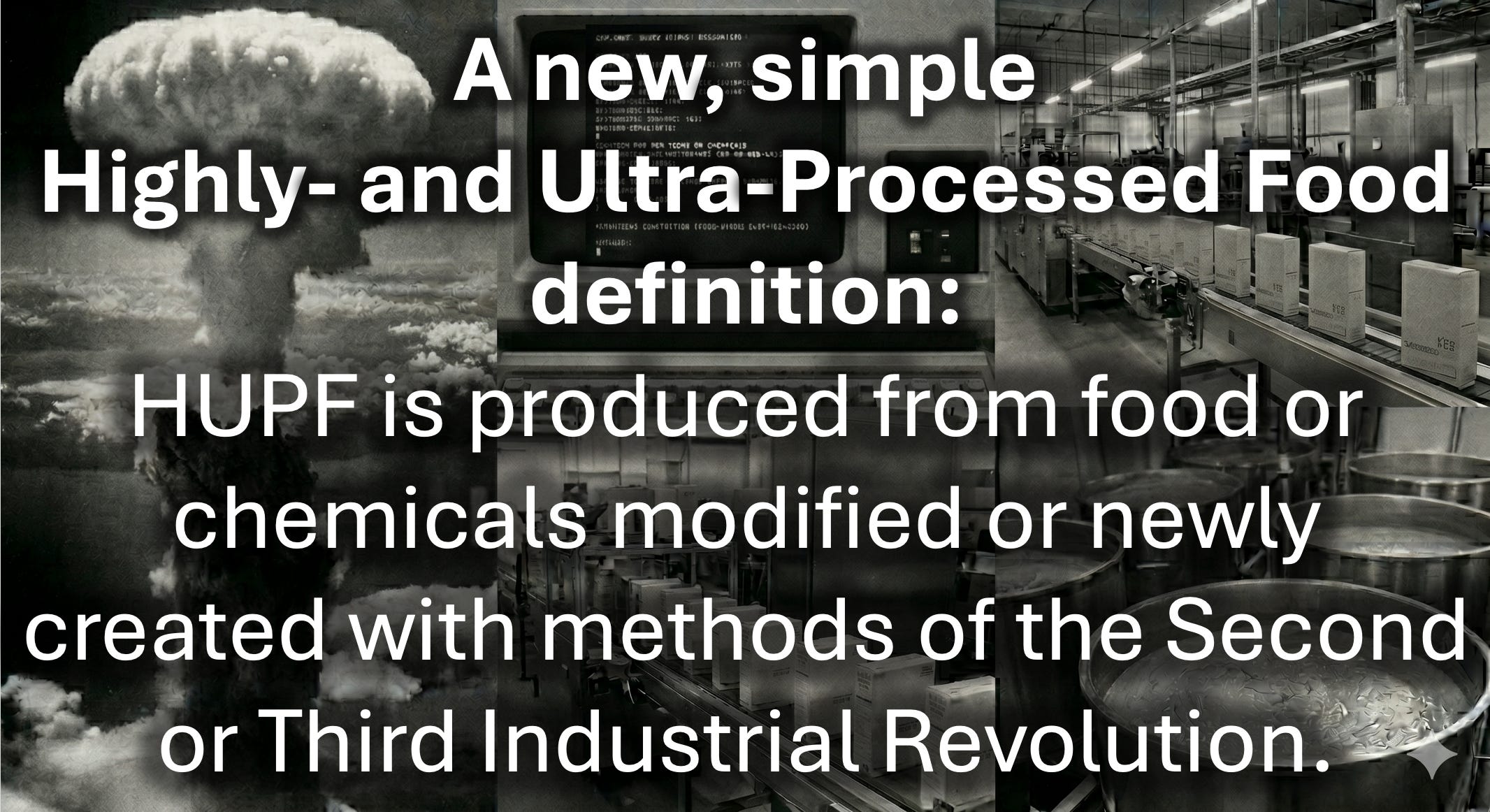
Highly- and ultra-processed food is produced from food or chemicals modified or newly created with methods of the Second or Third Industrial Revolution. That is my definition of HUPF in 23 words.
There are several tenets to the definition
1. HUPF is unnatural food. Natural food, if processed or modified, is done so with methods that predate the Second Industrial Revolution* (see the footnote for an explanation of the dates and the nature of the first three Industrial Revolutions), and in the case of techniques like fermentation, by thousands of years.
EXAMPLE
Yogurt is a food that can be very healthy in its natural form but is now sold mainly in a modified form with post-industrial ingredients,…