Preface
Microplastics is a very challenging topic. The research I did for this piece scared me in a way that I have not been scared by research before. I came to fully understand how immersed we are in microplastics on a daily basis, but how little we know about their effects, and how little we can ever know about how much and what kinds of plastics and, importantly, plastic additives, we are exposed to. Like all of us, I want some control of what goes in me and my family. The impulse I’m feeling at the moment is to avoid all plastics, but one look around me, and I know that is quite impossible.
Optimistically, when I put the issue in context, my sense is that microplastics is a long game problem, and the game has just started. There are more urgent and important food and health concerns in the near term, but we can’t ignore what is happening with plastic. The more quickly we react to the new microplastic environment we live in, the sooner we will understand the priorities for action, for us as individuals and for our society.
At the end of this piece I would be quite interested in your reactions to all of this in the comments section.
The story
In 1951 an efficient way to make polypropylene and high-density polyethylene plastic was discovered by Philips Petroleum chemists searching for a way to turn Philips’ huge holdings in natural gas into a profitable product. Polypropylene and high-density polyethylene are the numbers 5 and 2 in the recycling triangles on the bottom of many containers in your kitchen. Recycling number 1 is PET and is found on the bottom of soda bottles and prepared food containers. PET is a polyester, like the fiber in clothes and rugs. Together those three plastics are the most common of the six main types.
The manufacturing of plastics has been exploding since 1951, when 2 million metric tons of plastics were made, globally. In 2015, ten years ago, that annual figure was near 400 million metric tons. In 2017, half of all plastics ever made were produced in just the prior 13 years, between 2004 and 2017. And the trend keeps zooming upward.
Packaging for consumer products and food is the biggest user of plastic, 40% or 50% by some estimates. Other major sectors are building and construction and textiles.
Plastics production grew so quickly from the 1950s that by 2004, marine biologist Richard Thompson reported on the vast quantity of plastic waste in the ocean and the presence of something he termed “microplastics.” In the space of 50 years the developed world had created a global plastics crisis.
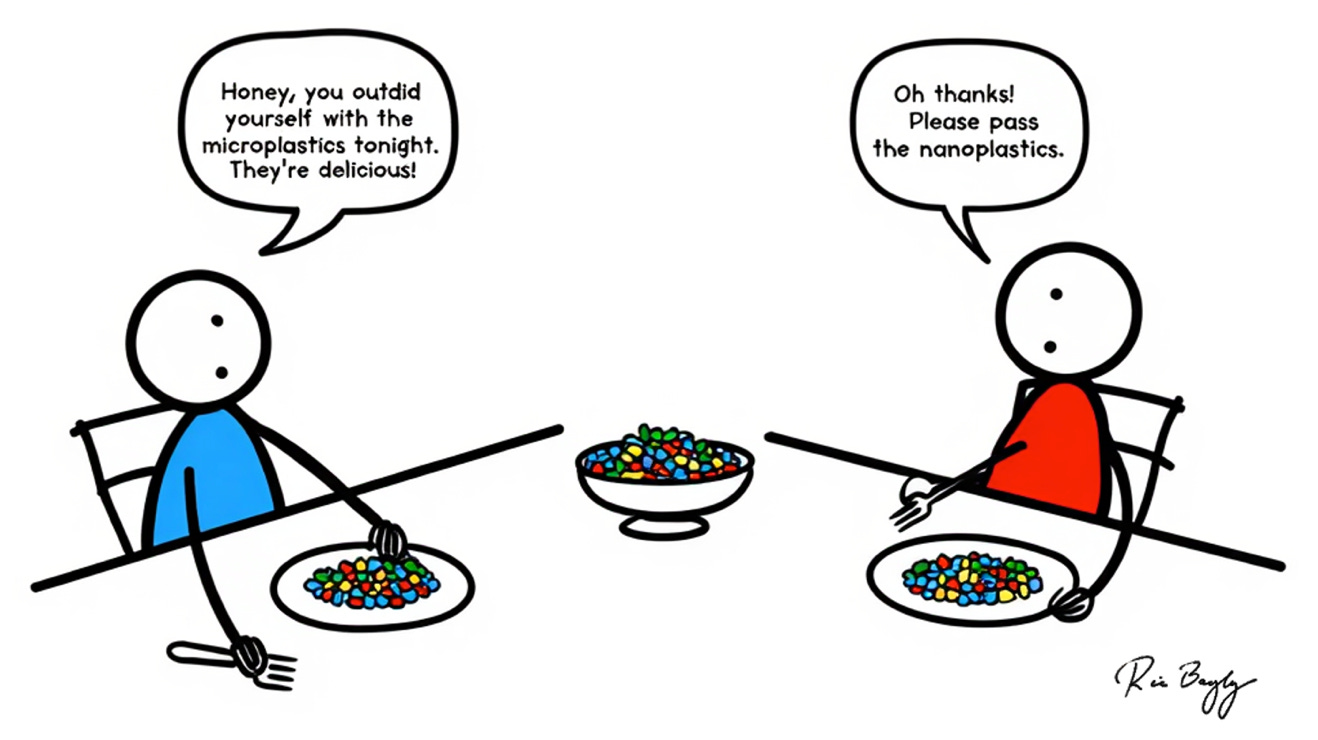
What exactly are microplastics, and how about nanoplastics?
Microplastics are primarily shed from larger pieces of plastic, although some are manufactured at a micro or nano level, such as microbeads used in personal care and cosmetic products. Microplastics are defined as ranging from 5 millimeters (a little less than ¼ inch) to 1 micron (or one-millionth of a meter) in length. Nanoplastics are all the smaller particles down to the limits of detection technology, below 100 nanometers. Nanoplastics can easily pass through the lungs and intestinal lining to enter the bloodstream, where they can travel to and enter our organs, but microplastics are found in our organs as well. Secretary of Health RFK, Jr. has correctly identified that these micro- and nanoplastics can be “…found in samples of human tissue: in the brain, the liver, the kidneys, the colon, the placenta, and testicles.” Nanoplastics are small enough to enter into individual cells.
Where do microplastics come from?
Breakdown of waste plastic creates 22% of microplastics in the oceans. Worldwide, in research where a brand on plastic waste could be identified, of the top 10 sources of plastic pollution in 2023, six were ultraprocessed food companies: Coca-Cola (perennially the top source of plastic pollution), Nestlé, PepsiCo, Mondelēz, Mars, and Danone. Two other top sources, Unilever and Procter & Gamble, specialize in body care and other products. The last two sources in the top ten were tobacco companies: Altria Group and British American Tobacco. The cigarette culprits are the filters in the butts thrown on the ground.
There are three main paths into our bodies from packaging plastics like soda bottles and baby food containers. First, particles are released into the environment and then we eat or drink them in our food and water. Second, we inhale them. Third, our food and water packaging releases microplastic directly into the food and water we are preparing to eat and drink. Additionally, nanoplastics from personal care and cosmetic products can enter through pores and abrasions in the skin and have been shown to cause skin cell damage, but skin contact is a minor entry point compared to the mouth and nose. Fortunately, one source of micro-and nanoplastics intended for skin contact, microbeads, were banned from certain personal care products like toothpaste and facial scrubs, first in 29 state laws and then in federal law in 2015.
Other major sources of microplastics in the environment include vehicle tire wear particles, which are bearers of toxins from the tires, and microfibers from laundry water after the washing of synthetic fiber clothes. City dust, a mix of plastic particles, is another leading source.
A team of scientists in China wrote somewhat poetically about the sources of microplastics:
“The presence of microplastics can be detected from the Tibetan Plateau to the Marianas Trench and from the houses we live in every day to the untouched skies over the Pacific Ocean.”
Their analysis, along with analyses by others, found drinking water, food, and inhaled air were the major sources of microplastics in humans.
Research published by the National Academy of Sciences estimated that a one-liter bottle of water contained over 100,000 plastic particles, 90% of them nanoplastics.
Our poetic Chinese scientist friends estimated that of the microplastics counted in the body, 45% came from water, 33% from fruits and vegetables, and 21% from indoor and outdoor air, but more from indoor.
The quantities estimated to come into the body on average from food, water, and air might vary greatly depending on the methods of different researchers, and they will vary for each individual according to their environment. The consistent finding is that micro- and nanoplastics are everywhere, and we eat, drink, and breathe them.
Why are micro- and nanoplastics harmful?
Microplastic particles are rough and irregular in shape and porous. They gather pollutants like bacteria, viruses, heavy metals, PCBs, pesticides, and carcinogenic polycyclic aromatic hydrocarbons, which are the products of the incomplete combustion of coal, oil, gas, wood, and tobacco. Once in your body these free riders can be released.
The rough particles can act like splinters and damage tissue.
And then there are the additives. The global plastic additives market approached $50 billion in 2020.
The most worrisome effects of microplastics in the body are from the release of the chemicals added to them when they are made. Of 13,000 additives to plastic, over 3,000 are concerning because they are persistent, accumulate in tissue, or are known or potential toxins. Many more of the chemicals might be toxic, but they haven’t been studied.
Some of the worst chemical additives that we know about include:
* Bisphenol A, or BPA, which is used in metal cans, plastic food containers, reusable water bottles, and water pipes. BPA can be regarded as a potential human carcinogen. It’s an endocrine disrupter, a reproductive toxin, can pass through the blood-brain barrier, and is linked to nervous system disorders and degeneration. BPA has toxic genetic and epigenetic effects. It’s not good for your DNA.
* Phthalates are used to make plastic flexible. Phthalates are linked to endocrine, reproductive, respiratory, and nervous system problems.
* Styrene, a building block of plastics, is a kn…