Dear every body,
Welcome to the third edition of Body Babble! I hope you’re all well.
A few updates before we begin…
* Priti Salian from the excellent Reframing Disability(also on Substack) published a lovely interview with me about my work. I’ve been a fan of Priti’s newsletter for several years so it felt very exciting to be featured. Have a read!
* You may or may not have noticed that I’ve been recording audio versions of each newsletter. You can listen to these as a voiceover (above) or on Spotify, if that makes things more accessible to you (or you’re dying to hear me do ASMR).
* If you enjoy this edition, please let me know! Like, comment, subscribe, share. I won’t know you’re reading unless you let me know you exist!
Today we’re talking about accessibility in nightlife. Given I ended my last newsletter with an ode to dancing (and the sign-off “See you on the dancefloor”), it seems only fitting that we’re now exploring how Deaf, disabled and neurodivergent people can participate in nightlife.
This is a topic I’ve become interested in over the last few years, as it’s become increasingly relevant to my own life. For a lot of my twenties, I was too ill to leave the house in the daytime, let alone think about going out at night! But as I approached thirty and my health and mobility were steadily improving, I found myself dreaming of the dancefloor. I say dreaming, because there was one slight obstacle: where to go?
My friends, who were beginning to settle down, were less inclined to go out than they were a decade ago. Nights catering to queer women seemed few and far between and anyway, I’d struggled to make a group of queer friends in my twenties because I’d been so unwell. And then there were the access barriers: how I had trouble standing still; my fatigue; the heat; the lack of seating.
I know I’m not the only one feeling the push and pull of the dancefloor. In the UK in recent months, a wave of events and initiatives are striving to make clubbing more accessible. I’m thinking of Deaf Rave, who put on club nights for the Deaf community. Or United by the Groove, which recently hosted Manchester’s first accessible rave. Or the subject of today’s newsletter, Dancefloor Intimacy, which encourages us to imagine our own nightlife utopia by asking: “What’s your dream accessible clubbing experience?”
By the end of this edition, I hope you’ll tell me yours.
Thanks for reading Body Babble! Subscribe for free to receive new posts and support my work.
In this edition of Body Babble, we’ll cover:
* Why Ali Wagner set up Dancefloor Intimacy
* What a Dancefloor Intimacy focus group looks like
* People’s perceptions about disabled people and partying
* Physical barriers and discrimination
* What would an accessible dancefloor look like?
* Communicating accessibility and giving people choice
* The nightclub as a space for sex and politics
* Why we need the dancefloor
Discovering Berlin’s clubbing scene
When Ali Wagner moved to Berlin, she threw herself into the city’s vibrant queer clubbing scene. Quickly, nightclubs became her “second home”:
“They’re somewhere where I’ve met so many of my cherished friendships. Where I’ve realised my queerness. Where I’ve learned so much more about myself.”
But while the club was initially a place for Ali to escape and experiment, at some point the lifestyle began to take a toll. “I loved it,” she says, “I was having the time of my life. But then I realised, ‘Oh f**k,’ I was doing that because I felt a certain way.”
While we might associate a Berlin clubbing scene with freedom, in reality Ali found it “super exclusive”. She felt anxiety in crowds, experienced aggression from men, and struggled with the fact that there was never anywhere to sit down. All she often needed was to be able to step away from the dancefloor, “chill” and have a conversation with someone:
“When clubs don’t allow you to relax at times and feel safe, some people can lean into abusing substances, and I realised that was something I was doing, because I was trying to cope with the fact that I was so overwhelmed.”
Putting accessibility at the forefront of club culture
40% of disabled people report being “unable” or having “extreme difficulty” accessing nightclubs or music venues. According to Ali, the problem is that clubs usually only consider accessibility as an afterthought:
“It’s like: ‘We’ve sold all the tickets, we’ve designed the event, we’ve invited everyone to come.’ And then: ‘Oh, well, how can we make this more accessible?’ And I think my dream is that it’s something that actually inspires events and inspires design.”
As part of her final-year thesis, Ali began to research how neurodivergent people experience nightlife. But when she received a grant from her university, she was able to expand that research to include more people:
“There are so many disabled individuals, neurodivergent, Deaf, blind, chronically ill individuals, who can’t access or don’t feel safe or welcome in these spaces. Or they don’t have anyone to go to these spaces with.”
She launched Dancefloor Intimacy: a movement that puts accessibility at the forefront of club culture. The initiative runs focus groups with disabled people, and those who attend are paid a stipend (most recently, they’ve been working with London’s iconic Fabric).
“My purpose is to be the facilitator,” says Ali. “The disabled ravers are the ones actually making the change. They’re the ones giving their honest opinions and insights.”
People don’t think disabled people want to party
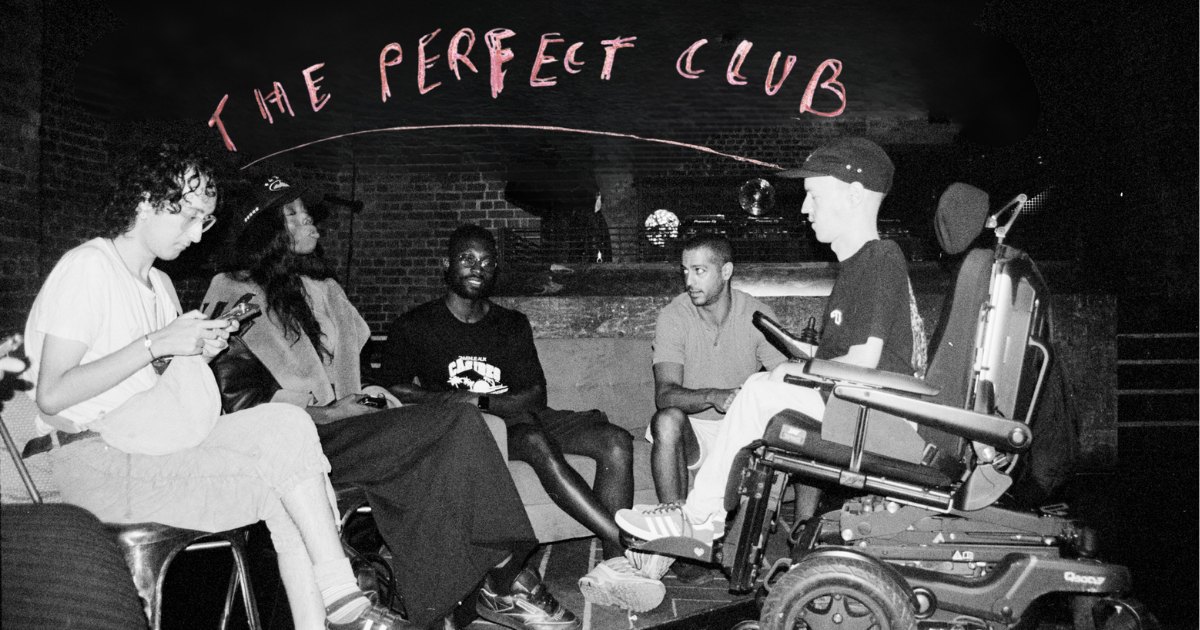
At a Dancefloor Intimacy focus group, half a dozen young disabled people are sat around a table, armed with pencils, paper and crayons. Behind them, text on a big screen asks “What is your ideal accessible clubbing experience?”. If it’s refreshing to be asked this, it’s also a little jarring—it’s hardly a question you hear every day.
“People don’t think that disabled people want to go to clubs and festivals,” says Ali. Although this is partly because of physical access barriers (wheelchair-users “can’t get through the door”), it’s probably also because up to 80% of disabled people have a non-visible disability.
Tatum, a creative and producer with muscular dystrophy, is one of the focus group’s participants:
“People think, ‘Oh, disabled people don’t want to be here, because we don’t see them.’ So then access isn’t implemented, so disabled people can’t come, and the cycle goes around. But when access is actually put in, you see how many disabled people turn up.”
Dealing with other people’s perceptions
Katouche, a content creator with cerebral palsy, is also one of the group’s participants. She “loves a night out, every part of it” and enjoys “the breadth of urban music”, from R&B to Afrobeat, rap, bashment and soul.
But when she goes clubbing, “people can point and laugh”:
“You are a spectacle. In general you don’t see visibly disabled people in public life. And I feel like the nightlife scene is a microcosm of the power and social dynamics that exist in society. So people are quite astonished to see a disabled person in the club.”
Tatum, who uses different mobility aids on different days, often gets intrusive comments from strangers. Using a walking stick, they get comments like: “‘Oh God, you’re that old already?’”. And when they use their wheelchair, “people either try not to acknowledge me or they’re like, ‘Oh, it’s so cool that you’re out.’”
Discrimination at the door
Katouche’s experience of going clubbing is further complicated.
“There’s layers to it,” she explains. “Especially when you’re dealing with a community within a community. There’s no regard for Black disabled people, especially Black dis…