Hello, and welcome to Body Babble! You can help me keep publishing independent essays and reporting on disability, access and queerness by:
* subscribing
* sharing this post with someone who might like it
* considering a monthly paid subscription
In any case, thank you so much for reading!
Celestine x
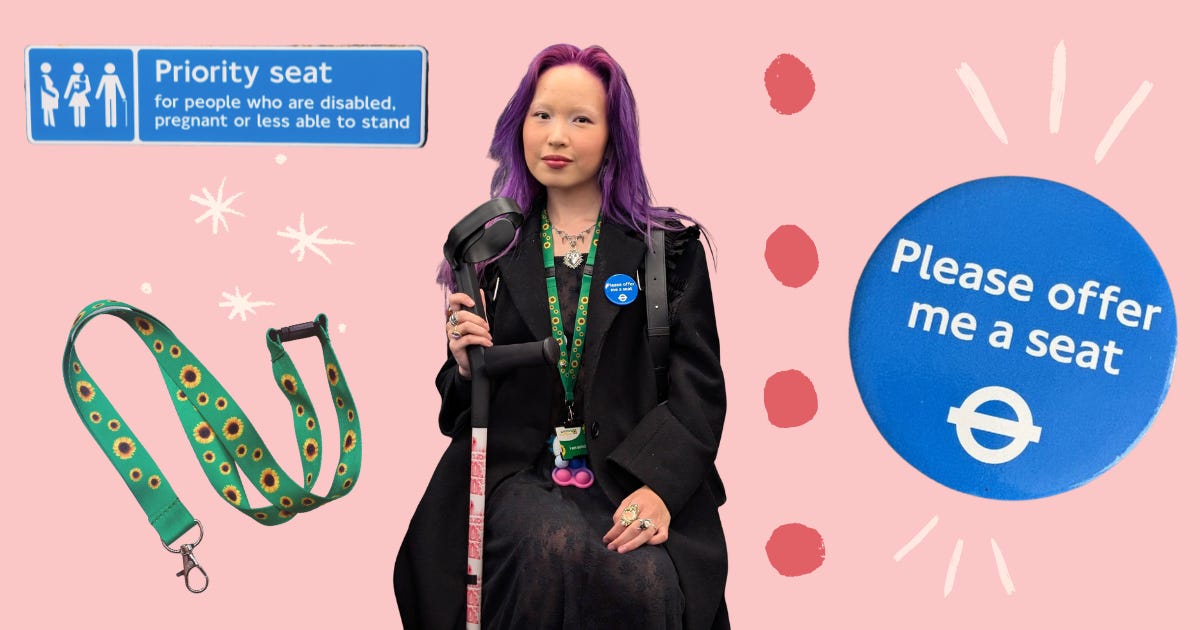
Dear every body, today we’re talking about people with non-visible disabilities’ experiences wearing Transport for London’s (TfL)‘Please Offer me a Seat’ badge.
Launched with a trial in 2016 and then officially in 2017, the blue TfL ‘Please Offer Me a Seat’ badge has now been used on public transport by Londoners with non-visible impairments for a decade. The badge can be ordered for free online and according to TfL, 140,000 have been claimed since its launch.
I was born in London and grew up here. As a teenager, I zipped around the city on the Tube, going to parks, free gigs or friends’ homes. But when I became ill at eighteen, my access to the city completely changed.
Between 2013 and 2019, I was able to take the bus to get to university or the cinema, but I only took the Tube a handful of times: the heat, steps, and having to stand or walk long distances made it too difficult. Then, for the four years I was mostly housebound, only going out occasionally and using a wheelchair, the Tube and the sound of its closing doors became a distant dream.
That is, until 2023, when my mobility began to improve and I was eager, like a tourist, to explore the city again. By this point I could walk longer distances, but standing still for more than a few minutes was a challenge.
I have PoTS, a dysfunction of the autonomic nervous system, which makes me prone to fainting with prolonged standing. If I stand still for too long, I get extremely hot, dizzy and faint. In other words, the only way I can travel safely on the Tube is if I always get a seat.
So I ordered a ‘Please Offer Me a Seat’ badge, as well as a Hidden Disabilities Sunflower lanyard, which was rapidly becoming the best-recognised symbol for non-visible disability. And tentatively, I began to take the Tube.
Of course I’d anticipated that I’d be stared at, and often ignored. I knew this because using a wheelchair had commanded its own kind of unwelcome attention. But what surprised me was how, now that my disability was less visible, the attention was of a different sort.
It wasn’t a response to visible difference but rather to its lack. The discrepancy between my appearance and youth and the fact that I was asking for a seat generated in strangers a mix of confusion, suspicion and scorn. I hadn’t felt so self-conscious since I was a teenager.
All from wearing a 4cm piece of plastic!
Thanks for reading Body Babble! Subscribe for free to receive new posts and support my work.
In this edition of Body Babble, we’ll cover:
* People’s experiences wearing the ‘Please Offer Me a Seat’ badge
* The ‘Baby on Board’ pregnancy badge
* Disabled people “faking it”
* The design of the badge
* A sticking plaster to a structural problem?
What it’s like to wear the badge…
“Are you going to catch me if I pass out?”
Jo, 21, lives with “a bunch of chronic illnesses,” including M.E/ CFS, Ehlers-Danlos Syndrome, PoTS and Endometriosis.
“I get dizzy very quickly and get blood pooling,” they explain. “Having a seat makes sure I don’t pass out and stops me from feeling as much fatigue and pain from having to stand and balance on the tube.” They add:
“It’s not like, ‘I’m a bit tired, I want to sit down.’ It’s like, ‘Are you going to catch me if I pass out?’
Jo wears their badge attached to their sunflower lanyard, because it “makes people believe you more”. But they describe the experience as “very hit-or-miss”.
“Sometimes people will look at the badge, look at me and just stare [...] Because I'm young and people don't understand that young people can have disabilities and need support. But other times people are really lovely and they offer me a seat straight away.”
“A very deep fear of having to justify”
Hugh, 30, moved to London from Australia seven years ago. He has Limb Girdle Muscular Dystrophy, and while he is able to stand if he really has to, he “will feel pain”, will “run out of energy elsewhere”, and has “a risk of falling.”
He’s worn the badge only a handful of times, because of “not wanting to be singled out, not being sure that people really know what it's for, and also a fear of not being believed.”
He’s seen horror stories online about people “being challenged or harassed in public”:
“I have a very deep fear of that, and needing to explain or justify. I think also because my disability is rare, if I tell people what it is, they won't have heard of it. Having to explain it feels very vulnerable.”
Thankfully Hugh recently had a positive experience on the Tube, where a fellow passenger reacted to his badge kindly and discreetly, giving him a seat: “I was nearly brought to tears because I have such a fear of the opposite happening.”
“Unless you’ve got a crutch, you’re not taken seriously”
Ysé, 26, is autistic, has anxiety and PTSD, and gets extremely overwhelmed on public transport. Sitting down gives her space from other passengers and reduces overstimulation: “Every sensory input that I receive multiplies and multiplies and multiplies.”
She wears the ‘Please Offer Me a Seat’ card on a sunflower lanyard, because the bright green lanyard is more visible and is also more widely recognised. And yet after wearing it for four years, she has not once been proactively ‘offered’ a seat. Despite this, she continues to wear the card, describing it as “my independence.”
She asks people in the priority seats if she can sit down, showing them her card and lanyard, which provide a visual cue that she’s “eligible” without having to explain the ins and outs of her disability. She has occasionally been refused, and once was laughed and shouted at, but most of the time someone will get up when asked by her directly. However, she says:
“I will then keep showing the lanyard because when people give me their seats, I’ll get a lot of dirty looks. Unless [you have] a very visible disability, you’ve got a crutch or something, [you’re] not taken seriously.”
She adds:
“If someone has a Baby on Board badge, people will offer them a seat. But the disability one, you see that less.”
Parallels with pregnancy
TFL’s ‘Baby on board’ badge was introduced in 2006, and is now claimed by 80,000 people each year. Remembering that my cousin Helena wore the ‘Baby on board’ badge in 2024 when she was pregnant, I ask her about her experience.
She tells me that wearing the badge, she was given a seat on the Tube probably 60-70% of the time – usually by young women in their twenties or thirties. When no one got up for her, she would ask them directly.
“I don’t think I ever got met with anyone saying no, at that point,” she says, “Although some people do look disgruntled. I think a lot of people pretend to be engrossed in their phone or book. They just don’t want to make eye contact.”
Helena especially needed to sit down early on in her pregnancy because she felt nauseous and faint. But at that stage, though she wore the badge, she “wasn’t visibly massive, so people were less likely to offer a seat.”
Though Helena’s experience was a “mixed bag”, she doesn’t describe the fear, guilt or second-guessing oneself that seems be part and parcel of having a non-visible impairment.
On a reddit discussion about the ‘Please Offer Me a Seat’ badge, one woman writes:
“For a month I switched ou…