Dear every body,
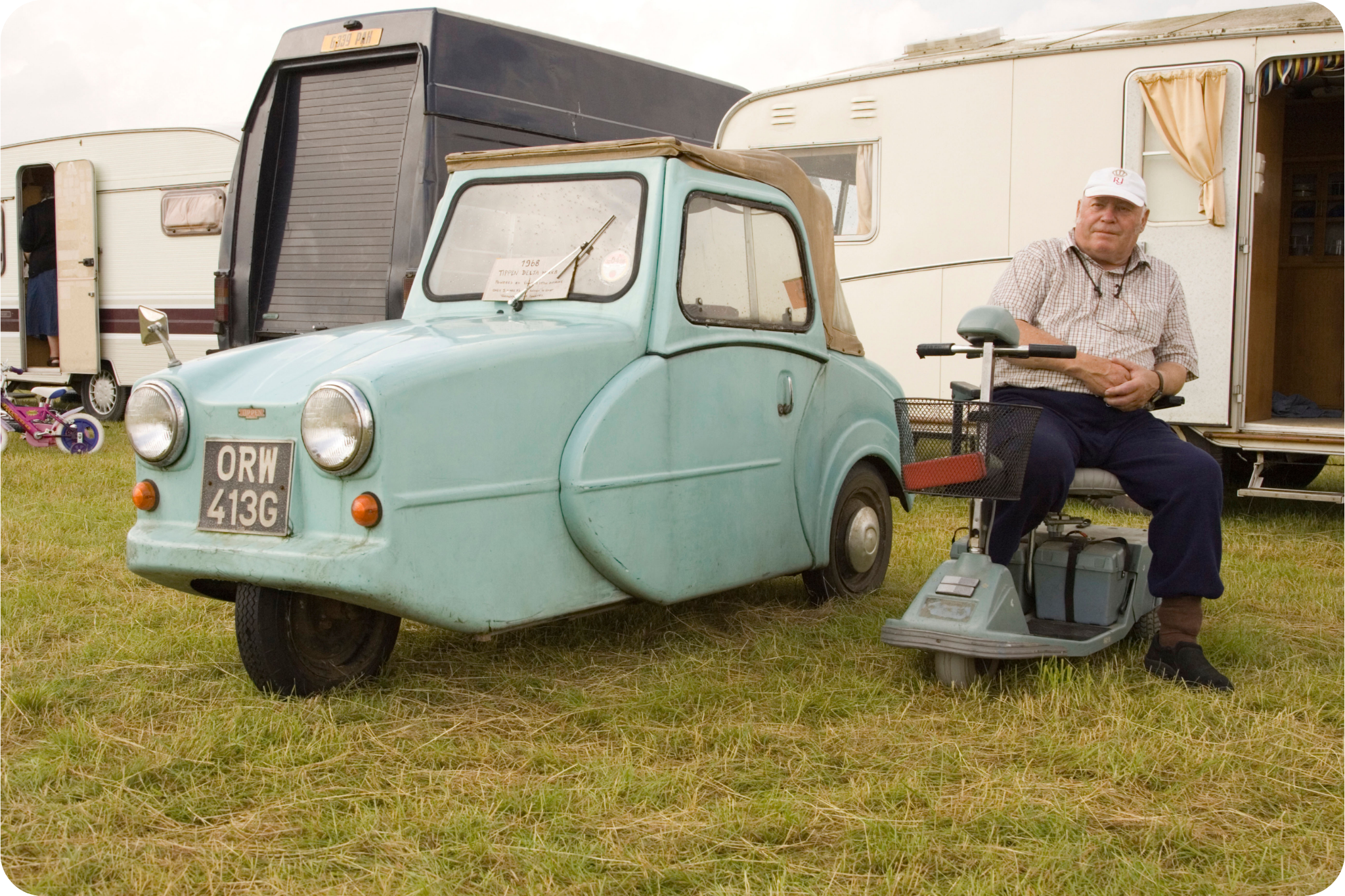
Did you know that the UK government used to lease disabled people a tiny blue three-wheeler? And that by the mid-1970s, these cars were driven by 25,000 people?
It’s UK Disability History Month (20 November- 20 December), and today we’re talking about the invalid carriage, also known as the Invacar. If you’re from a similar generation to me (b. 1995), you might not be familiar with this little blue “disability car.” I first came across it a few years ago, while browsing the British Film Institute’s online archive. I was fascinated to see footage of a noisy, blue three-wheeler that looked like it would topple at the slightest wind.
How had I never heard of it? How did it feel to drive one? And how much more disability history had I missed? Immediately, I was obsessed. I even wanted to make a film about it. But information online was scarce and repetitive, mostly spread across motoring forums, Reddit, and the odd thread of Boomer Facebook comments. The youngest ex-drivers of invalid carriages are now in their seventies, and finding first or even second-hand sources is becoming a challenge. Several times I’ve discovered a new lead, only to find out that the person had actually died months or years before.
Time is running out. We have years, not decades, to capture this piece of history using first-hand sources. And it’s not just about its cute aesthetic (although I agree, it’s adorable). I think that understanding the invalid carriage might help us navigate the ongoing fractious relationship between disabled people and the state.
Never has this been more relevant than in the UK in recent months. An ongoing scapegoating of disabled people has become backlash against Motability, a scheme which leases adapted vehicles to disabled people, and which was introduced in 1976 as a replacement for the invalid carriage.
I want to speak to a generation who knew the Invacar, to understand why it was eventually made obsolete by Motability. Was the invalid carriage loved? Or hated? Was it freedom on three wheels? Or a fibreglass death-trap?
Let’s find out…
Thanks for reading Body Babble! Subscribe for free to receive new essays about bodies and belonging.
In this edition of Body Babble, we’ll cover:
* What’s an invalid carriage?
* The mission of the Invalid Carriage Register
* Simon and Kay’s memories of their grandfather and his invalid carriage
* Problems with the vehicle
* How the invalid carriage was finally scrapped and replaced by Motability
* Why artist Tony Heaton spray-painted an invalid carriage gold
* The role of the invalid carriage in disability history and in understanding today’s backlash against Motability
What actually is an invalid carriage?
It sounds archaic, but “invalid carriage” is currently the legal term for power wheelchairs and mobility scooters in the UK. However, for much of the 20th century, “invalid carriage” referred specifically to any small, three-wheeled one-seater vehicle which was leased by the UK government to disabled people.
Different kinds of vehicles can be described as invalid carriages, including the 19th century wicker Bath Chair. But most often, invalid carriage is synonymous with the iconic Invacar: a pale blue motorised tricycle with a fibreglass shell which, from the ‘50s to the ‘70s, was leased by the UK government to qualifying disabled people. The “classic” blue invalid carriage is often the AC Model 70 Invacar, but variants were made by other manufacturers, like the Thundersley or Tippen Delta. In this article, I will be referring to these interchangeably as “Invacars” or “invalid carriages.”
Putting the vehicle back into public memory
Simon McKeown is the director of the Invalid Carriage Register, a volunteer-run project which promotes and conserves the history of the invalid carriage:
“Our mission is to put the invalid carriage back into public memory, because it’s currently missing,” he says. “Especially from young people’s memory.”
The project does its best to track all known invalid carriages worldwide, of which there are believed to be 300-400. Most of these are found in the UK, but “a small amount were distributed through the Commonwealth, so some of these vehicles are in different countries as a result.”
As medical tech and mobility aids rapidly develop, Simon thinks there is more need than ever for designers to be aware of the history of the invalid carriage. For example, a few years ago, Toyota ran a competition which awarded $1 million to the most “game-changing technologies” which could “improve the lives of people with lower limb paralysis.” The finalists included exoskeletons and a self-balancing, intelligent wheelchair.
But Simon is concerned that those young designers won’t have been able to access a design history which included the invalid carriage:
“Without history, we often think that it’s never been done before. But without knowing that these vehicles existed, how do you design better vehicles?”
A family history
For Simon, the invalid carriage represents first of all a “family history.” Simon’s grandfather, Ian Jones, had osteogenesis imperfecta, also known as brittle bone disease. He couldn’t walk very far and supported himself with a crutch; mostly, he used a wheelchair. He was from North Yorkshire, working class and “extremely poor” because although he was “very, very clever […] nobody would hire him.”
This was the late 1950’s and early ‘60s, decades before the UK would pass its 1995 Disability Discrimination Act, which would make public transport accessible to disabled people (at least, in theory).
“Before mobility was a provision, people couldn’t travel very far,” says Simon. “They couldn’t necessarily work. He couldn’t just get on a bus.”
When Ian was leased a government-issued invalid carriage, “it gave him a level of freedom.” He was able, for example, to take one of his first and only holidays, to a caravan park which he drove to on his own. Simon shows me a photo of Ian on that holiday (see below). He’s supporting himself on his crutches, and proudly leaning against his Tippen Delta, with a pipe in the corner of his mouth and a smile.
“I think you can see that he’s pleased", says Simon. “He genuinely liked the car. But I don’t think he enjoyed breaking down on his own particularly.”
Freedom, at what cost?
The invalid carriage was certainly cute, colourful and innovative. And there’s no doubt that for many, it provided an unprecedented freedom. But the reality of driving the vehicles was less than ideal: they were noisy, smelly, unstable, uncomfortable, poorly-heated and constantly breaking down. Built with a lightweight fibreglass frame, they were known to tip over in strong winds or even catch fire.
In a news report from ATV Today in 1969, a reporter asks three disabled motorists about their experience driving their invalid carriages.
“I broke down seventy-two times in six weeks”, says Mrs Goodman, who at the time of interview had been driving one for nineteen years. She adds: “The smell of the exhaust that comes into the cabin is really obnoxious.”
A single-seat design
One of the most controversial parts of the design of the car was that it was designed to seat only one person—as if disabled people had no families, friends or partners of their own. On the dashboard, a sign read “Passenger Carrying is Forbidden”.
This had its consequences. In the news segment from 1969, a disabled driver says:
“I have known a case recently where it has actually split a yo…