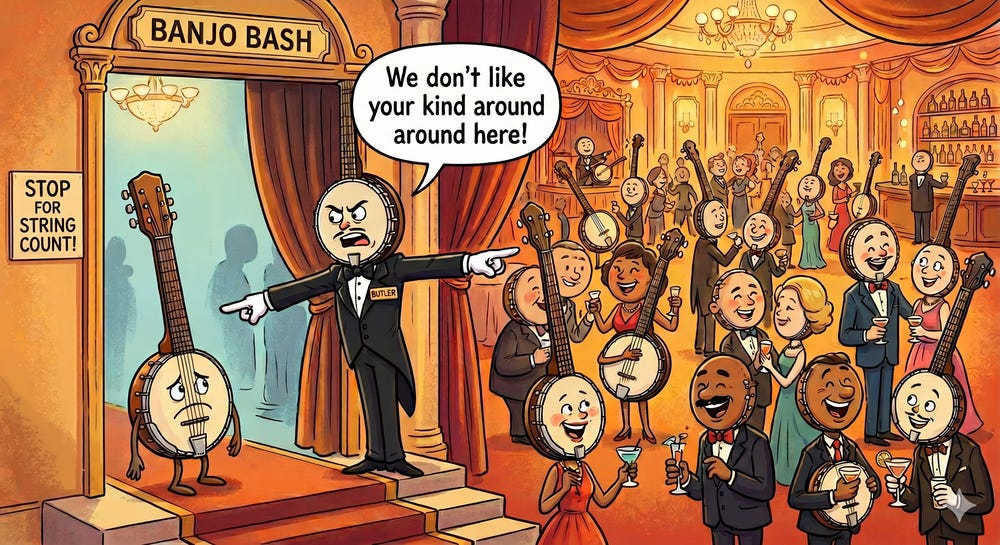
Three summers ago when Charlie Bowen took his first tremulous steps into the world of banjocity, he bought a six-string banjo … and immediately got grief.
“That ain’t no banjo!” one friend declared. “That’s just a guitar with delusions of grandeur. You can play dress it up all you want, man, but you’re not playing a banjo.”
“Okay, now, wait a minute,” Charlie protested. “If a banjo’s got four strings, it’s a banjo, right?”
“Sure,” the friend conceded. “That’s a tenor banjo, like the late, great Chuck Romine used to play.”
“And if it has five strings, it’s a banjo?”
“Well, of course. That’s God’s own old-time and bluegrass banjo.”
“But,” Charlie persisted, “if it’s got six stings, it’s NOT a banjo?!”
“Nope,” the friend insisted. “You can call it a ‘banjitar’ if you’d like or ‘ganjo,’ but don’t be calling it a banjo.”
“You know what, old buddy?” Charlie concluded. “You are a banjo bigot!”
But despite his brave front, Bowen finally caved to the peer pressure. The six-string banjo (which by then he had lovingly christened “Buzzkill”) was retired to a lonely closet. In its place Charlie bought his first five-string and began to learn tunes.
Truth be told, Bowen has fallen in love with the instrument, practicing every day, even starting to work the five-string into a corner of The Flood’s repertoire on a song or two (or three…).
Schooled by Seva Venet
By the beginning of this year, Buzzkill had been pretty much forgotten. That is, until last month when Charlie and Pamela traveled to New Orleans for a wonderful Road Scholar program built around the annual French Quarter Festival, four solid days of memorable music.
A highlight the whole long weekend was when legendary clarinetist Dr. Michael White played a private concert for the Road Scholar folks at their hotel. Sitting in with White’s quartet that morning was renowned New Orleanian Seva Venet, who was holding down the rhythm section with his six-string Vega banjo.
During the intermission, Charlie chatted with Venet, who said that he was quite aware of how provincial some banjo fanciers could be. However, Seva said, the six-string banjo has a proud legacy all its own. In fact, the banjo of choice for most players of early jazz and blues was the six-string.
Johnny St. Cyr, he noted, famously played his six-string in Louis Armstrong’s Hot Five and Hot Seven groups as well as with Jelly Roll Morton’s various ensembles. Legendary New Orleanian Danny Barker and early bluesman Papa Charlie Jackson also played the six. Even jazz superstar Django Reinhardt started out playing a six-string banjo in the dance halls of Paris, long before he cemented his legacy as the pioneer of the gypsy jazz guitar.
The secret to playing the instrument, Seva said, is that, while it is tuned like a guitar, it’s not played like one. Don’t pick it like a guitar, he said, but play it high on the neck where the slapped chords can sing out.
And, like his hero Danny Barker, Venet likes to add color to his chords by playing 6ths and 9ths and other variations on the usual banjo choices.
Buzzkill Bounces Back
Inspired by hearing and watching Seva Venet play that morning, Charlie came home from the New Orleans Road Scholar outing eager to bring Buzzkill out of the retirement, especially on The Flood’s old hokum tunes like this week’s podcast selection, “Tear It Down.”
As noted earlier in Flood Watch, a lot of the hokum tunes that The Flood has always loved were born far to the south of us, in place like Memphis and New Orleans.
So it’s always a treat to find a song that grew a little closer to home. This tune traces back to a youngster named Bob Coleman — Kid Cole, they called him — from the west side of Cincinnati. It was 98 years ago this very month that Bob recorded it in Chicago.
More Hokum?
Finally, if more hokum music is what you need to make your Flood Friday complete, remember we’ve got a whole channel waiting for you on the free Radio Floodango music steaming service.
Just drop in and click the “Hokum” button or, better yet, take the express route by clicking this link to jump to it directly.