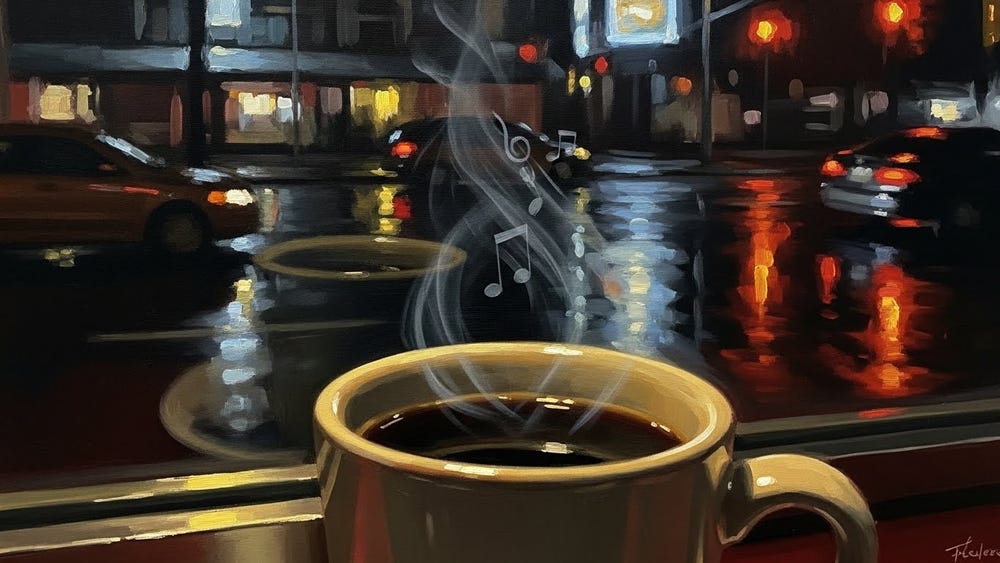
Our guitarist Danny Cox paints pictures with his sound. He has a positively uncanny capacity for discovering ways to bring out the colors and textures in all kinds of melodies and to plant stories in the minds of everyone who hears.
Just listen to his treatment of this rich old Sonny Burke composition, finding all kinds of new magic and nuance in this poignant melody.
About the Song
As reported earlier, “Black Coffee,” written in 1948, spent the first decade of its life as a darling of vocalists. Recording it, for instance, revamped the careers of both Sarah Vaughan and Peggy Lee as their fans grooved on Paul Francis Webster’s sparse, evocative lyrics.
But composer Burke knew the potential of his melody as well; he himself performed it on alto sax in 1948. However, about decade passed before the song started getting serious attention as a jazz instrumental. That’s because it was just what a young Ray Charles was looking for.
While Brother Ray rarely singled out “Black Coffee” in interviews, he spoke extensively about the artistic philosophy that informed his instrumental treatments during that era.
His decision to record “Black Coffee” instrumentally for The Great Ray Charles album was a deliberate effort to be recognized as a serious jazz musician, not just an R&B star on the radio.
For that project, his second studio album, Charles avoided his signature vocal style in order to highlight his piano blues with all those Art Tatum-influenced flourishes. For the “Black Coffee” session (April 30, 1956), he deviated from his usual big-band horn arrangements and stripped the performance down to a trio. He was joined on the date by Oscar Pettiford on bass and Joe Harris on drums.
Later in his autobiography, Brother Ray, he noted that these sessions allowed him to explore the chord structures of this fundamental jazz standard.
Other Renditions
After Ray Charles’s performance, other artists took “Black Coffee” on instrumental outings, such as Bobby Scott (1959), Earl Hines (1964) and Earl Grant (1968).
Meanwhile, a wide and wildly varied group of singers also have served up “Black Coffee” in the 70 years since its introduction, from Canned Heat (on its 2003 Friends in the Can album) to the Pointer Sisters on 1984’s That’s a Plenty album.
k.d. lang’s “darkly twangy” version from her 1988 album Shadowland is considered an essential track in her discography, bringing a new interpretation to the song.
Women have been especially attracted to the song, from Petula Clark (1968), Sinead O’Connor (1992) and Rita Cooledge and Gladys Knight (both 1996) to Maria Muldaur (2002) and Marianne Faithful ( 2008).
For more about the song’s history, see our earlier Flood Watch article by clicking here.
More from Danny
Meanwhile, speaking of more renditions, would you like some more Danny Cox tunes for your Flood Friday? We gotcha covered. Visit our free Radio Floodango music streaming service and give the Danny Channel a listen.
Click here to set the Danny playlist in motion.