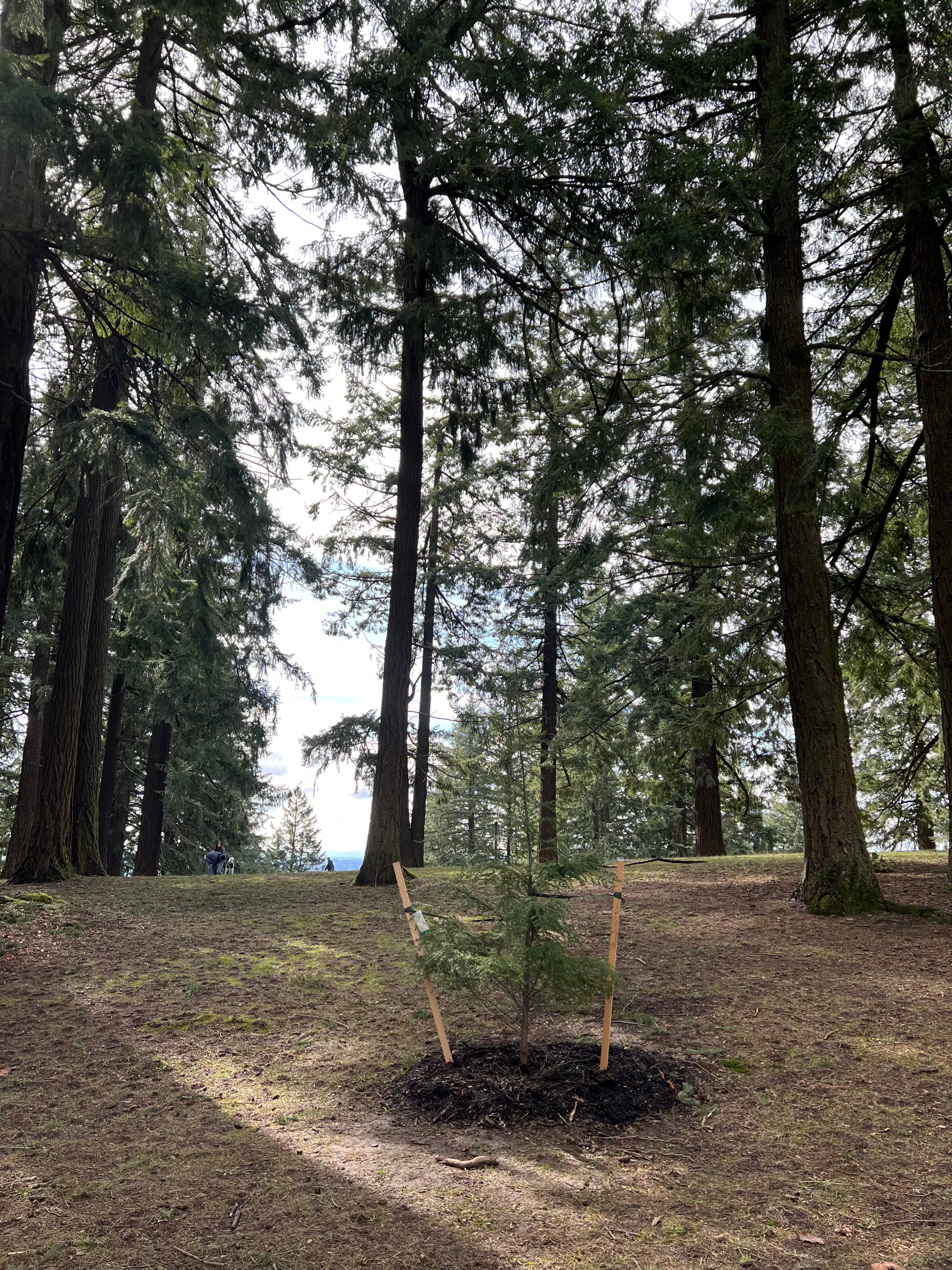
I was on Mt. Tabor last week and as I walked around the circular path at its top I saw the little hemlock in the picture at the top of this post. I had an instant fondness for it, propped between two helpful sticks, guiding it up towards its neighboring trees. Because the tree is shorter than I am, I felt a kinship to it. What will it take for this small tree to survive? What will it need to learn?
These are my questions, for myself. When I think about the responsibilities humans have at this moment, both to our communities and to the ecosystems of which we are a part, I feel like that hemlock, in proportion to those trees. That’s when the phrase “It’s ok to be a beginner” came into my head. It felt like an answer, a balm to my worried self.
One of the many reasons I ended up leaving academia is that I’m an interdisciplinary thinker and it’s difficult to feel a sense of belonging or value in academic institutions unless you’re a specialist. I understand the impulse to go deep in a small area, to give oneself a better sense of certainty about the subject one studies. Yet it has seemed to me that there are some problems, like patriarchy, violence, white supremacy, or ecosystem destruction, that demand both a braiding together of multiple knowledges and a translation of theoretical and specialized language into a vernacular that calls to non-specialists to join in.
What “counts” as expertise? Is it lived experience? Is it identity? Is it credentials, certifying the hours and years we’ve spent reading and communing with an idea? Is it institutional standing and publications? Is it the capacity to receive and send energy where it is most needed? Is it the ability to move and excite others? Is it the capacity to channel information outside the logic and rationality of the mind? Is it embodied knowing?
So much of what the dominant culture ratifies as expertise is rooted in a very narrow definition of professional specialization. If being a credentialed professional lets you charge money for your services, marks you as “better than” others and thus worthy of high fees, then knowledge acquisition is about separation and hierarchy and the elevation of “rationality” above other sources of knowledge.
To me this is not a theoretical discussion. These definitions have real world consequences. They exclude entire communities from the arena of credibility. Sometimes it is appropriate for beginners to attend, listen, take in the wisdom of elders and say almost nothing back. But I wonder how many people tell themselves they have nothing to offer to the complex problems we are facing as a collective because they don’t have the training, the expertise, the theoretical sophistication or the credentials to play.
The fragmentation of being into mind and body, feelings and thoughts, masculine and feminine, is a strategy to push away what is threatening and embrace the fiction that we can attain some kind of transcendent mastery over something. It’s a great distraction from the terror of death and dissolution. It’s a particularly Western phenomenon. For me, when I think about how I was taught to learn, I remember how I was encouraged to see myself as separate from the world, below those who knew more, and only worthy of speaking if I had something absolutely new to add to what was already there.
I think about how I was set up to objectify myself and the external world, to objectify “nature” and see myself as not that, and how cruel that was, because it made me hate and deny the parts of myself that were weak, and vulnerable, and that didn’t have a fast answer to a complex problem.
It wasn’t until much later that I learned about the Zen concept of beginner’s mind and how treasured that state is; how difficult it is to stay there. I like to think of all knowledge as partial and transient, and of all of us as having something to bring forward, no matter who might say we aren’t credible, or that we don’t look the way a person should look, we don’t talk the right way, or we don’t belong in the room. I hope if you’re catching your breath, thinking of speaking but then holding it, that you won’t stop yourself next time.