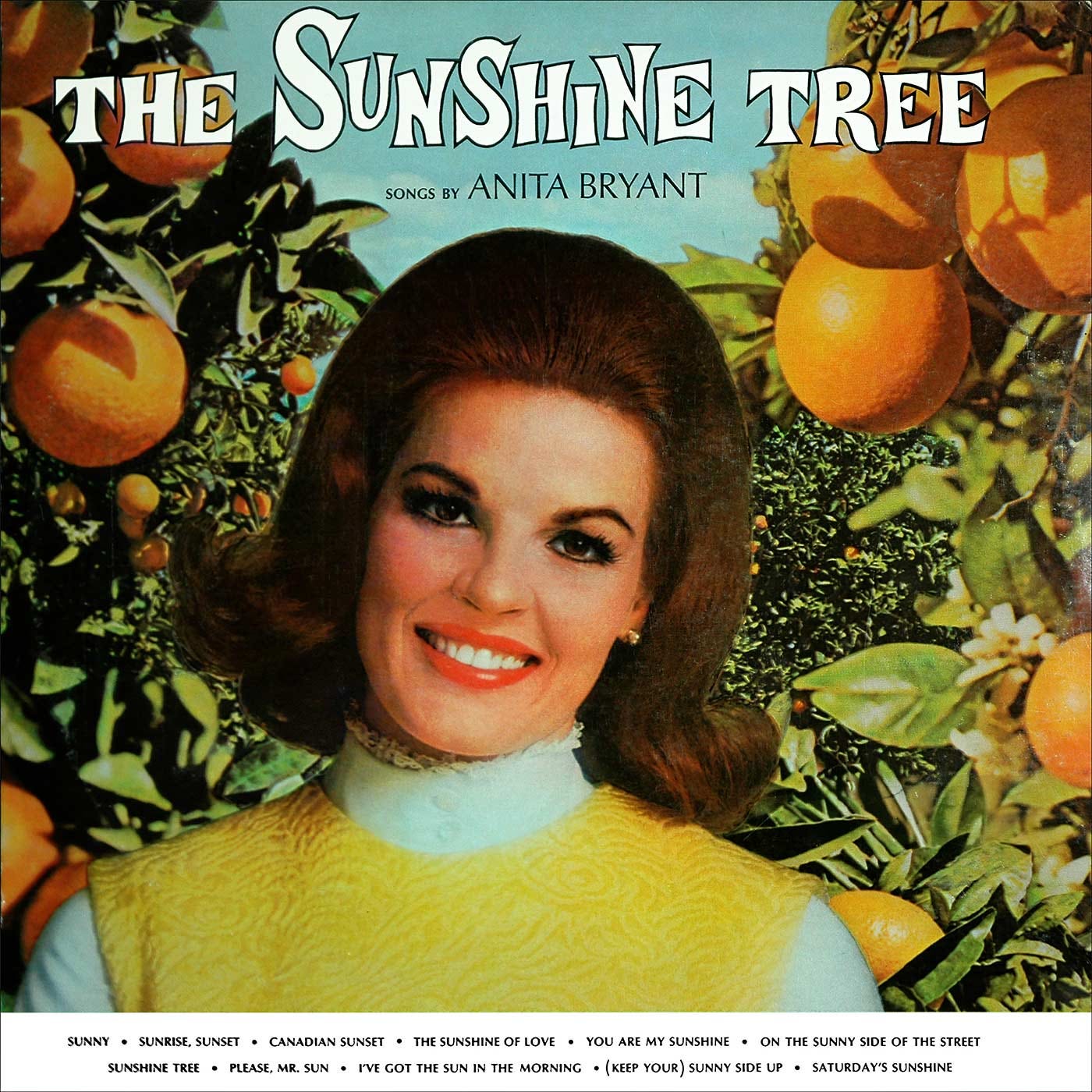
Here’s a transcript of the video: I want to talk to you today about Anita Bryant.
That name will mean everything to some of you, probably a small minority of you. Most of you don’t know who she was, so let me tell you.
She was a Florida beauty queen who sold orange juice publicly, who decided in 1977 that she was going to oppose a resolution in Miami-Dade County supporting gay people. She was horrified that such a thing was being done.
She was a Christian—born-again Christian, as a matter of fact, whatever that means—who took the stand that gay people were a menace and that children must be protected from them. So she started something called the Save Our Children campaign to protect children from homosexuals.
I was so enraged on the spot that I didn’t know what I was going to do about it. And then I realized I had a perfect voice in Michael Tolliver, the gay character in Tales of the City.
Michael gets a letter from his parents saying how thrilled they are that they’re supporting this wonderful woman, Anita Bryant, in her campaign. And he has to tell them that he’s gay himself.
So I wrote this coming-out letter that was part of my series, which was the easiest thing I’ve ever written. It came out of me in less than an hour, I think, sitting at my desk at the Chronicle.
I realized that I had said something important when I had done it, because it was so personal. Even though it was Michael talking and not me—I wasn’t brave enough to do that with my parents—but they were getting the newspaper, and they would know, I presume, who I was talking about.
I had not come out to my own parents at this point, so this letter was two birds with one stone, I thought.
I read the letter at a gathering—something called the Moon Over Miami Benefit—which was an immediate response to Anita Bryant’s fag-baiting. That was the following weekend, as I remember. It was before it had appeared in the newspaper.
It was an amazing moment for me. I went up to the front of the Castro Theatre and read the letter. At the end of it, you could have heard a pin drop. I could hear people crying. I think I might have been crying myself at that point.
I sat down in my chair, and suddenly there were all these hands on me—men and women—just touching me in various places, to be a part of my comfort, I suppose.
When I reflect on this letter, and on the number of people who’ve said it was their reason for coming out—and some very famous people who read the letter publicly—I realize that it’s probably the most significant thing I’ve ever written.
This thing that I did in forty-five minutes. I was speaking truth, I guess, at a time when it needed to be spoken, and many people responded to it.
Anita Bryant ended up being successful in her campaign to overturn the ordinance, but she galvanized the gay community in a way that she could never have expected. So many of us all over the country were reacting to her.
And it basically cursed her for the rest of her life, because people only thought of her as the woman who was against gay rights in Florida. I think she suffered a little because of it. It makes me a little sad to even think of that—that she was so wrongheaded, so stupid in her Christian beliefs, what she thought were Christian beliefs, that she couldn’t let go of this issue for the rest of her life.
She died this year, by the way. I don’t want anybody cheering that on, because I think that’s ugly. She paid the price for her foolishness, for her stupidity.
She got hit by a pie in the face once upon a time, and that made publicity. I always wondered if her husband might have been part of the… I just wonder if he was actually gay, and that had been part of her opposition to the concept.
She never got out of her ignorance—never climbed out of that pit.
I’m not sorry about what happened to her, because it had to happen to her. She was so obstinate in her refusal to see our humanity that she couldn’t end up doing what would have been the Christian thing: accepting the reality of gay life.
It’s interesting to note that opposition—the opposition—is often the thing that causes marginalized people to stand up and fight. That’s what happened with her, and that’s what must happen now with the people who are opposing trans rights across the world.
This is no time to get quiet, especially if you’re gay—in the old sense of the word, gay. We owe it to our trans brothers and sisters to fight for them at this point.
So, having said that, I want to end this little diatribe by reading Michael’s letter to you from many, many moons ago—1977.
Dear Mama,
I’m sorry it’s taken me so long to write. Every time I try to write to you and Papa I realize I’m not saying the things that are in my heart. That would be O.K., if I loved you any less than I do, but you are still my parents and I am still your child.
I have friends who think I’m foolish to write this letter. I hope they’re wrong. I hope their doubts are based on parents who loved and trusted them less than mine do. I hope especially that you’ll see this as an act of love on my part, a sign of my continuing need to share my life with you. I wouldn’t have written, I guess, if you hadn’t told me about your involvement in the Save Our Children campaign. That, more than anything, made it clear that my responsibility was to tell you the truth, that your own child is homosexual, and that I never needed saving from anything except the cruel and ignorant piety of people like Anita Bryant.
I’m sorry, Mama. Not for what I am, but for how you must feel at this moment. I know what that feeling is, for I felt it for most of my life. Revulsion, shame, disbelief - rejection through fear of something I knew, even as a child, was as basic to my nature as the color of my eyes.
No, Mama, I wasn’t “recruited.” No seasoned homosexual ever served as my mentor. But you know what? I wish someone had. I wish someone older than me and wiser than the people in Orlando had taken me aside and said, “You’re all right, kid. You can grow up to be a doctor or a teacher just like anyone else. You’re not crazy or sick or evil. You can succeed and be happy and find peace with friends - all kinds of friends - who don’t give a damn who you go to bed with. Most of all, though, you can love and be loved, without hating yourself for it.”
But no one ever said that to me, Mama. I had to find it out on my own, with the help of the city that has become my home. I know this may be hard for you to believe, but San Francisco is full of men and women, both straight and gay, who don’t consider sexuality in measuring the worth of another human being.
These aren’t radicals or weirdos, Mama. They are shop clerks and bankers and little old ladies and people who nod and smile to you when you meet them on the bus. Their attitude is neither patronizing nor pitying. And their message is so simple: Yes, you are a person. Yes, I like you. Yes, it’s all right for you to like me, too.
I know what you must be thinking now. You’re asking yourself: What did we do wrong? How did we let this happen? Which one of us made him that way?
I can’t answer that, Mama. In the long run, I guess I really don’t care. All I know is this: If you and Papa are responsible for the way I am, then I thank you with all my heart, for it’s the light and the joy of my life.
I know I can’t tell you what it is to be gay. But I can tell you what it’s not.
It’s not hiding behind words, Mama. Like family and decency and Christianity. It’s not fearing your body, or the pleasures that God made for it. It’s not judging your neighbor, except when he’s crass or unkind.
Being gay has taught me tolerance, compassion and humility. It has shown me the limitless possibilities of living. It has given me people whose passion and kindness and sensitivity have provided a constant source of strength. It has brought me into the family of man, Mama, and I like it here. I like it.
There’s not much else I can say, except that I’m the same Michael you’ve always known. You just know me better now. I have never consciously done anything to hurt you. I never will.
Please don’t feel you have to answer this right away. It’s enough for me to know that I no longer have to lie to the people who taught me to value the truth.
Mary Ann sends her love.
Everything is fine at 28 Barbary Lane.
Your loving son,
Michael
I get a kick out of reading that, I have to admit, because it reminds me of the truth that I saw forty years ago and still see: that being gay has been the best thing that’s ever happened to me. It’s been the light of my life.
As I approach the end of my life—not immediately, I hope, but certainly the last scary decade—I know that I believed that then, and I believe it now.
Even though the words change—there are more queers now than gays—that’s fine. I’m happy with that. I like queer. Christopher Isherwood used to say queer.
I’m so grateful that I’ve been part of this community and this world, which is filled with compassion and decency and goodness. I’ve seen it all the time, and it makes me pity the people who have not experienced the goodness of gay life.
So thank you for coming along today. I do appreciate it, and I’ll see you soon.