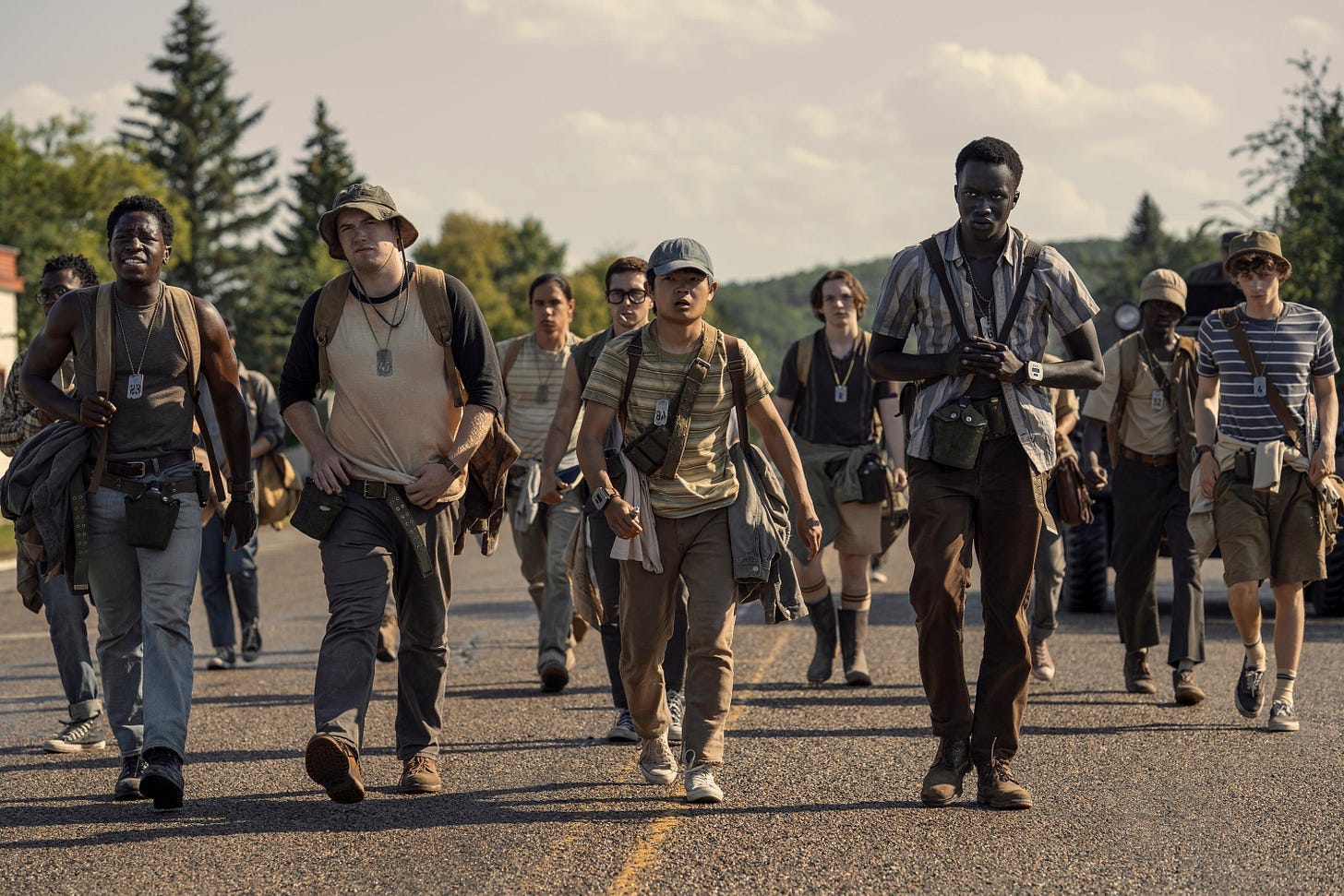
Set in an alternate reality where the U.S. is under the control of an authoritarian regime (lol), The Long Walk is a story about a group of young men who must march across the country and outlast one another for the chance to win untold riches.
Fifty boys, one from each state, must walk at a pace of three mph until they are the last one left. If they fall below that speed for too long, they die. If they step off the concrete path, they die. If they stop to take a dump, they die. There are more ways to die than there are to win, but this heavy handed metaphor for the poverty draft, shows us that if you make people poor, and desperate enough, then they might just risk it all.
The first contestant we meet is a grungy, ill-mannered young man by the name of Ray (played by Cooper Hoffman). He’s arguing with his mother, the prolific Judy Greer, as she very reasonably asks him to drop out of the death march. She cries while begging him to reconsider, and Ray does little to console her, in fact, he inflames the situation by berating her.
It’s only when they’re about to part ways for the final time that he manages to show an ounce of humanity and gives her a conciliatory hug. From our first impression it’s hard to describe him as anything other than another mouthy, self-centered young man with contempt for the world. A dickhead.
Though as the story progresses, and we see the relationships between Ray and the others develop, the softer, more righteous parts of him are unveiled. The man who manages to bring out the best in Ray, and becomes his closest friend along the way, is a self-assured foster kid by the name of Peter McVries (played by David Jonsson).
Please allow me to digress and heap praise upon the man, but if you don’t know David Jonsson, then you will soon. I first had the pleasure of seeing him on Industry, where he played Gus, an absolutely charming and deeply intelligent investment banker. Though his role on the HBO series was limited, he never once failed to captivate and light up the screen. A nonpareil talent.
As the hours pass and bodies pile up along the highway like roadkill, Peter and Ray are forced to become dependent on one another for both companionship and survival. It’s the type of beautiful, healthy male relationship that we love to see on and off screen. More than once Peter saves Ray’s ass, and later down the line, Ray repays the favor tenfold.
The bromance between Ray and Peter is enthralling, but I’ll be the first to admit that the writing itself was a bit lackluster. There was so much high school humor in this movie that I started to wonder if it was written by teenagers. But ultimately, the bonds formed and destroyed along this nightmarish trek was enough to make me sanguine about the tremendous capacity of young men.
Cooper Hoffman had me rolling my eyes upon his first arrival, but ended up redeeming himself with how selfless he was. Towards the end I found myself apologizing for every bad thought I ever had about the man. I’m sorry Cooper.
Tut Nyuot, who plays a supporting role as the good christian boy from Louisiana named Art, delivered one of the best scenes in the entire film, one so devastating that I could even hear the frat bros behind me stress eating popcorn and sniffling in between bites.
Like a well-crafted novella, the film is both compact, at 108 minutes, and charming. Character development and backstory comes mostly from dialogue, and there’s only one (maybe two?) flashbacks in the entire film, but it’s enough for us to get invested. The gore is minimal, and despite it being based on a book by the King of Horror, it’s not as scary as you’d think.
Even though this trauma-bonding hike through the country is unlikely to break the box office, I’d still recommend it for the scaredy cats, the David Jonsson fans, and anyone that wants to see a well-paced, B-tier Stephen King adaptation.
Dreaming of Kafka is a reader-supported publication. To receive new posts and support my work, consider becoming a free or paid subscriber.