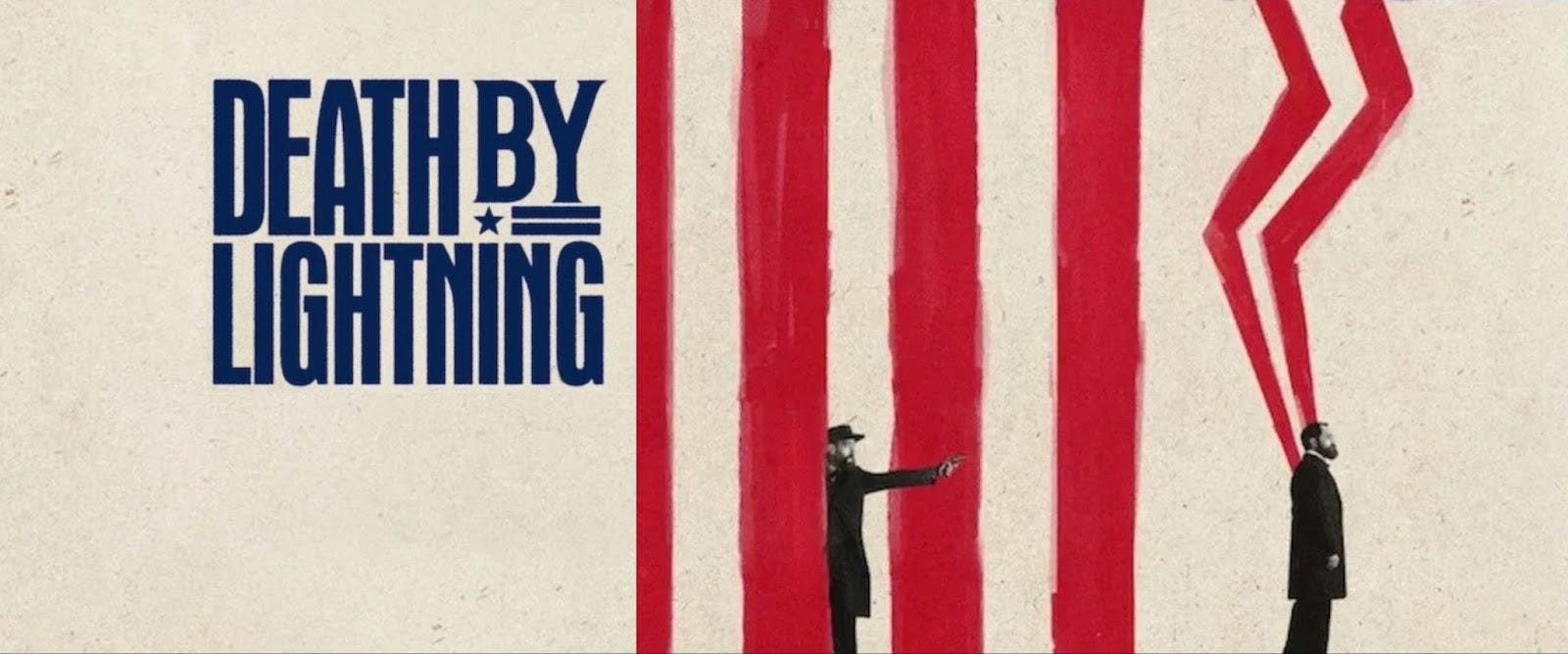
Death By Lightning, is a four part miniseries on Netflix that deftly depicts the violence of men and the political climate that emboldens them. Based on the book, Destiny of the Republic by Candice Millard, this historical drama examines how political rhetoric has contributed to what historian Richard Hofstadter calls, the Paranoia Style of Politics, a uniquely American phenomenon that ultimately led to the assassination of our 20th president, James A. Garfield.
The opening scene begins in 1969 with a few movers shuffling boxes around at the Army Medical Museum. One of the careless workers tips over a wooden crate, and out rolls a jar filled with a murky white liquid. They pick it up to discover a floating brain labeled “Charles Guiteau”.
“Who the f**k is Charles Guiteau.” One of the men exclaims.
Flashback nearly a hundred years, 1880, and we meet Garfield’s soon-to-be assassin, played by Matthew Macfadyen, as he’s rotting away in a Manhattan cell for a petty crime. His professional career is sparse, but his schemes are numerous: fraud, plagiarism, failed business ventures. Ultimately he has dreams and plans of becoming a politician, a man of importance. And if Guiteau had been a Republican in 2025, then maybe he’d be successful, perhaps even secure himself the highest office in the land, but America was less hospitable to scammers and failsons in 1880 than it is today.
Hundreds of miles away, woodworking on his quaint farm in Mentor, Ohio, we meet another man with great political ambitions, but from a much poorer background, James A. Garfield. Michael Shannon’s depiction of this flinty, progressive politician is both revering and hope-inducing. Parables or playful metaphors litter the dialogue of this even-keeled man. Rarely do we get outbursts of anger, loss of control, but even when we do, those feelings are in accordance with the occasion. Shannon’s portrayal of the oft forgotten president reminds me a bit of Daniel Day-Lewis’ Lincoln, but with much less self-righteousness.
Though, as kind as Shannon’s portrayal of Garfield is, the historical drama has no problem eviscerating other politicians of the time. Chester Arthur, (Nick Offerman), is a bumbling drunk, with few original ideas of his own, but many deep political ties. The most formidable of them being a conniving womanizer, Roscoe Conkling, played by Shea Whigham, who has managed to gain complete control over the Republican Party because of corruption and cronyism.
What I enjoy most about this show is that it doesn’t make any idealized claims about what American politics was like then or now. Throughout each episode, we see the predominantly white men in charge of running our country hurl invectives at one another, unconcerned about the reverberations of their language. Conkling and Arthur are especially guilty of fomenting mobs against this new progressive president as he tries to do away with the “spoils system.” Newspapers happily reprint their bogus claims that he’s “missing” or “running the country” into the ground, and then one of those newspapers lands into the lap of a disgruntled office seeker, Guiteau himself.
In 1969, Richard Hofstadter wrote an essay in Harpers called The Paranoid Style in American Politics, that has come to define conservatism ever since. Written in the shadows of the Red Scare, Hofstadter claims that the American right wing (though not exclusively), has wielded the language and tactics of conspiracy to provoke the dispossessed. Their propaganda has largely proven fruitful as communism and socialism are viewed poorly by most Americans, even those that don’t know the definition of either. American liberals historically have been pro-capitalism, so while they don’t explicitly repeat right-wing talking points, they largely agree with them in principle and endorse them by silence. But the cost of this conspiratorial rhetoric has proven to be disastrous.
Out of the 45 U.S. presidents, 4 have been assassinated, and an additional three have been shot. This means 15% or roughly one out of seven U.S. presidents have either historically been killed or shot at. By most occupational standards, the role is perhaps one of the most dangerous ones out there. Many of the aforementioned assassins have made bold claims that they are saving the nation from the threat within, utilizing the same populist, anti-communistic talking points that are parroted by the conservatives and endorsed liberals alike.
Macfadyen’s portrayal of Guiteau is as illuminating as it is horrifying, because although the man has a dubious professional career, and a weak relationship with the truth, if we closely examine his character and his politics, we find that he’s not too different from many modern Americans. His material suffering, coupled with his indomitable faith in god, lead him down what he believes is the righteous and necessary path for saving the country. When he experiences self-doubt and starts to question his plans, he turns to the papers, turns to the politics of the time and finds himself emboldened once again. Scientists examine his brain post-mortem, and try to find a clinical excuse for his heinous crime, but find nothing. The truth, unfortunately, is far more implicating. Only America, a country as rich as it is cruel, could routinely produce a man like Charles Guiteau, an armed white man with few opportunities, and outsized ambitions.
Charles Guiteau and James Garfield are two sides of the same coin, but the truth is that both of them, in their pursuit of legacy and relevance in a deeply divided nation, are as American as they come.