Many thanks to Sabrina Wallace for engaging with my research and finding synergies with her own in the video above.
Wallace and I appear to have certain things in common:
* the belief that a nefarious agenda is being followed to hook human bodies up to an external control network;
* willingness to examine primary source material that otherwise hides in plain sight because people have been primed to look in the wrong places. Wallace seems particularly strong on IEEE documentation;
* a sense of historical consciousness; and
* condemnation of the professions that, through their cowardice and complicity, have helped to facilitate the building of a biodigital slavery system.
I was particularly interested in Wallace’s discussion of literature that I had not previously encountered. I have now read the sources she cites, and the following remarks are largely based upon them.
Biodigital Convergence
I have previously shown that the planning for the “IT/Bio/Nano” era — essentially, connecting human bodies to an external control network — goes at least as far back as the early 2000s in literature by NASA, the National Science Foundation, the RAND Corporation, and other non-healthcare-related organisations (Hughes, 2024a, pp. 337-338).
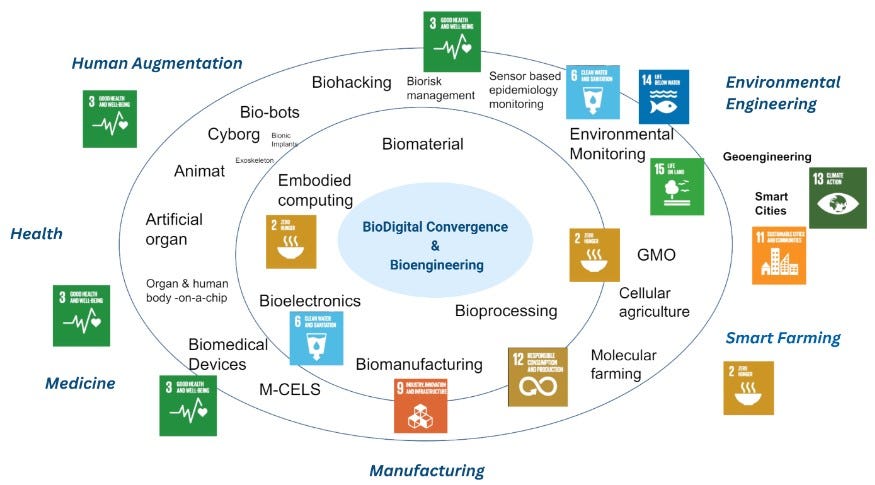
In that context, it is interesting that Wallace shows the following diagram from the International Electrotechnical Commission (IEC):
Although the IEC claims that this is about managing biodigital convergence responsibly to meet “global challenges,” the other way of looking at it is that the UN Sustainable Development Goals (2015) serve to camouflage and legitimise the central agenda of “biodigital convergence & bioengineering.” In this way, the overarching project announced in the early 2000s, with key milestones forecast for 2020, 2025, and 20230, remains on course.
A key technological breakthrough towards biodigital convergence came in 2010 when Charles Lieber and his colleagues invented nanowire transistors so small that they could “enter and probe cells without disrupting the intracellular machinery,” enabling “two-way communication with individual cells” (Shaw, 2011). Soon afterwards, enormous amounts of funding began flowing into graphene and neurotechnology research (Hughes, 2024a, pp. 338-342).
In 2018, Pentagon neuroscience adviser, James Giordano, characterised the brain as “the twenty-first-century battlescape,” claiming that it is possible to “put minimal sized electrodes in a network within a brain through only minimal intervention to be able to read and write into the brain function, in real time, remotely” (Giordano, 2018). Thus, the military dimension to biodigital convergence is undeniable. This has never fundamentally been about health.
“Healthcare”
While developments in biodigital technology were accelerating towards weaponisation in the 2010s, the IT/Bio/Nano concept was repackaged for the public in terms of medicine and healthcare. For example, in 2012, “Medical Body Area Networks” (MBAN) were given the stamp of approval by the U.S. Federal Communications Commission (Harbert, 2012).
Ignoring the previous literature on biodigital convergence, Zafar et al. (2021) falsely claim that “the idea of integrating biological cells into the communication engineering perspective was first proposed by Akyildiz et al. [2015],” in the context of transmitting “vital physiological parameters” to a “remote healthcare provider.”
Akyildiz’s project “PANACEA: Internet of BioNanoThings for Early Detection and Mitigation of Infections” (2018) frames the “Internet of BioNanoThings” in terms of disease prevention. Ostensibly, it is about “a revolution in biomedical technologies” intended to “improve human health and quality of life” (Guler, 2018).
“The Internet of Medical Things,” according to Viziello et al. (2023), “will enable next generation healthcare by enhancing human abilities, supporting continuous body monitoring and restoring lost physiological functions due to serious impairments.” The misleading term “enhancement” is also common to the transhumanist literature (Johnson et al., 2024), and it disguises the weaponizable potential of the new technologies.
Evidence shown by Wallace indicates that the market value of the “Body Area Network” is gigantic: $30.8 billion in 2022, forecast to rise 22.3% p.a. to $229.8 billion in 2023. As with transhumanist technologies, there is massive investment. Akyildiz has made it big as a so-called “Megagrant Leader.”
Human Bodies as Nodes on a Control Grid
Assuming, as I think Wallace and I do, that “healthcare” in this context is merely a smokescreen intended to conceal military measures and render transhumanist technologies more palatable to the public, it is interesting to ignore the medical and healthcare language in the relevant literature and to see what is left.
For example, the IEEE Biomedical Circuits and Systems Conference, held in Toronto in October 2023, explored the following technologies: “Biosensor Devices and Interface Circuits”; “Body Area/Sensor Networks”; “Innovative Circuits for […] Biofeedback, Neuromodulation, and Closed-Loop Systems”; “Biotelemetry and Energy Harvesting/Scavenging Circuits and Systems”; and “Lab-on-Chip / BioMEMS / Point-of-Care Devices.” Applications based on those technologies include: “Artificial Intelligence of Things”; “Bio-signal Recording”; “Machine Learning”; “Genomics and Systems Biology”; “Human-Machine Interfaces”; and “Bioinformatics.” Shorn of the medical terminology, these concepts create the impression of human brains and bodies as mere nodes on a technocratic network, to be monitored and managed by A.I.
That, indeed, appears to be the plan. An IEEE paper, titled “Industrial Cyberphysical Systems: A Backbone of the Fourth Industrial Revolution,” claims that
Cyberphysical systems (CPSs) are perceived as the pivotal enabler for a new era of real-time Internet-based communication and collaboration among value-chain participants, e.g., devices, systems, organizations, and humans. (Colombo et al., 2017).
Here, humans must be connected to the control grid just like any other object; it has nothing to do with health.
The National Institute for Standards and Technology launched a “CPS [Cyber-Physical Systems] Public Working Group” in 2017 to advance interoperability between different elements and systems on the grid. More recently, there has been a strong drive, spearheaded by Tony Blair, to ensure “interoperability” in relation to so-called “vaccine passports.” Again, once the misleading reference to health is stripped out, all that remains is the image of human beings as nodes on a biodigital control network.
Wallace notes developments in “brain-to-brain” and “muscle-to-muscle” interfaces, whereby one person’s thought processes can directly control the bodily movements of someone else. Thus,
The intention from one subject (sender) is recognized using electroencephalography (EEG) based brain-computer interface (BCI), which is sent out to trigger transcranial magnetic stimulation (TMS) on the other subject (receiver) and induce hand motion. (Mashat et al., 2017)
Proof of concept for this was first established in 2011; the first brain-to-brain interface involving rodents was achieved in 2013; the first human-to-human study took place in 2014; and the brains of multiple rats were connected bidirectionally in 2015 (Nam et al., 2021).
Whatever the alleged medical justification is for such research, it is no wonder that Klaus Schwab salivates over the prospect of “direct communication between our brain and the digital world” and being able to read other people’s thoughts. For if human brains can be hooked up to an external control network, then potential for direct neurological control knows no bounds.
Surveillance
IEEE 802.15.6 (October 17, 2018) sets out the standards for a “wireless body area network (WBAN) — note that the earlier “medical” (in MBAN) has here been replaced by “wireless” (WBAN). The WBAN “connects independent nodes that are placed in the clothe…