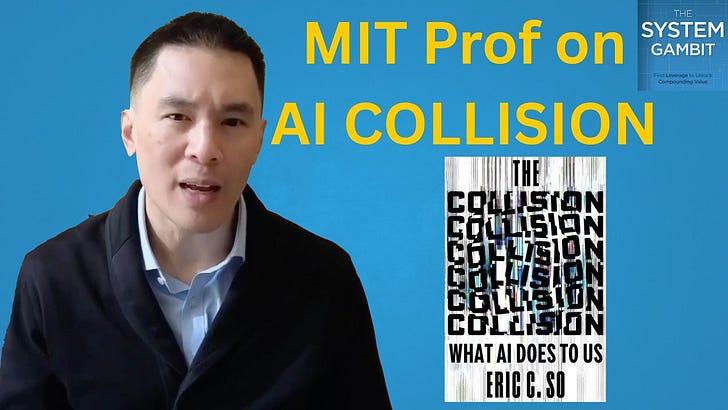
Eric So is the Sloan Distinguished Professor of Global Economics and Behavioral Science at MIT Sloan, where his research examines how artificial intelligence, human behavior, and market incentives interact. A tenured full professor, he is a member of both the Global Economics and Management group and the Behavioral and Policy Sciences area at the MIT Sloan School of Management.
Much of So’s current work is in applied AI, examining both sides of the human–machine interface: how people interpret and respond to AI advice, and how AI systems themselves develop emergent behaviors when deployed in real-world organizational settings. He leads the AI in Financial Markets and Decision-Making research group at the MIT Initiative on the Digital Economy. At MIT Sloan, he serves as Faculty Co-Director of the AI Executive Academy and Lead Faculty for the Generative AI Hub for Teaching and Learning. His forthcoming book, The Collision: What AI Does to Us, explores the friction between AI capabilities and human judgment.
So joined MIT in 2012 after earning his PhD from Stanford’s Graduate School of Business and his master’s in economics from Cornell. An award-winning educator, he teaches Applied AI and Quant Investing, and serves as Faculty Chair of the PhD program.
As artificial intelligence reshapes how we work, learn, and create, a more important question is emerging:
Are we using AI to strengthen our minds, or slowly surrendering the ability to think for ourselves?
AI promises effortless solutions and seemingly limitless capacity. It can write, analyze, brainstorm, and solve problems in seconds. But beneath the excitement lies a growing tension: the collision of human intelligence and machine intelligence is creating two very different kinds of AI users.
Some use AI to think better. Others use it instead of thinking.
The difference could shape not only how we work, but how we think.
In The Collision, MIT professor Eric C. So explores this emerging divide, drawing on cutting-edge research, his own widely discussed work, and stories from workers across industries who are both struggling and succeeding in the age of AI.
His central question is one we should all be asking: What happens to our ability to think independently when intelligent machines make it easier than ever to avoid the struggle of thinking for ourselves?
How to Use AI Without Losing Yourself
The answer isn’t to reject AI. It’s to learn how to use it without allowing our own cognitive abilities to atrophy.
So offers four principles for navigating this new landscape:
* Value the struggle of human effort. The process of working through a difficult problem isn’t wasted time. It’s how we develop understanding, judgment, and intellectual resilience.
* Know who you are without AI. Maintain a clear sense of your own ideas, capabilities, and identity beyond the tools you use.
* Reinvest the cognitive surplus AI creates. When technology saves us time and effort, use that capacity to pursue deeper thinking, creativity, and meaningful work, and not simply to do more of the same.
* Treat AI as a cognitive trainer, not a replacement. Use it to challenge your assumptions, expand your perspective, and sharpen your reasoning rather than outsourcing the thinking itself.
The Real Challenge of the AI Age
The promise of AI isn’t just that we can accomplish more with less effort. It’s that we can redirect our effort toward things that matter more.
But that promise comes with a responsibility: to distinguish between using technology to expand our capabilities and using it to avoid developing them.
For professionals navigating an AI-driven workplace, parents wondering how their children will learn, and anyone trying to make sense of this technological shift, The Collision offers a timely framework for understanding both the promise and the peril.
The goal isn’t to compete with machines at what they do best.
It’s to make sure that, as our tools become more intelligent, we don’t become less thoughtful.
Thanks for reading The System Gambit! This post is public so feel free to share it.