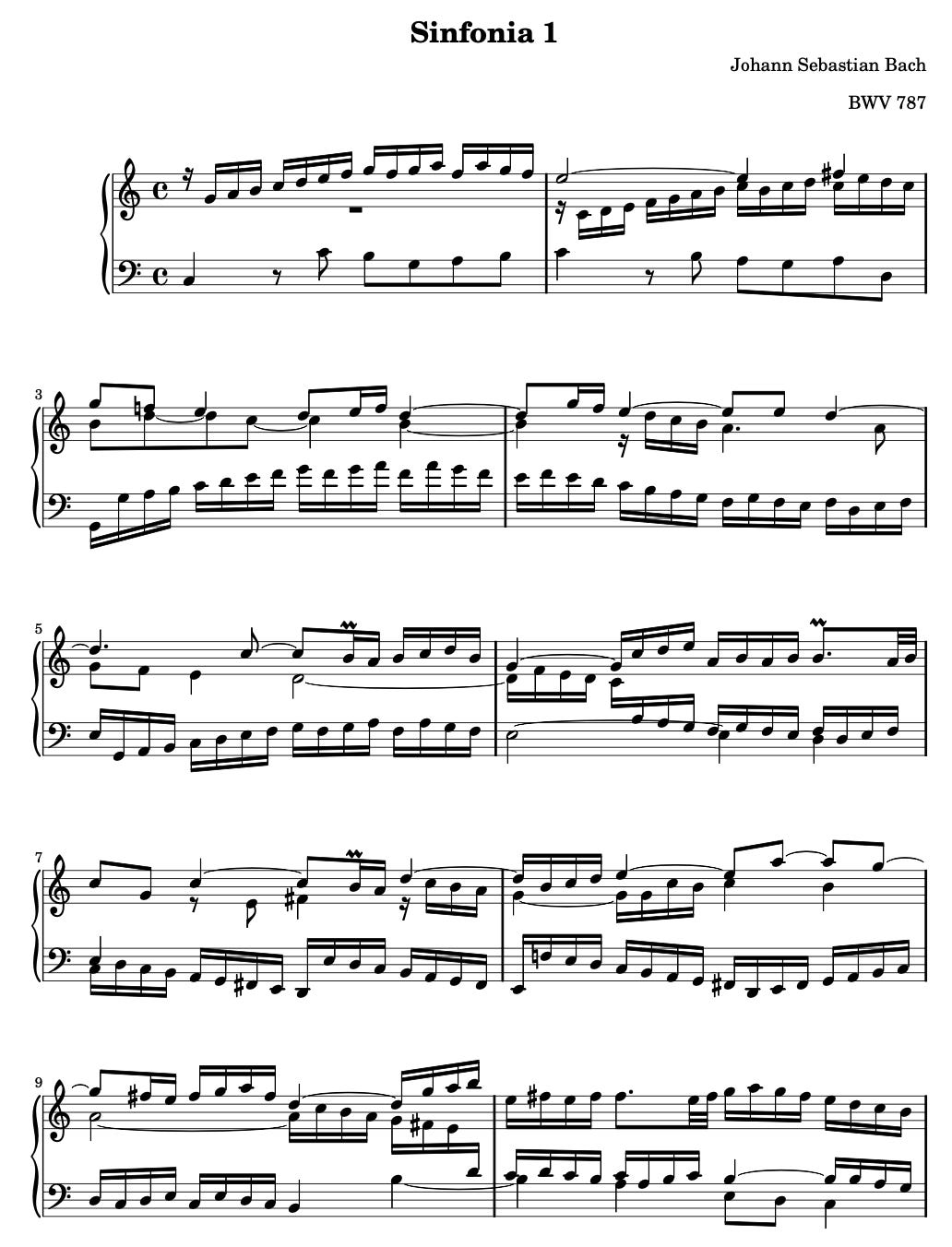
I recorded most of the Bach 2-part Inventions a while back, and now it’s time to begin playing all 15 3-part Sinfonias. They’re gems, all of them!
This first Sinfonia is a subject-oriented piece, with very few episodes and no countersubjects. Bach presents the subject — either in its original form, or in inversion — in almost every measure. And here we see Bach composing a fugal work in C major based on a subject with an ascending tetrachord. I find it compelling that he used the same 4-note motive in the “little” Fugue in C major BWV 952, the C major 2-part Invention, and the Fugue in C major from Book 1 of the Well-Tempered Clavier. Did Bach choose deliberately to link those C major pieces motivically, or was it a subconscious creative impulse? We’ll never know.
In two nifty moments, Bach presents the subject in a stretto. (According to Google, the word stretto is an Italian musical term meaning “narrow,” “tight,” or “compressed.” Musicians use the term to describe “the overlapping of a fugue’s melodic subject and answer, where a second voice begins playing the subject before the first voice has finished it.”) In measures 10 and 11, the subject appears in the soprano voice and is answered in stretto by the bass voice. A striking feature of this stretto is that the subject appears in inversion. The stretto in measures 16 and 17 is a bit different: the alto voice states the subject in its original form, but the bass voice overlaps with the subject in inversion — a counter-stretto!
What do we not find in this piece? Countersubjects, dense chromaticism, and unusual key changes. The deceptive cadence in e minor at measure 10 (which foils the expected cadence in G major), and the modulation to d minor in measure 13 are not very surprising. What makes this piece captivating is the relentless presence of the subject in its various guises.
If listeners want unusual chromaticism and consistent countersubjects, they will have to wait for Sinfonia #2.