Welcome to SLOW READ, where we tackle the books you’ve always wanted to read at a pace you can handle.
Hosted by Sarah Stewart Holland and Laura Tremaine
We are currently reading The Stand by Stephen King (unabridged version)
You can find our full Reading Schedule here
Join the SLOW READ community on Substack for bonus episodes, book club meetings, and Side Quests with Sarah & Laura
____
If you prefer to read instead of listen, below is a cleaned up transcript of the episodes as well as links to all the books and Substacks we mentioned in this episode…and several fun bonus links and videos!
Mentioned in this episode:
Station Eleven by Emily St. John Mandel
Watership Down by Richard Adams
Creation Lake by Rachel Kushner
Friday Black by Nana Kwame Adjei-Brenyah
Chain Gang All Stars by Nana Kwame Adjei-Brenyah
In Cold Blood by Truman Capote
Monsters A Fan’s Dilemma by Claire Dederer
____
Sarah: Hello, I am Sarah Stewart-Holland.
Laura: And I’m Laura Tremaine. Welcome to Slow Read, where we tackle the books you’ve always wanted to read at a pace you can handle. We are currently reading The Stand by Stephen King, and today we’re going to talk about Chapters 26 through 34.
Sarah: Things are getting real gruesome as society fully collapses. We’re going to talk about that and the maggots and the swelling and the “bonbons” of bodies. And hopefully get to all that before we go “tharn.” Did I say that right?
Laura: I think you did say that right. Can I just say, first of all, this section has probably one of the worst scenes in the whole book. It’s short, but it’s awful. And as I was reading this section, all I could think was: I’m really worried that I told all the readers that this book isn’t very scary.
Sarah: Well, it’s not scary. It’s just gross.
Laura: I really thought, damn, we should have given people a warning last week. I don’t want to say this section is inconsequential, but by the time we get to the end of the book, this won’t be what stands out. This is like a bridge section from all the setup.
Chapter 26: The Media and the Military
Sarah: Chapter 26 is quite a doozy. It really is like... let’s go around the country and show you the collapse of American society. First shout out to the great state of Kentucky, my home state. There is, in fact, no “University of Kentucky Louisville.” That’s just the University of Louisville. But I was excited either way.
Laura: Can I just tell you that I am still reading every word aloud. I was reading this one aloud in bed and Jeff, my husband, came to bed and listened. And he was like, “This is scary.”
Sarah: What I found so interesting is we start in Kentucky, we go to Boston, Los Angeles, Missouri, New York City, Des Moines. And there’s a real focus on colleges and media. It’s either protests at college campuses or media defying this military shutdown of information.
Laura: He talks about how the Kent State protesters get mowed down. Stephen King being of the age and generation that he is, that is a callback to one of the biggest events of his young adulthood. He almost reenacts it in a way. I actually just got chills because I think that was very purposefully placed.
Sarah: I just thought it was so interesting that he was almost hyper-focused on media. Like the Los Angeles Times distributing about 10,000 copies. But actually, as I say this, the flow of information makes sense because we’re on this compressed timeline. We’re not to the part where people are truly out of food. We’re not to the part where the electricity has shut down. The media would fall apart first. So now I’ve talked myself into that this is a brilliant move.
Laura: We’re definitely not to people running out of food because almost everybody’s dying. They don’t even have a chance to run out of food.
Sarah: I also really liked what Harold tells us later—that Mother Nature doesn’t work this way. The way that everyone’s dying and it’s happening so quickly means that something else is at play here. This isn’t just something that occurred in nature.
Laura: Can I just share my naivete right here? I just don’t immediately default to “government conspiracy trying to kill us all.” I don’t.
Sarah: Yeah, I don’t either. I absolutely think that people underestimate the power of the federal government to exert its will. But that power comes from size. And size means secret keeping is incredibly difficult. No one can keep a secret. Literally no one.
Chapter 27: Larry and the “Rancid Bonbons”
Sarah: Chapter 27, Larry Underwood in New York City. Everybody’s dead in New York City, which means there’s just a lot of bodies. This whole section was really... I mean, he’s walking around the city encountering rotten corpses. It’s really, really gross.
Laura: Well, and it’s very cinematic. Setting that scene in New York City makes it so we can all picture what the streets would be like completely empty and with dead bodies everywhere.
Sarah: This was the “rancid bonbon” chapter with Larry where I was like, I didn’t need that. I could have gone my whole life without hearing a dead body described as a rancid bonbon.
Laura: What did you think about when Larry and Rita go to a steakhouse and cook a dinner?
Sarah: I mean, we’re saying there’s plenty of food, but is there plenty of food people know how to prepare? I don’t know what else you do. In those initial shocks, it’s so surreal. You do kind of cling to whatever normal, pleasurable experience you can find.
Laura: What did you think about Rita as a character?
Sarah: I was fascinated. I couldn’t quite... was this Rita’s Yankee Stadium moment? Did she go to Cartier and just go to town?
Laura: I picture Rita as a Real Housewife of New York City. Like she’s done a lot to her face. She’s dripping in diamonds. And like the opposite of Stu, she has no skills to survive.
Sarah: I’m intrigued by their partnership and where they’re going to go.
Franny and Harold
Laura: Let me tell you what partnership I’m much less invested in. And that is Franny and Harold. Harold was weirding me all the way out.
Sarah: I’m surprised you’re mentioning them as a partnership. Did you just get that vibe right away?
Laura: I just mean like they’re the only ones left there. And Harold was weirding me out. I got some red flags.
Sarah: Good instincts. Imagine, because we all have these people at every stage of our life where you’re like, If there’s only two of us left on this planet... For Franny, it’s her friend’s little brother. The worst. If it was these assholes who I’m stuck in Paducah with post-pandemic, I’m going to be mad. I’m just telling you, the survivors are skewing... not great. Not a great cross-section of humanity.
Sarah: But do you really think that the survivors would be like the ultimate hero pinnacle of society people?
Laura: It does feel like there should be like one or two more “normals.”
Sarah: Stu is normal. Franny’s normal. That’s all I’ve got, Laura.
Laura: I don’t think Larry is un-normal in the same way. He’s just so selfish. It feels like his weaknesses are going to be very easily exploitable, which is my concern as we get further into this chapter, because there seems to be one person in particular ready and willing to manipulate and exploit.
Chapter 28/29: Stu Goes “Tharn”
Sarah: Back to our normies. Stu is back in Stovington, Vermont. He’s still at the disease control center. Everybody’s dying. And he’s worried like, they’re either going to kill me or I’m going to get trapped in here and starve to death, which is a truly terrible way to die.
Laura: This is where we get “going tharn.” He talks a lot about Watership Down and the rabbits and going tharn. I loved the sentence: “Going tharn, a good word for a bad state of mind.” It’s sort of frozen in the headlines. And he doesn’t freeze.
John Phipps: Don’t Panic. Don’t Go Tharn, Either.
Sarah: But then, oh my God, he gets stuck in this damn hospital. I felt like he ran around that hospital for 25 pages. I was like, Just get out of here. And then as he’s finally in the stairwell, someone grabs his ankle.
Laura: This is an imagery tie-in to It. Even if you haven’t read it, you know the clown coming out of the sewer. My dog has an irrational fear of storm drains. She will pull your ass all the way across the other side of the street not to walk in front of a storm drain. So this is just cellular.
Sarah: And he has to kill Dr. Elder to get him out of his way. Here’s what’s interesting to me: this idea that people’s dying pursuit would be violence. That in these final moments of a human life, someone would try to take some people out with them. That is not my experience of humanity.
Laura: But I think Dr. Elder, for example, that wasn’t his primitive source coming out. He was under orders to kill Stu. But he’s dying. He’s literally delirious.
Sarah: I think the closest equivalent is like a natural disaster. And people’s instinct in a natural disaster is to help people. I’ve seen it.
Laura: Okay, but what if it’s not about violence? What if it’s about a denial of what’s actually happening? It’s a clinging to the status quo. If I can follow my role as a military member, then that will protect me in a way. I definitely buy that.
Sarah: So Stu gets away. He gets out. He doesn’t go tharn.
Chapter 30: Arnett
Laura: We go back to Arnett, Texas. This is a very short chapter. But because there’s nothing there, it’s dead. The town is silent and dead.
Chapter 31: Randall Flagg and the Network
Sarah: Okay, buckle up. Now we’re to Chapter 31 with the dark man, the walking man, the faceless man, Randall Flagg. We start this chapter with a minor character named Christopher Bradenton.
Laura: Bradenton appeared in Chapter 23. He was a conductor on one of the underground railway systems by which fugitives moved. Randall Flagg exploits this network.
Sarah: This was giving One Battle After Another the new film.
Laura: The premise is that there is this network out there that continues to exist where people are in this secret communication with each other. I thought that was really interesting to place Randall Flagg within that. It’s not ideologically driven. It’s just exploiting the secretness of these networks.
Sarah: Bradenton is delirious. So Randall Flagg—or Richard Fry—shows up. He’s sitting on his chest trying to get the keys to a car. And I’m like, dude, I thought the last chapter we established you could fly. Why do you need a car? And why do you give a shit if you have the papers? Everybody’s dead.
Laura: We are going to play with throughout the story of: Is Randall Flagg man or monster? Is Randall Flagg man or devil? When he is acting as a man, I don’t know that Randall Flagg totally knows. He’s going to do some things like need the car that are very human. And then he’s going to do other things where you’re like, That’s not human.
Chapter 32: Lloyd in Prison
Laura: Here’s what we do know. Poor Lloyd is about to starve to death in prison. Oh, poor Lloyd and his hamburger fingers.
Sarah: I was like, did you have a plan? You thought, I’m going to hamburger my fingers to get this bedpost.And then he got the bedpost and he had no plan at all.
Laura: No, he just uses it to bang on the bars. Well, he’s smart enough to sock away a dead rat to eat later. He did save some food.
Sarah: I used to think the worst way to die would be to be crushed by a crowd. But this might be a close second. I’ve watched a single documentary about a crowd crush experience at a sporting event, and it haunts me. But being stuck in a prison with rotting bodies and no food... pretty close second.
Chapter 33: Nick and the Bully
Laura: Then we go back to Arkansas with Nick. Back to my concerns about would a dying bully stumble out of the woods, delirious and sick, and be like, You know what I’m going to do with my last dying 10% of energy? I’m going to beat the shit out of Nick Andros. I don’t know, man.
Sarah: It felt very bookie. Like, of course the villain is going to stumble back. It was giving zombie.
Laura: I also quibble with the idea that Nick Andros, who cannot hear, doesn’t feel when someone enters a room behind him. Every person with hearing problems that I’ve ever known, their senses are very differently abled. So the fact that Nick doesn’t hear him bust in... unrealistic.
Sarah: I thought you were going to say you quibble with the fact that Nick Andros is sitting around reading Jane Eyre.
Laura: My answer to the side quest of what would you do when everyone’s dead is not sit around and read the classics. Because guys, it’s going to get to a point where shit’s going to fall apart. You’re going to have nothing but books left. Save it for then, friends. Be watching your DVDs before the electricity plants go down.
Chapter 34: Trash Can Man
Laura: Final chapter, Trash Can Man. Donald Merwin Elbert. First of all, with a name like that, why wouldn’t you be burning shit down?
Sarah: Baby Donald had a rough start. This is a sad story. His father kills his siblings. His mother escapes. The father is killed by the sheriff... who his mother then marries. I literally wrote “Oh my God” beside that part.
Laura: And the poor sheriff, I had a lot of sympathy for him. He was like, This boy is not right. We need to get him some help.
Sarah: He burned a church. He burned some lady’s pension check. And he gets electroshock therapy treatment. I really liked the way he articulated how tenuously he was gripping onto normality. He’s like, I had it. I had a grasp on it and I just couldn’t quite hold it.
Laura: It’s obviously setting us up to see what’s going to happen with Trash Can Man next. He is also enacting our theme of the side quest: What would you do if you were alone and could do anything? He has been dying his whole life to go blow up those big gas silos. And so he’s like, I’m going to go do it. Here’s my chance. Chance of a lifetime.
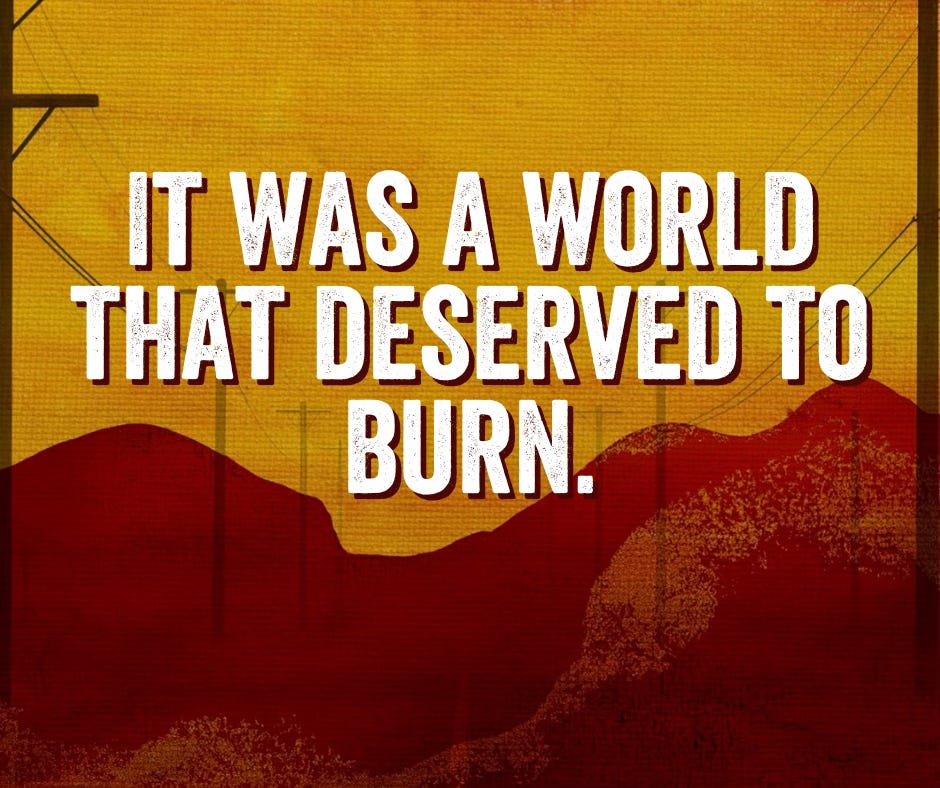
Sarah: I thought this was so powerful. He sees a bug stuck in gasoline and he says: “It was a world that deserved to burn.” And then a little bit later, he said: “There was a whole country ripe for burning under the summer sun.”
The TV Station
Laura: We didn’t talk about the scene that I find to be one of the scariest in the whole entire book.
Sarah: The one in the local TV station where the men have lined up the other men and are shooting them on camera?
Laura: Yes. It was so disturbing. The scene itself is awful. And then we get to see it through Franny’s eyes when she turns on the TV. There were so many things happening—race stuff, history stuff, tribal stuff. It was purposely being televised.
Sarah: I think there’s something about the televised aspect and the complete detachment from any law and order. It was very much giving “inmates running the asylum.” It felt like a horror short story. It felt like Friday Black or Chain Gang All-Stars. I was really disturbed by that scene.
Why Read Horror?
Laura: I think now might be a good time for a little pep talk about why we read horror.
Sarah: I need a pep talk.
Laura: We read horror because it lets your mind and imagination play out some things that sort of already always linger back there. Some part of us, we’re all scared of the monster under our bed. And horror gives us a playground for that.
Sarah: I think true crime is scarier than horror. In Cold Blood really shook me.
Laura: I think true crime is playing around with the presence of violence, whereas I feel like horror is playing around with the presence of death. And to me, that’s different. Facing the reality that we will all turn to ashes and dust can be freeing in a way.
Sarah: Well, and to just pep talk anyone on The Stand in particular... I do want to say without any spoilers that the book is about to get a lot more relational. No more rancid bonbons.
Laura: Please tell me there’s no more rancid bonbons.
Sarah: I’m not going to promise that to you! But we’re about to move to: Okay, everyone’s dead. Now what happens? And what happens is going to be pretty relational.
Next Week:
We are reading Chapters 35 through 42. It is 96 pages. We can do it!
Up Next: The Side Quest
Head over to the paid subscriber section where we are discussing what we would do if the city was suddenly empty. See you on the other side.