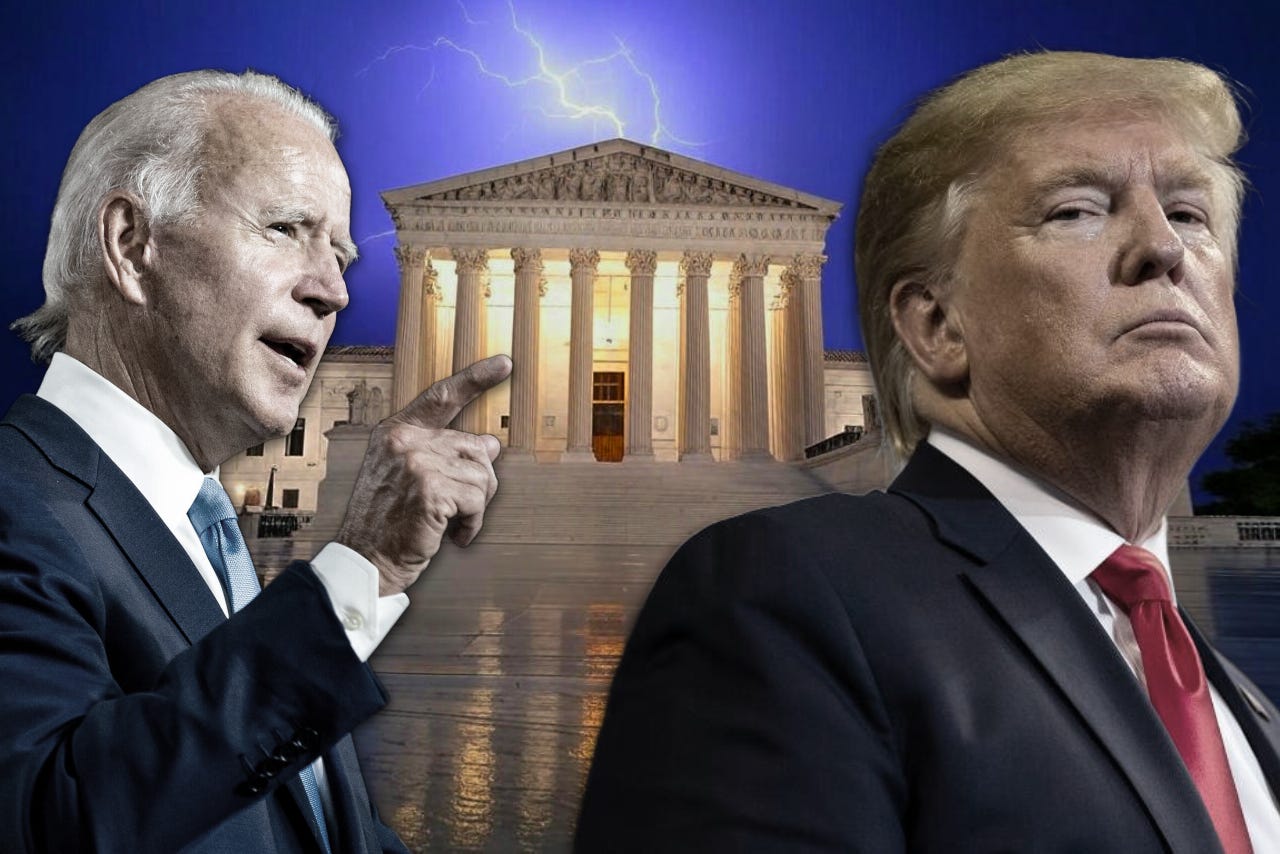
In his final hours as President of the United States, Joe Biden issued a series of preemptive pardons for Anthony Fauci, Mark Milley, the members of the January 6th Committee, and his extended family. This action was one of the most disgusting uses of presidential power to grant reprieves and pardons in the history of our Republic. And the action’s constitutionality should be questioned.
In Article II, Section 2 of the US Constitution, the president is vested with the power to “grant reprieves and pardons” through these words:
“The President shall…have power to grant reprieves and pardons for offenses against the United States, except in cases of impeachment.”
The keywords here are “for offenses against the United States,” which infers a criminal conviction in federal court. In fact, the US Supreme Court has already ruled on that. If you accept a pardon, there is an inference of guilt. Therefore, the question that begs to be asked is valid: Are pre-emptive presidential pardons constitutional?
Biden, in the early days of his presidency, lauded the Wilson and Roosevelt administrations, both of which expanded presidential authority and the purview of the Executive Branch unconstitutionally. Roosevelt’s New Deal was choke-full of presidential authority expansion beyond the limits of the Constitution. Brion McClanahan documents each—and the expansionist agendas of Wilson and Truman, as well as several others, in his book, 9 Presidents Who Screwed Up America: And Four Who Tried to Save Her. It’s definitely worth the time.
So, it should come as no surprise that Biden felt unencumbered by the Constitution in his actions, specifically with his precedent-setting issuance of pre-emptive presidential pardons. It’s never happened before, and, through an originalist's view of the Constitution, it appears unconstitutional.
Some would attempt to defend Biden’s actions by juxtaposing them with President Gerald Ford’s pardon of Richard Nixon after his resignation stemming from the Watergate scandal. But there are significant differences between the two.
Ford’s pardon of Nixon was singular, focused solely on Nixon, covering all federal offenses he committed or was under investigation for during his presidency. It was a direct response to a specific legal threat—a threat that had already been initiated. Ford’s action prevented any further legal action against Nixon.
Biden’s actions, conversely, were preemptive because no investigative or legal actions had commenced against anyone receiving a pre-emptive pardon. Biden’s actions were aimed at protecting individuals from potential future legal actions regardless of any criminal conduct.
Biden issued pre-emptive pardons to Fauci, Milley, the J6 Committee, and his family members. However, according to the Constitution, presidential pardons are only valid for issuance in instances of transgressions against the United States. So, how could they be valid and binding?
But what to do? Well, if Biden can execute precedential actions, so can President Trump.
President Trump should instruct his Solicitor General to file an emergency petition with the US Supreme Court (SCOTUS) to definitively rule on the parameters of the presidential reprieve and pardon clause in Article II, Section 1.
It can be successfully argued that Article III, Section 1 gives the SCOTUS purview over establishing the defining parameters associated with Article II, Section1, through the words:
“The judicial Power shall extend to all Cases, in Law and Equity, arising under this Constitution, the Laws of the United States, and Treaties made, or which shall be made, under their Authority;—to all Cases affecting Ambassadors, other public Ministers and Consuls;—to all Cases of admiralty and maritime Jurisdiction;—to Controversies to which the United States shall be a Party…”
Because the SCOTUS is a co-equal branch of our federal government—and the one charged with judicial review—it does not need to be presented with a case to accept or decline because the Executive’s action has already taken place. All it needs is a petition from the Solicitor General.
This petition isn’t even an act of partisan politics because it concerns constitutionality; the definition and parameters would apply to all presidents regardless of party.
The Supreme Court should be motivated to make this ruling because failure to do so would create a constitutional crisis.
For example, suppose presidential pre-emptive pardons are allowed to stand. What is to keep every president, at any time, from issuing pre-emptive pardons to the entirety of his staff and cabinet? What would prevent a president from issuing pre-emptive pardons to sycophantic private citizens or crony foreign nationals?
Inaction by the SCOTUS would render moot its ruling on presidential immunity because a POTUS could, theoretically, issue himself a pre-emptive pardon for any and all actions undertaken before, during, and after his or her tenure. Hunter Biden’s pre-emptive pardon serves as precedent for that.
Moving forward, President Trump should request that liberal constitutional attorney Alan Dershowitz be seated as a Solicitor General specifically for this action in front of the Supreme Court. Dershowitz is on record as holding the idea of preemptive presidential pardon in contempt as wholly unconstitutional. Few possess his knowledge, experience, and expertise in matters of the US Constitution and constitutionality.
Additionally, Mr. Trump must talk directly to the American people, circumventing the mainstream media, and explain that this action is not an act of retribution but a question of constitutionality that would bind all presidents to limitations set forth by the Constitution. He doesn’t even have to state that he wants the pardons revoked. He is simply asking the Supreme Court—the proper authority on the Constitution—for clarification on a matter of constitutionality.
Personally, if I were in President Trump’s place and Biden would have left the pre-emptive pardons at only his son, I probably would have let the subject go. The question of what we would do for our children—especially troubled children like Hunter—is a question of personal sacrifice.
But the moment Biden issued pre-emptive pardons to Fauci, Milley, the J6 Committee, and his extended grifter family, there was no question that the issue of pre-emptive pardons had to be addressed.
We, as a nation and our federal government as a whole, have strayed far from the limitations set forth by the US Constitution. Our federal government routinely ignores the 9th and 10th Amendments even as it expands its authority beyond its constitutional boundaries by bastardizing the meanings of clauses in the Constitution and enabling the bureaucratic regulatory process. By allowing this expansion of authority, we now find our constitutional right to free speech under attack.
Mr. Biden said it himself in his farewell babblings. No one should be considered above the law. I put it to you that no president should feel he can exist above the limitations of the Constitution.
All we are asking for is a ruling by the SCOTUS on a matter of constitutionality. It’s their job, the reason that branch exists, to determine constitutionality. All we are asking is that they do their jobs.
Underground USA is reader-supported. Please consider becoming a paid subscriber.
This Is How You Come To The Aid Of Your Neighbor?
Many people may think I’m naive for believing that people rise to the occasion when disaster strikes. However, I’m not naive. I have witnessed this firsthand as a professional firefighter and paramedic and through my own experiences with numerous natural disasters, primarily hurricanes and tornadoes.
In every instance, I have witnessed people stepping up to help their neighbors and even strangers. It may be something ingrained in us as Americans; who knows?
I have come to understand one important thing: while people who "run towards the fire" can be found everywhere in our country—and likely across the gl…