Bernie was coming out of a small post office that serviced the tiny hamlet north of Coffs Harbour when the police stopped her and wanted to know why she wasn’t wearing a mask.
She told them she had an exemption, but she had left it at home. This was true, but they didn’t care.
After a few words, they arrested her by throwing her down to the sidewalk with such force that they broke her sternum.
She would then spend six hours in the lockup, with no one knowing where she was, nor was she offered medical assistance. One officer came in and growled at her, “I hope you die of Covid.”
The two police officers who arrested her were both far younger and taller than her.
Oh, and she was also wearing her nurse’s uniform.
In court, the Magistrate stated that while it was correct that she did have a mask exemption, and while it was also correct that the police had been overly aggressive in his opinion, she needed to be made an example of.
So she was convicted and fined, and to top it all off, her foster child—who she had been a mother to since the child was four—was permanently removed and all access to him was withdrawn.
He was fourteen years old.
Now we all know that Covid was not that dangerous, and the science is clear that masks don’t work—a fact that Bernie knew then, being a nurse. But a government- and media-driven fear campaign had consumed the land, and the people were tackling this the only way the state offered: unquestioning compliance.
Trust the science—even though, deep inside, most knew that another definition of the word “science” is “question.”
But this compliance afforded the weak among us—especially some of those who wore a police uniform—the right to be aggressive to anyone who resisted. And so for the first time in our history, officers who grew up under a media campaign that stated clearly “violence against women is wrong” were given a brutal pass, and they took it.
I have interviewed several older women who claimed they were brutalised by their communal sons, all of whom were wearing a badge that stated “serve and protect.”
This path we found ourselves on—maybe we’re still on it, for the only way to tell is to see how they will react when the fear returns—is the path to tyranny. It’s the path that led Iran, which in the 70s was as free as we were then, to the sadistic regime that exists now.
A regime where young women, if they dare to contravene the strict rules—no hair out in public, no dancing, no public affection—could see themselves arrested, caned and, if they are virgins, raped, for the regime believes that virgins go straight to heaven.
The most terrifying truth is that although the Iran revolution started in violence, the regime managed to install itself thanks to the majority of the people remaining quiet, and being compliant in a hope that it will rectify itself. Like the majority of us did in covid, where many people posted comments stating that they wished police had used real bullets and not rubber ones, when the videos of the anti-lockdown protests went live.
This connection, was why I decided to reach out to anyone in Iran who would fill us in on what life was actually like there, on the ground.
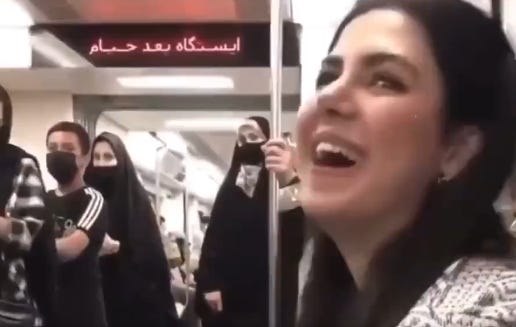
The first two interviews were life-changing for me, for I could not fathom that level of cruelty, especially towards young women. But this interview was different, for following the strikes from the US and Israel, the women were dancing in the streets and removing their mandatory hijabs.
In West Papua the people are facing the same brutality, and according to Julian King, who I interviewed—who is completing a PhD about West Papua—many of the Indonesian soldiers who are participating in the brutality, who video their acts of torture and post it online, are trained by us. We even supply them the weapons of war.
These brutalised people are the Fuzzy Wuzzy Angels who once risked their own lives to save our grandfathers who were fighting the Japanese.
In the map of our country’s history, this is where we are.
A people who consumed The Handmaid’s Tale but apparently learned nothing from it.
The lesson of course is simple: democracy, for all its faults, offers a citizen the greatest amount of liberty, but that democracy needs vigilance, for many humans, once in power, do not—like moths—fly toward the light.
In the six years I have been a part of a community that challenged and still challenges blind compliance.
One of our goals was to get the world to hear our plight, to help. But doesn’t that mean, if we are fair human beings, that we have an obligation to listen as well?
For in this era, where tyranny is trying to create a new world under the guise of protecting people from being offended, we are not alone. It is happening everywhere from Finland to Canada.
A global push to control the world with digital ID and an AI surveillance system—and if they succeed, a social credit score system.
And once the world has that amount of control, do you really believe that those in charge, and those who police it, will be benevolent?
Perhaps the best argument against this question is to go back in history and find a dictatorship that was caring and kind, a regime that didn’t revel in their power but rather focused only on defending the freedom of their people.
But back to Iran.
I have no idea what will happen next; a world war, the regime claws back control and once again arrests, beats, rapes and kills thousands, or perhaps the people will rise.
But what I do know is that there has always been war, and cruelty and murder, but amidst the carnage love has always endured and so has humanity’s capacity to dance.
And that is what is happening now, in the eye of the cyclone, empowered by forces greater than us all: the Iranians are dancing. And perhaps, momentarily and precariously, they are dancing for every human who wants to have the freedom to be the navigator of their own dress code, thoughts and destiny.
And if you think I’m overreacting, in the interview Melika talks about how free her people used to be. A people who loved to dance. To which I replied, that once, my people loved to laugh. We called it taking the piss and we thought it was a foundation block of our identity, but now jokes are frowned upon, and our hate speech laws are trying to match the UK’s where you can go to jail, even if you are a grandmother, by posting something that some finds offensive.
Perhaps, rather than waiting until we reach a state like Iran is now, we should listen carefully to the stories of the Iran people, in a hope that we can find a way to circumnavigate the controls and the violence and go back laughing and who knows, maybe rather than instructing our children to fear everything, we could teach them through example, how to dance.
Michael Gray GriffithCafe Locked Out.