When you picture the Beatles, you see four mop-topped lads from Liverpool—John, Paul, George, and Ringo—standing together with their instruments, creating magic. This image is so powerful, so deeply embedded in our cultural consciousness, that it’s easy to believe they played every single note on every single record. The myth of the self-contained band, four musicians who needed no one else, has persisted for decades. But like many myths, there’s more to the story. 🎸
Sure, we all know about Eric Clapton playing guitar on “While My Guitar Gently Weeps” Billy Preston on keyboards for “Get Back,” and George Martin adding flourishes here and there. But the the Beatles’ revolutionary sound emerged from a collaborative effort far more extensive.
While the Fab Four were undeniably brilliant songwriters and performers, their iconic recordings often featured “hidden hands”—talented session musicians whose contributions shaped some of the most beloved tracks in popular music history. These uncredited artists added strings, brass, exotic instruments, and specialized skills that transformed simple melodies into the complex, layered soundscapes we recognize today. Understanding their role doesn’t diminish the Beatles’ genius; rather, it reveals the true scope of their creative ambition and their willingness to embrace whatever was needed to realize their musical vision. 🎵
(You’ll find my list of the top 15 most notable guest players at the bottom of this essay).
Beyond Guitars: The Early Collaborators
Even in their earliest days, the Beatles relied on outside musicians to fill crucial gaps. The most famous example occurred before most fans even knew their names. When the group recorded “Love Me Do” for their debut single in September 1962, producer Martinwas unsure about Ringo Starr’s drumming. Ringo had only recently joined the band, and Martin wanted to ensure the track was as tight as possible for such a crucial release. His solution? Bring in Andy White, a seasoned session drummer who had worked on countless records. 🥁
White’s contribution to “Love Me Do” represents one of the most significant—and contentious—instances of session work in the Beatles’ catalog. The version that became the hit single features White on drums, with Ringo relegated to playing tambourine. For years, this fact remained obscure, with fans assuming they were hearing the “real” Beatles lineup. White himself later reflected on the irony: he played on one of the most famous debut singles in rock history, yet few people knew his name. His crisp, professional drumming provided the reliable foundation the song needed, demonstrating how even the earliest Beatles recordings benefited from external expertise.
Martin frequently stepped in to play piano, adding subtle textures that enriched tracks without calling attention to themselves. His classical training and studio experience allowed him to quickly sketch in keyboard parts that complemented the Beatles’ arrangements. On songs like “Misery” and “In My Life,” Martin’s piano work added a sophistication that elevated the material beyond standard rock and roll. These contributions were so seamlessly integrated that listeners naturally assumed one of the Beatles was playing—a testament to both Martin’s skill and his understanding of how to serve the song rather than showcase himself. 🎹
Martin's piano work on "In My Life" showcases his brilliant studio innovation and classical training. He composed and recorded a baroque-style keyboard solo for the song's instrumental break, playing it at half-speed on the piano. The tape was then sped up to normal playback speed, which raised the pitch an octave and created a bright, harpsichord-like timbre that perfectly complemented the song's nostalgic mood. The part’s distinctive, almost crystalline quality would have been impossible with an actual harpsichord or piano played at normal speed. The result was one of the most memorable instrumental moments on "Rubber Soul," demonstrating Martin's genius for using studio technology to create sounds that served the Beatles' artistic vision. 🎹
The Pepper Paradox: Orchestral Architects
“Sgt. Pepper’s Lonely Hearts Club Band” in 1967 marked a watershed moment, not just for the Beatles but for popular music generally. The album’s ambition required sonic possibilities far beyond what four musicians could provide, no matter how talented. The Beatles didn’t just want to make another rock album—they wanted to create something unprecedented, a work that would push the boundaries of what a recording could be. Realizing this vision meant bringing in dozens of session musicians, transforming Abbey Road Studios into a laboratory where rock met classical music in ways no one had attempted before. 🎺
The orchestral contributions to “A Day in the Life” represent perhaps the most dramatic example. The song’s famous crescendo—that apocalyptic surge of sound linking the verses—required a 40-piece orchestra. But this wasn’t just any orchestral arrangement. Paul McCartney and George Martin gave the musicians unusual instructions: start at the lowest note on your instrument and gradually climb to the highest, but get there at your own pace. The result was controlled chaos, a swelling wall of sound that seemed to tear reality apart. Each individual musician in that orchestra contributed to one of the most iconic moments in rock history, yet few Beatles fans could name a single one of them. The anonymous violinists, cellists, horn players, and woodwind specialists became part of something larger than themselves—exactly what great session work should be. 🎻
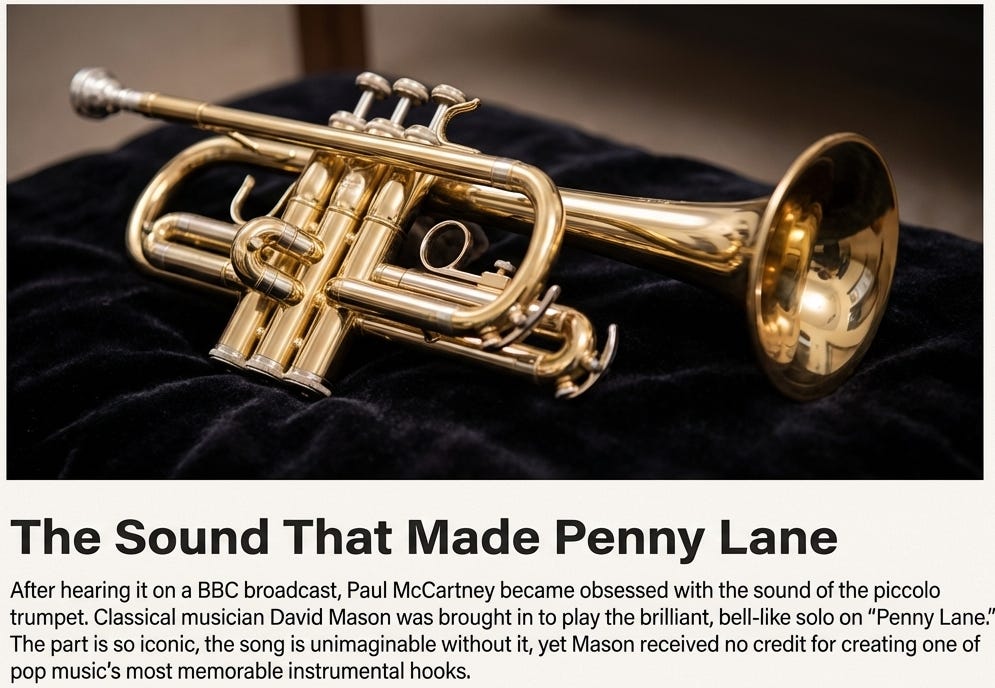
“Penny Lane” offered a different kind of orchestral magic. The song’s baroque trumpet solo, played by David Mason, became one of its most distinctive features. Paul McCartney had recently heard a piccolo trumpet—a smaller, higher-pitched instrument than the standard trumpet—on a BBC broadcast and became obsessed with adding that sound to his new composition. Mason, a classical musician with the London Symphony Orchestra, was brought in for exactly for this purpose. His brilliant, bell-like solo transformed “Penny Lane” from a charming nostalgia piece into something extraordinary. That solo became so identified with the song that it’s impossible to imagine the track without it, yet Mason received neither credit on the record nor significant compensation (he got 24 pounds) for creating one of pop music’s most memorable instrumental moments. 🎺
Throughout “Pepper,” similar stories repeated. String players added lush arrangements to “She’s Leaving Home.” Brass musicians provided the circus-like atmosphere of “Being for the Benefit of Mr. Kite!” French horns and other classical instruments wove through tracks, creating textures that no guitar-bass-drums setup could approximate. These weren’t just embellishments—they were fundamental to the album’s identity as a work that transcended genre boundaries.
Filling the Gaps: Specialized Talents
Beyond the large orchestral sections, the Beatles regularly called upon session musicians who possessed specific skills that the band either lacked or preferred to outsource for efficiency or sonic precision. These specialists brought distinctive flavors that became integral to the Beatles’ evolving sound. ✨
Consider the haunting mellotron on “Strawberry Fields Forever.” While the Beatles did play mellotron on various tracks, the instrument’s complexity and the specific sounds required for this psychedelic masterpiece sometimes needed expert handling. The mellotron—an early sampling keyboard that played recordings of real instruments—could produce everything from flutes to orchestral strings, but coaxing the right performance from it required skill and patience. Session musicians familiar with the instrument’s quirks helped realize John Lennon’sambitious vision for the song, adding to its dreamlike, otherworldly quality.
The sitar work on “Norwegian Wood (This Bird Has Flown)” represents another crucial instance of specialized contribution. While George Harrison famously taught himself sitar and studied with Ravi Shankar, the precise sitar work on some tracks required consultation with session musicians who had mastered the instrument’s complex technique. The sitar’s distinctive sound opened entirely new sonic territory for Western pop music, but achieving that sound properly required expertise that went beyond simply owning the instrument. 🎸
Harmonica players, trumpeters, French horn specialists, harpists—the list of session musicians who added distinct elements to Beatles tracks is longer than most fans realize. The French horn solo on “For No One” came from Alan Civil, a renowned classical musician. The harp glissandos that add such elegance to various tracks came from session harpists who could execute these complex flourishes flawlessly. Each specialized instrument required someone who had devoted years to mastering it, and the Beatles were smart enough to recognize when they needed that expertise rather than attempting to fake it themselves. 🎶
The Enduring Legacy and Re-evaluation
Why did these talented musicians remain largely uncredited? The answer lies partly in the business practices of the era. Session musicians were typically hired as contractors, paid a flat fee for their services with no expectation of credit or royalties. This was standard practice across the music industry, not something unique to the Beatles. Also, there was a strong commercial incentive to maintain the image of the self-contained band. Record labels and managers understood that fans connected with the personalities of the four Beatles, not with anonymous orchestral players. Listing dozens of contributors might have diluted the brand, made the records seem less like pure Beatles creations.
There was also a legitimate artistic philosophy at work. The Beatles and George Martin viewed these session musicians as tools—highly valued tools, to be sure—but instruments in the service of a larger vision. Just as no one expects credits for the specific guitar or piano used on a track, session musicians were sometimes seen as extensions of the technology rather than co-creators. This perspective seems unfair from our modern vantage point, but it reflects the hierarchical nature of music production in that era. 🎼 Modern album credits often list everyone from string arrangers to programming assistants, acknowledging that great music requires a village.
Recognizing these contributions doesn’t diminish the Beatles’ genius one bit. If anything, it highlights their intelligence and ambition. They understood their strengths and weren’t too proud to bring in expertise when needed. Their greatness lay not just in their songwriting and performing, but in their ability to conceptualize sounds they couldn’t personally create and then collaborate effectively with those who could bring those visions to life. The Beatles were brilliant curators and directors of talent, orchestrating (sometimes literally) complex musical productions that required skills beyond their own considerable abilities. 💫
A Fresh Listen
The next time you put on “A Day in the Life” or “Penny Lane,” listen differently. Try to identify the layers—the anonymous violin player in the crescendo, the trumpeter whose solo defines the melody, the session pianist adding texture beneath the vocals. These hidden hands shaped the sound that made the Beatles legendary. They were part of the alchemy that transformed good songs into timeless masterpieces.
The Beatles’ story isn’t diminished by acknowledging these collaborators; it’s enriched. We see a band that understood when to step back and let specialists work their magic, a producer who knew how to assemble the perfect team for each vision, and an era of music-making that valued the final result over individual credit. These session musicians may have remained in the shadows, but their artistry echoes through every note of the music that changed the world. 🌟
Their legacy reminds us that great art is rarely the product of isolated genius. It emerges from collaboration, from the willingness to incorporate diverse talents in service of a shared vision. The Beatles and their hidden hands created something together that none could have achieved alone—and that collaborative magic is worth celebrating.
The Beatles’ Most Eminent Session Musicians: Top 15
Here’s a list of the most significant session musicians who contributed to Beatles recordings, ranked by the impact and memorability of their contributions:
1. Alan Civil - French Horn
Contribution: The iconic French horn solo on “For No One” (Revolver, 1966) Significance: One of Britain’s premier classical horn players, Civil created one of the most haunting and memorable instrumental moments in the Beatles catalog. His melancholic solo perfectly captures the song’s bittersweet reflection on lost love.
2. David Mason - Piccolo Trumpet
Contribution: The baroque trumpet solo on “Penny Lane” (1967) Significance: A principal player with the London Symphony Orchestra, Mason’s brilliant piccolo trumpet work became inseparable from the song’s identity. Paul McCartney specifically sought out this unusual instrument after hearing it on a BBC broadcast.
3. Andy White - Drums
Contribution: Drums on the hit single version of “Love Me Do” (1962) Significance: Perhaps the most controversial session contribution, White replaced Ringo Starr on what became the Beatles’ debut chart single, providing the tight, professional drumming George Martin wanted for this crucial release.
4. Eric Clapton - Lead Guitar
Contribution: The searing lead guitar on “While My Guitar Gently Weeps” (The White Album, 1968) Significance: While technically a guest rather than anonymous session player, Clapton was already a guitar legend when George Harrison brought him in. His emotive solo became one of rock’s most celebrated guitar performances.
5. Billy Preston - Keyboards
Contribution: Electric piano and organ on “Get Back,” “Don’t Let Me Down,” and other Let It Be sessions (1969) Significance: The only musician ever credited alongside the Beatles on a single (”Get Back”), Preston’s soulful keyboard work helped ease tensions during the fractious Let It Be sessions and earned him the informal title of “the Fifth Beatle.”
6. The Session Orchestra for “A Day in the Life” - 40-piece orchestra
Contribution: The apocalyptic crescendos on “A Day in the Life” (Sgt. Pepper, 1967) Significance: While individual names are lost to history, this 40-piece ensemble created one of rock’s most iconic moments by following Paul and George Martin’s instructions to climb from their instruments’ lowest to highest notes at their own pace.
7. James Buck and Neil Aspinall - Harmonica and Percussion
Contribution: Various contributions including harmonica on “Being for the Benefit of Mr. Kite!” Significance: While Aspinall was the Beatles’ road manager, both he and Buck filled in instrumental gaps when needed, showing how the line between “Beatles personnel” and session musicians often blurred.
8. The Mike Sammes Singers - Backing Vocals
Contribution: Vocal chorus on “I Am the Walrus” and “Good Night” (1967-68) Significance: This professional vocal group added ethereal backing to some of the Beatles’ most experimental work, lending classical legitimacy to psychedelic experimentation.
9. Erich Gruenberg - Violin
Contribution: String arrangements on “Yesterday,” “Eleanor Rigby,” and other tracks Significance: As concertmaster for various Beatles string sessions, Gruenberg led the string players whose work transformed simple pop songs into sophisticated compositions. His violin anchored the haunting “Eleanor Rigby” octet.
10. Jimmy Scott - Harmonica
Contribution: Harmonica on “Love Me Do” and other early tracks Significance: Scott’s harmonica added bluesy authenticity to early Beatles recordings, providing a sound that connected their British Invasion pop to American blues and folk traditions.
11. Mal Evans - Harmonica, Alarm Clock, Counting, and Various
Contribution: The count-up in “A Day in the Life,” the alarm clock, and various instrumental parts Significance: The Beatles’ loyal road manager appeared on numerous tracks, most famously counting the bars in “A Day in the Life” and providing the alarm clock that punctuates the song.
12. Sheila Bromberg - Harp
Contribution: Harp glissandos on various tracks including “She’s Leaving Home” Significance: One of London’s premier session harpists, Bromberg added elegant flourishes to Beatles arrangements, with her most notable work appearing on Paul’s orchestrated ballad about a girl running away from home.
13. Ray Cooper - Percussion
Contribution: Congas and various percussion on later Beatles recordings Significance: An in-demand session percussionist, Cooper added Latin and exotic rhythms that expanded the Beatles’ sonic palette beyond standard rock instrumentation.
14. Session Players on “She’s Leaving Home” - String Ensemble
Contribution: The lush orchestral arrangement (Sgt. Pepper, 1967) Significance: Performed by a professional string ensemble arranged by Mike Leander (not George Martin, in a rare instance), these musicians created one of the most emotionally affecting arrangements in the Beatles catalog.
15. The Session Brass for “Got to Get You Into My Life” - Brass Section
Contribution: The Motown-inspired horn section (Revolver, 1966) Significance: These brass players helped Paul McCartney realize his vision of a Motown-style soul song, with their punchy, energetic playing transforming what could have been a standard rock track into something funkier and more sophisticated.
The Beatles’ Most Exotic Instrumental Skills
Each of the Beatles experimented with various instruments without necessarily becoming virtuosos, of course.
Paul McCartney - Trumpet and Flugelhorn Paul’s father was a semi-professional trumpet player, and Paul learned trumpet as a young boy before switching to guitar when rock and roll captured his imagination. He returned to his brass roots in the Beatles years, most notably, according to some reports, playing the flugelhorn solo himself on “For No One” (some sources credit session player Alan Civil). Paul also played recorder on “The Fool on the Hill” and occasionally contributed bass harmonica and mellotron parts, demonstrating his willingness to experiment with any instrument that served the song.
George Harrison - Sitar and Indian Instruments George’s fascination with Indian music led him to study sitar under the legendary Ravi Shankar. He played sitar on “Norwegian Wood (This Bird Has Flown),” “Love You To,” and “Within You Without You,” the latter featuring an entire Indian classical arrangement. George also experimented with the swarmandal (Indian harp) and became proficient enough on sitar that Ravi Shankar later said George had genuine talent and dedication, though Western commitments prevented him from fully mastering the instrument’s decades-long learning curve.
John Lennon - Harmonica and Mellotron While John’s harmonica playing on early Beatles tracks like “Love Me Do” and “Please Please Me” seems straightforward, he approached it with a bluesy expressiveness that required real skill, having studied Little Walter and other blues harmonica masters. His most exotic contribution might be his adventurous use of the Mellotron—an early sampling keyboard that played recordings of real instruments when you pressed the keys. He continued exploring the instrument’s eerie, tape-based sounds throughout the psychedelic period.
Ringo Starr - Unconventional Percussion While Ringo is obviously a drummer, his most exotic moment might be playing the African talking drum on “Mother Nature’s Son,” showcasing his willingness to explore world percussion. He also played timpani, bongos, congas, tambourine, and various found-object percussion throughout the Beatles catalog. Perhaps his most unusual contribution was playing the anvil (an actual blacksmith’s anvil struck with a hammer) on Maxwell’s Silver Hammer, though that instrument’s theatrical metallic clang suited the song’s dark comedy perfectly despite being, well, literally a chunk of metal and a hammer.
Collective Experimentation Beyond their individual exotic instruments, all four Beatles demonstrated remarkable willingness to pick up and experiment with whatever was available in the studio—from Paul’s kazoo to John’s harpsichord attempts, from George’s ukulele (which he loved) to Ringo’s occasional piano. This instrumental curiosity meant that the line between “Beatles playing unusual instruments” and “session musicians brought in for expertise” was often determined by complexity and time rather than rigid boundaries about who could or couldn’t attempt something new. 🎸🎹🎺