If you spend enough time on eBay, you start to understand something that no museum exhibit quite captures: Beatles history is still circulating. It hasn’t been locked away. It’s out there, passing between collectors, surfacing in attics, changing hands in real time. This week, four items caught my attention—each one telling a different story about the band, about the music industry, and about what happens when cultural artifacts outlive everyone who originally touched them. 🎸
Pro tip for the auction: Use my links below to check the current high bid. If you’re serious, throw a bid on it now to stake your claim. It helps support the channel at no cost to you, and it ensures you’ll be notified about the final countdown. This site contains affiliate links for which I may be compensated.
Item 1: All Four Signatures on a 1963 Parlophone Promo Card
Current bid: $4,025.00 | View on eBay
March 1963. The Beatles have just released Please Please Me. Beatlemania is weeks away from becoming a word that newspapers will need. Someone at Parlophone Records is handing out promotional photo cards, and somewhere in that brief window—while the band is still accessible enough to sign things for people who simply ask—all four Beatles put their signatures on the reverse of one of these cards. 📸
What makes this particular item compelling beyond the obvious is the detail. Four different pens. Four different shades of blue. Paul in dark blue fountain pen. John in lighter blue fountain pen. George in blue ballpoint. Ringo in darker ballpoint. These are not assembly-line signatures knocked out on a production line—these are four young men from Liverpool who had not yet become untouchable, signing in their own individual hands with whatever they had in their pockets that day.
The card itself is 5¾” x 3⅝”—small enough to hold in one hand—graded VG++++ with light handling and no fade. It comes with two certificates of authenticity, including one from Frank Caiazzo, widely regarded as the world’s leading Beatles autograph expert. Early 1963 all-four signatures don’t surface often, and when they do, the condition on this one is exceptional.
Item 2: The “Beattles” — America’s First Beatles Record, Spelled Wrong
Current bid: $2,551.02 | View on eBay
This is one of the great stories in Beatles collecting, and it begins with a typo. 🎵
In February 1963—almost a full year before Ed Sullivan—the small Chicago label Vee Jay released the Beatles’ American debut single, “Please Please Me” backed with “Ask Me Why,” catalog number VJ-498. America wasn’t ready. The single sold modestly and disappeared. Capitol Records, which had the right of first refusal on Beatles product in the US, had already passed on it.
Vee Jay was so uncertain about this unfamiliar British group that they couldn’t even get the name right. On the earliest pressings of VJ-498, the label reads “The BEATTLES”—two T’s. This is not a deliberate variation. This is a small American label in 1963 receiving unfamiliar product from England and not paying particularly close attention to the spelling.
This specific copy is among the rarest VJ-498 variants. Labels are Near Mint. Vinyl is Near Mint-. This is the true first American all-Beatles record, pressed before the country knew who they were, with a typo that the label presumably corrected as quickly as possible once anyone noticed. The combination of historical significance, rarity, and the sheer accidental charm of the misspelling makes this one of the most coveted 45rpm records in Beatles collecting. 🏆
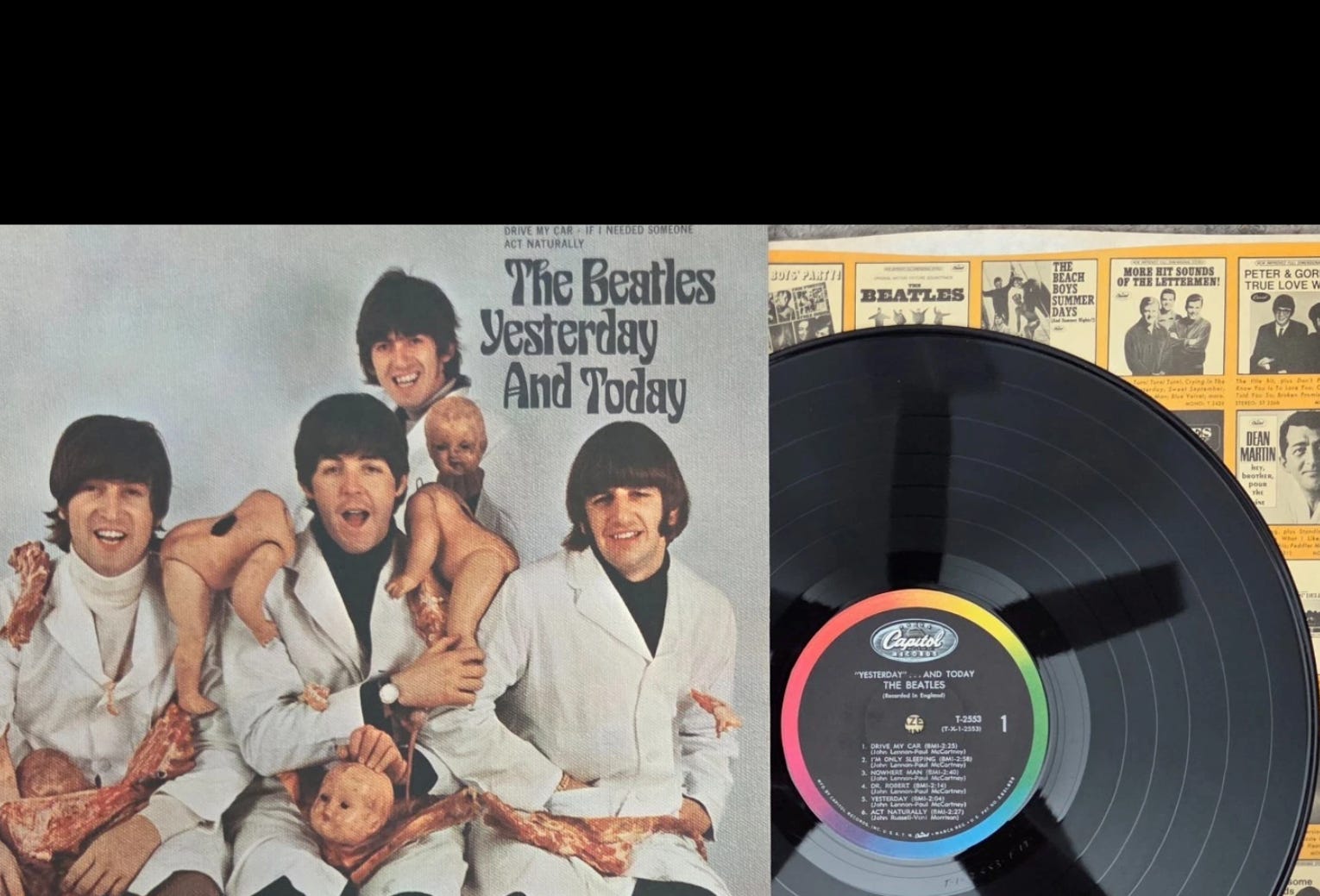
Item 3: A First State Butcher Cover, Still in Shrinkwrap
Current bid: $2,150.00 | View on eBay
The butcher cover is the most notorious album artwork in Beatles history, and the story behind it deserves its own essay—which Beatles Rewind recently featured. But for the uninitiated: in June 1966, Capitol Records released the US compilation album Yesterday and Today with cover art showing the Beatles in white butcher smocks, holding raw meat and dismembered baby doll parts. The image was photographer Robert Whitaker’s surrealist commentary on the band’s treatment as commodities. Capitol immediately recalled the album and pasted a new, inoffensive cover photo over the original. 🎭
A First State copy is one that was shipped and sold before the recall—before anyone pasted anything over anything. The original artwork, untouched, exactly as Capitol pressed it before the phone calls started. These are genuinely rare. A First State in Near Mint condition is the kind of item that serious Beatles collectors spend years looking for.
This copy is mono (Capitol T-2553), Near Mint, pressed at the Los Angeles factory (identifiable by the “6” on the back cover), still in original shrinkwrap. Four great corners. No creases. No seam splits. The vinyl is VG++ with Near Mint labels, and the inner sleeve is present and intact. It also comes with a copy of Capitol’s original recall letter—the document demanding the album’s return due to the controversial cover—which is a remarkable piece of contextual history to include (although the letter included with this item is a photocopy).
The seller calls it “the most popular Beatles collectible of all time,” and that’s not an unreasonable claim. First State Butcher Covers in this condition don’t appear often. 🌟
Item 4: The First-Day Please Please Me Gold Mono Pressing
Current bid: £490.00 (approx. $651.82) | View on eBay
This one is for the serious UK pressing collectors, and the detail that matters here is the matrix number: 1G. In UK Parlophone pressing terminology, 1G denotes a first-day pressing—the first copies off the press on the day of release. This particular copy of Please Please Me in gold mono was found in Liverpool, which adds a layer of provenance that no certificate of authenticity can replicate. 🎼
It is also the Dick James version—Dick James being the music publisher who signed Lennon and McCartney in early 1963, whose name appears on the earliest pressings of the album before the label details were updated. This is the earliest identifiable variant of the earliest Beatles album.
The condition is honest and detailed: graded Ex-/Ex-, a few light scuffs and superficial scratches that don’t affect play, with the Gold label described as beautiful with no rubbing and no spindle marks. The eBay seller played and recorded it—a charming piece of due diligence—and noted only a few light ticks on “Love Me Do” before the singing starts. Comes with the correct EMITEX inner sleeve, also graded Ex. The sleeve itself is in excellent shape with no tears or folds to the flaps.
For collectors who care about first pressings specifically, the 1G matrix on a Gold mono Please Please Me is about as close to the source as it gets. This is the album as it existed on March 22, 1963, the day it was released. 💛
Why These Four Matter
What connects these four items—beyond their Beatles provenance—is that each one captures a specific, unrepeatable moment in the band’s history. The signed promo card: the weeks before everything changed. The Beattles single: America hearing them for the first time, getting their name wrong. The butcher cover: the moment Capitol Records panicked and tried to make the controversy disappear. The 1G pressing: the first day Please Please Me existed as a physical object in the world.
Beatles collectibles are not just memorabilia. At their best, they are primary documents—objects that were physically present at moments that mattered, that have survived decades and are still circulating, still telling their stories to whoever picks them up next. 🏆