Hey Jude: The Story Behind The Beatles’ Epic Ballad
“Hey Jude” stands as one of The Beatles’ most iconic achievements—a seven-minute ballad that became their longest single ever and one of their biggest commercial successes. 🎵 Released in August 1968 as the first single on Apple Records, it topped charts worldwide and spent nine weeks at number one in the United States, tying the all-time record for longest run at the top of the American charts. The song’s unprecedented length, unusual structure with its extended four-minute coda, and communal “na-na-na” sing-along made it unlike anything in pop music at the time. And, more than just a commercial triumph, “Hey Jude” emerged from a moment of personal crisis within the Beatles’ inner circle and became a timeless anthem of hope and resilience.
The Inspiration
Paul McCartney wrote “Hey Jude” in the summer of 1968 to comfort John Lennon’s five-year-old son Julian during his parents’ divorce, after John left his wife Cynthia for Yoko Ono. 💔 McCartney composed the song while driving to visit Cynthia and Julian at their home in Weybridge—Cynthia later recalled being touched by his concern for their welfare and said she would never forget that he composed the song on the journey to see them. The original title was “Hey Jules” but Paul changed it to “Jude” because he thought it sounded better musically.
What makes the song even more layered is that McCartney was going through his own breakup at the time. The line “And anytime you feel the pain, hey Jude refrain” was actually a message to himself about releasing emotion rather than “playing it cool.” 🎹
Paul’s breakup was with the actress Jane Asher. They had been together for five years (1963-1968) and were engaged to be married. In mid-1968, Jane allegedly came home early from an acting job in Bristol and found Paul in bed with American scriptwriter Francie Schwartz. On July 20, 1968—just about a month after Paul wrote “Hey Jude”—Jane went on the BBC television show “Dee Time” and publicly announced their engagement was off, which apparently shocked Paul himself.
Interestingly, John Lennon thought the song was actually about him, telling interviewers that while Paul said it was for Julian, John always heard it as a message to himself during the tumultuous Yoko period—”He’s saying, ‘Hey, Jude – hey, John.’”
The Song’s Unusual Structure and Length
At over seven minutes, “Hey Jude” was the longest single to top the British charts at the time. 🕐 Musicologist Alan Pollack noted the unusual structure uses a “binary form that combines a fully developed, hymn-like song together with an extended, mantra-like jam on a simple chord progression.”
The song has a conventional verse-bridge structure for about 3 minutes and 8 seconds, then shifts to a coda that lasts nearly 4 minutes with the same static chord sequence repeating over and over. The coda consists of nineteen rounds of the chord progression with the “Na-na-na na” refrain gradually building in intensity. This was groundbreaking—the arrangement and extended coda encouraged many imitative works through to the early 1970s and essentially created a new template for how pop songs could be structured.
The Beatles’ record company, EMI, was skeptical about releasing such a long single. “DJs will never play it!” they protested. John Lennon’s response was simple: “They will if it’s us.” 📻 He was right—fifty years later, radio still plays the song in its full seven-minute glory.
“The Movement You Need Is On Your Shoulder”
When McCartney first played the song for John and Yoko at his home, he sang the line “The movement you need is on your shoulder” and then said “I’ll change that, it’s a bit crummy,” but Lennon insisted “You won’t, you know. That’s the best line in the song”. ✨ Paul had considered it just a placeholder lyric, but John recognized its enigmatic power—it was exactly the kind of line that could mean different things to different people.
Lennon later told interviewer David Sheff in 1980: “Hey Jude is a damn good set of lyrics and I made no contribution to that.” (Although, of course, John did insist that Paul keep the line “The Movement You Need is On Your Shoulder.)
This essay continues below. Click on the title of this product to view on Amazon. As an Amazon Associate, I earn from qualifying purchases.
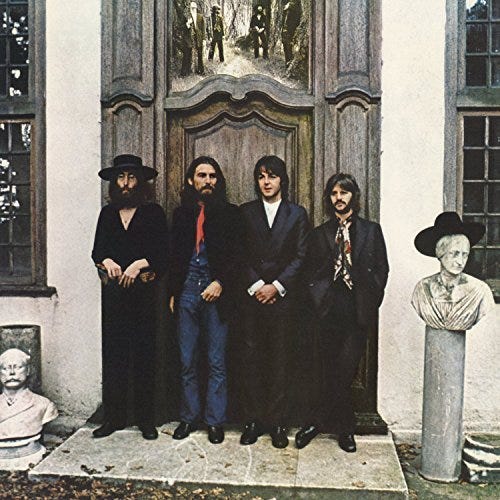
Hey Jude (The U.S. Album) by The Beatles
The Historic TV Performance
The promotional film was shot on September 4, 1968 at Twickenham Film Studios and first aired on David Frost’s “Frost on Sunday” show on September 8, 1968. 📺 It was later broadcast in the United States on The Smothers Brothers Comedy Hour on October 6. This marked the Beatles’ first live audience appearance in over a year—and that appearance was extremely unusual for them at that point in their career, as the band had essentially stopped performing live and retreated to the studio.
The performance was carefully staged with a 36-piece orchestra in white tuxedos and 300 extras who were brought in to sing along during the coda. 🎻 Students had handed out leaflets in the area to recruit participants, and the Beatles’ assistant Mal Evans invited fans from outside EMI Studios. The result was a diverse mix of young and old, students and parents, all joining together for that communal “na-na-na” finale that captured the song’s theme of optimism and togetherness.
The filming also marked a significant moment for the band: it was Ringo Starr’s return to the group after he had walked out during a White Album session following criticism of his drumming. 🥁 Despite the internal tensions, the performance gave fans a glimmer of hope that maybe the Beatles weren’t falling apart after all.
What the Other Beatles Thought
The recording sessions at Trident Studios led to an argument between McCartney and George Harrison over the song’s guitar part, though they ultimately worked it out. 🎸 The sessions were marked by discord within the group for the first time, partly due to Yoko Ono’s constant presence at Lennon’s side.
The specific disagreement about the guitar part was that George Harrison wanted to play guitar phrases that would echo or answer each of Paul’s vocal lines—a natural thing for a guitar player to do. But Paul felt this didn’t fit his vision for the song, which was to start simply with piano and vocals and gradually build up to the orchestral coda.
So, Paul simply vetoed George’s idea, saying “No, George, I really don’t hear it, I don’t think that’s gonna work.” The Beatles had an unofficial rule that whoever wrote the song was “the boss of the song” and had final say on the arrangement.
The fact that they put so much effort into the elaborate TV performance—and that the song became one of their biggest hits—suggests they all recognized they had something special, even during this turbulent period. The song went on to sell approximately eight million copies and is frequently included on music critics’ lists of the greatest songs of all time. 🏆
“Hey Jude” remains a testament to Paul McCartney’s gift for writing songs that speak to universal human experiences—comfort in hard times, encouragement to take risks in love, and the simple power of coming together to sing. What began as a message to a five-year-old boy dealing with his parents’ divorce became an anthem that has resonated with millions for over five decades.