What is “great” music? Everyone’s got an opinion. And while there’s no accounting for taste, let’s assume, for the moment, that popularity (the amount of listening) equals “great.”
Whatever our taste, “great” music must stand the test of time. Let’s say 10 years. By my math, that means anything released in 2016 or earlier is now officially entering “Oldies” territory. And when you look at the data right now, the results are shocking. Ladies and gentlemen, we aren’t just listening to the past, we are living in it. Oldies currently account for over 75% of all music consumed in the U.S. 🤯
But who is at the top of the mountain? Let’s dive in.
The “Immortals” of the Digital Age 🎧
When it comes to pure “volume”—how many times a song is clicked on a streaming app—three names consistently rise like cream.
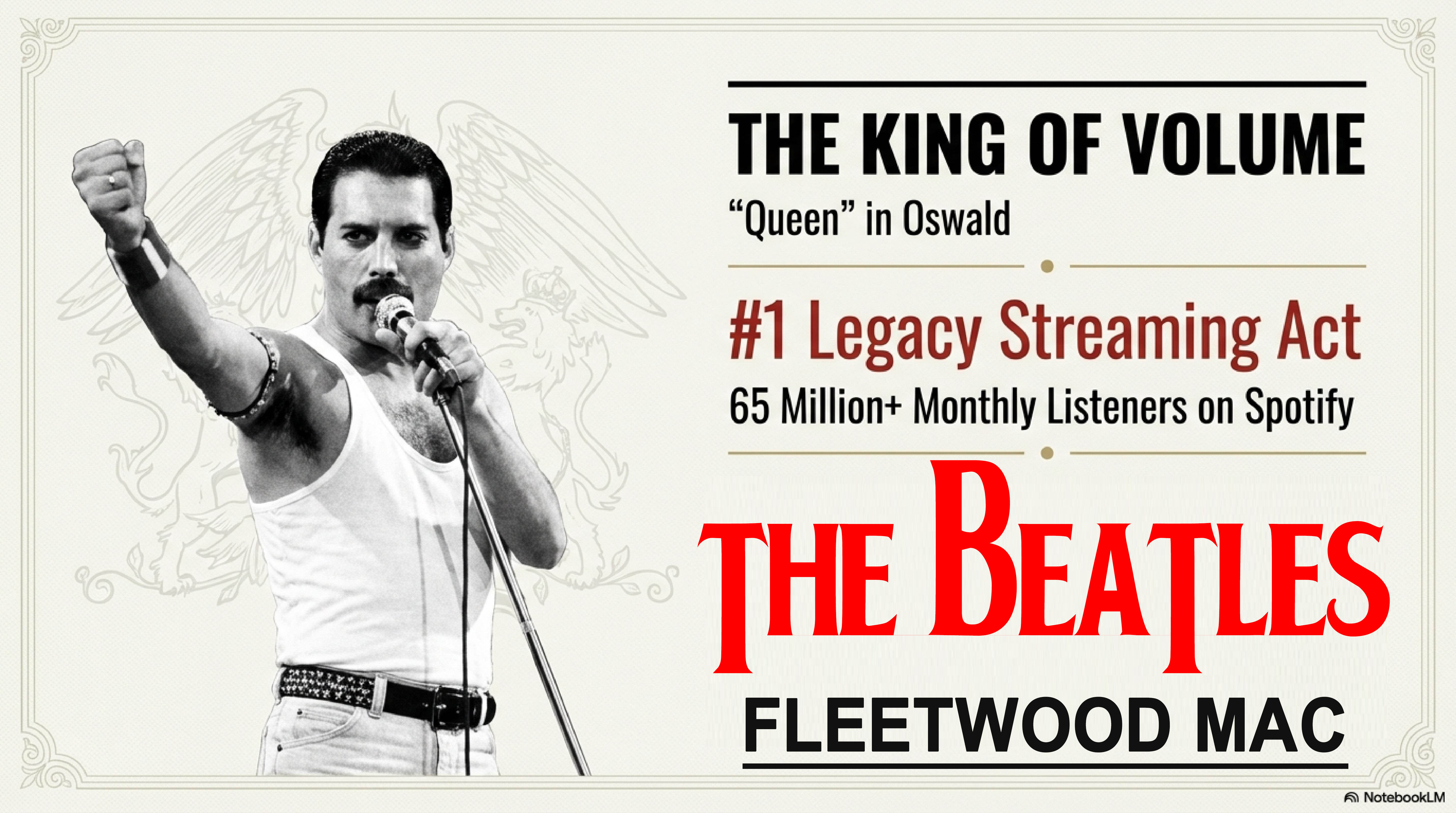
Queen: This is the big surprise, the perfect example of an act more popular today than during their creative zenith 40 years ago. Back in the ‘70s and ‘80s, Queen was a superstar band, but they weren’t necessarily “Number One.” They didn’t have the endless string of chart-toppers that the Beatles or the Bee Gees had. But today? They are the undisputed heavyweight champions of legacy streaming. 👑 With over 50 million monthly listeners on Spotify, they are outperforming almost everyone, including today’s pop megastars. Even though the legendary Freddie Mercury has passed away, original members Brian May and Roger Taylor have kept the flame alive by touring the world’s biggest stadiums with vocalist Adam Lambert.
The Beatles: They remain the gold standard. While they stream well (over 40 million monthly), their real power is in Physical Ownership. In a world where music is mostly “free,” the Beatles still move millions of dollars in physical merchandise every year, including vinyl. People don’t just want to hear Abbey Road, they want to hold it in their hands. 🍏 Not to mention the endless stream of books and documentaries— on average, between 20 and 40 new Beatles-related books are published each year.
Fleetwood Mac: Rumours is a permanent resident of the Top 20. It has spent over 600 weeks on the Billboard 200. Thanks to a unique “vibe” that 19-year-olds have adopted as their own, the Mac is a streaming juggernaut. Their superpower: The music never gets old.
The TikTok Time Machine 📱
TikTok has become the most powerful force for resurrecting old music since classic rock radio (and believe it or not, many kids today don’t even know what “radio” is). When Kate Bush’s “Running Up That Hill” appeared in Stranger Things in 2022, that 1985 song hit #1 on iTunes 37 years after release. And this pattern repeats constantly: Fleetwood Mac’s “Dreams” went viral in 2020 after a skateboarding-cranberry-juice video, resulting in a 127% spike in streams and re-entering the Billboard Hot 100 after 43 years. TikTok doesn’t just revive songs; it strips away the “oldness” and presents them as fresh discoveries. (Of course, it helps if the music is good.) 🛹
Cross-Generational Discovery 🎸
Now, something fascinating: Younger generations are bypassing their parents’ tastes and diving straight into their grandparents’ era. When I was a kid, nothing was more cringeworthy than hearing my parents’ muzak. But today, a 16-year-old might scroll past Taylor Swift to listen to Led Zeppelin, unaware that “Stairway to Heaven” is an antique. Algorithms don’t care about chronology: if you like guitar-heavy rock, Spotify serves you up Nirvana and Metallica alongside Greta Van Fleet. In a college dorm this semester, you might hear Dark Side of the Moon blasting down the hallway, not because it’s a “classic” but because it just slaps. And the kicker: discovering your favorite “new” song is actually 40 years old doesn’t diminish it—it enhances it. In a world of disposable content, that permanence is credibility. 🌙
The “New” Oldies (The 10-Year Graduates) 📱
Since we’re using the 10-year rule, we have to acknowledge the obvious: The “Oldies” club keeps getting bigger. We are now welcoming the heavyweights of the late 2000s and early 2010s.
Eminem is the poster child for this. He is currently one of the top 10 most-streamed artists period. His catalog from 20 years ago (like “Lose Yourself”) is pulling daily numbers that would make a modern pop star weep. 🎤
Then there’s Linkin Park and Nirvana. For the current generation, these aren’t just “alt-rock” bands; they are the “Classic Rock” of their era. Their 10-year-plus tracks are the foundation of the “Billion Stream Club,” proving that raw grit has a much longer shelf life than polished pop. 🤘
Albums vs. Songs: How We “Vote” 🗳️
Do people still listen to albums? Short answer: “yes and no.”
* The “Single Song” Stars: There are plenty of “Oldies” stars kept alive by one or two massive songs. Think of Journey with “Don’t Stop Believin’.” It’s a permanent anthem, but it doesn’t mean people are listening to Journey albums.
* The “Full-Experience” Legends: This is where the real “Popularity” lives. Artists like Pink Floyd, Led Zeppelin, and Michael Jackson still have people listening to their albums from start to finish. When someone puts on The Dark Side of the Moon, they aren’t looking for a “quick fix” for a minute or two, they are ready for a journey. 🚀
This is why Vinyl sales are such a vital metric nowadays. The turntable, once an endangered species, now carries enormous weight. The current top sellers aren’t just the newest hits; they include Bob Marley’s Legend and ABBA Gold. When a fan spends $35 on a record, they are making a permanent “vote” for that artist’s place in history (even when adjusted for inflation). 😂
The “Human Spark” 🌟
So, why are these oldies so popular relative to the new stuff?
I think it’s because of the “Human Spark.” Modern music is often “optimized” by computers to be perfectly catchy for a 15-second social media clip. It’s “perfect,” but it can feel a little sterile, stale, like two-day-old donuts.
The “Oldies”—whether they are from 1966 or 2016—were usually made by people in the same room, making music together, not on a Zoom call. You can hear the slight rasp in the vocal, the drumbeat that isn’t perfectly “on a grid,” and the raw emotion of a band trying to capture lightning in a bottle. In a world of digital perfection, we are desperate for something that sounds human.
The Verdict 🏆
If you look at the numbers, the “Most Popular” oldie isn’t just one band—it’s a feeling of permanence.
* If you measure by Daily Plays, the king is Queen.
* If you measure by Cultural Weight and Sales, nobody beats The Beatles.
* If you measure by Nostalgia, the winner is Eminem. Obviously, “Nostalgia” is a relative term.
Ultimately, the music that survives the 10-year test does so because it offers something that “current” music can’t: it has already stood the test of time. We live in a fast-moving world, but when we put on an “Oldie,” we are plugging into something that has already won the war. 🌟