Why does “Ticket to Ride” sound so heavy compared to everything else the Beatles recorded in early 1965? Seriously, put on “Eight Days a Week” or “I Feel Fine” or any other Beatles single from that era, then play “Ticket to Ride” immediately after. Something’s different. The drums hit harder, the chord changes so dramatic. The whole song has this weight, this thudding insistence that Beatles records simply didn’t have before. Most people can hear that something’s off—or rather, something’s incredibly on in a way that feels almost proto-heavy metal for 1965. But what exactly changed? 🤔
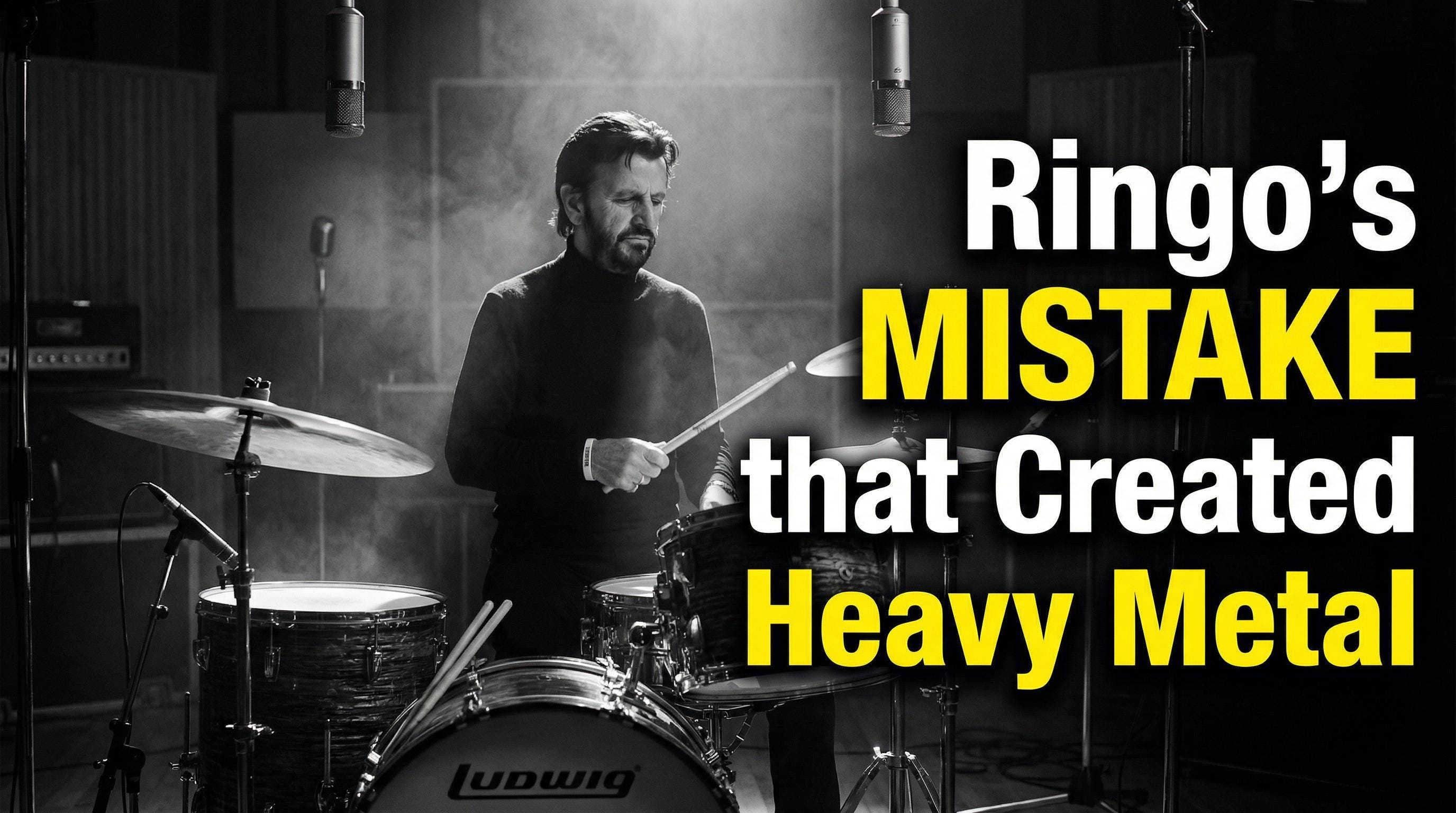
The answer is gloriously simple and perfectly Beatles: Ringo played it wrong. During the “Ticket to Ride” sessions at EMI Studios in February 1965, Ringo was supposed to play a standard rock beat, the kind of straightforward drumming that powered most Beatles songs up to that point. But either accidentally or instinctively—accounts vary on whether this was a mistake or a creative impulse—Ringo started playing the floor tom with the bass drum, creating that distinctive thudding sound that makes “Ticket to Ride” feel like it’s being played by a band twice as heavy as the actual Beatles. George Martin and the band liked the “mistake” so much they kept it. And in keeping it, they accidentally invented a drum sound that would help define hard rock for the next decade. 🎵
The Sound That Shouldn’t Have Worked
Here’s what Ringo did that was “wrong”: instead of playing a traditional rock beat with the snare drum providing the backbeat while the bass drum kept time underneath, he doubled up the floor tom and bass drum together. That floor tom—the largest drum in the kit, the one that sits on the floor and produces the deepest tone—became a primary voice rather than an occasional accent. The result is that thudding, almost tribal quality that drives “Ticket to Ride” forward with relentless momentum. Every beat lands with more weight than standard 1965 pop drumming allowed. 🥁
If you listen to the isolated drum stem from “Ticket to Ride” you can hear exactly what Ringo’s doing. That floor tom is absolutely front and center, providing a low-end thud that works in tandem with the bass drum to create a sound that’s less “pop band” and more “something heavier is coming.” The snare is still there doing its job, but the floor tom/bass drum combination is what you remember. It’s what makes the song sound like it’s being played by a band that’s discovered something darker and more powerful than “She Loves You.” 🔊
The technical side gets interesting when you consider how EMI Studios captured it. This was 1965, which means four-track recording with limited options for mixing. The microphone placement on Ringo’s drums had to capture that floor tom prominence without drowning out everything else. The drums in “Ticket to Ride” are mixed louder and more prominently than on previous Beatles records, which amplifies Ringo’s unconventional beat into something that dominates the entire sonic landscape. 🎚️
Compare “Ticket to Ride” to literally any other Beatles single from early 1965 and the difference is shocking. “Eight Days a Week” has perfectly competent, cheerful drumming that serves the song without calling attention to itself. “I Feel Fine” features Ringo’s solid backbeat. These are good drumming performances, but they’re playing the role drums traditionally played in pop music—keep time, provide rhythm, don’t overshadow the vocals. “Ticket to Ride” throws that playbook out. The drums aren’t just keeping time; they’re a primary melodic element, creating a hypnotic, almost menacing pulse that defines the song’s character as much as John’s vocals or George’s guitar. 🎸
The Pattern of Productive Mistakes
“Ticket to Ride” fits perfectly into a broader Beatles pattern of turning accidents into innovations that changed popular music. The most famous Beatles “mistake” is probably the feedback that opens “I Feel Fine,” recorded in October 1964 just a few months before “Ticket to Ride.” John leaned his guitar against an amp during a take, creating unintentional feedback that the band loved so much they deliberately incorporated it into the recording. But “I Feel Fine” was a gimmick, a cool effect at the beginning of a song. The “Ticket to Ride” drum mistake was structural; it changed how the entire song sounded and felt. ⚡
Later Beatles mistakes-turned-features include John’s backwards guitar solo on “Tomorrow Never Knows,” created when he accidentally played a tape backwards and realized it sounded better than the original. The Beatles developed a reputation for recognizing when “wrong” was actually better, when the accident revealed something more interesting than the plan. But “Ticket to Ride” represents something special because it came relatively early—this is still mop-top Beatles—and because the “mistake” wasn’t some studio trick but a fundamental change in how drums were played and recorded in rock music. 🎭
Why It Changed Everything
The influence of that “Ticket to Ride” drum sound on what came next in rock music cannot be overstated. When Led Zeppelin’s John Bonham created his legendary powerful drum sound, when Keith Moon of The Who played with that anarchic, tom-heavy style, when hard rock and heavy metal emerged with drums that were louder and more prominent than anything in early rock and roll—all of that traces back in part to Ringo’s “mistake” in February 1965. He proved you could make drums a primary sonic element rather than just rhythmic support, that the floor tom could be a lead instrument, that heavier and louder could be better. 🌟
What makes this particularly fascinating is that Ringo was never considered a flashy or technical drummer. The brilliance of the “Ticket to Ride” drum part is in its simplicity—it’s just a different choice about which drum to emphasize, executed with Ringo’s characteristic solid timekeeping. This proved that innovation didn’t require technical virtuosity; sometimes it just required playing the “wrong” way and having the confidence to keep it. That’s a very Beatles lesson: genius isn’t always about doing something incredibly complex, sometimes it’s about doing something simple differently. 🎯
The other crucial element is that “Ticket to Ride” wasn’t some experimental B-side—it was released as a single in April 1965 and went to number one in the UK and US. Millions of people heard this drum sound, and thousands of aspiring drummers tried to figure out how to replicate it. The influence rippled out immediately because the song was ubiquitous. Every band that covered “Ticket to Ride” had to contend with that drum part. The “mistake” became canon almost instantly. 📻
The Technical Breakdown
For the music production nerds, let’s get specific about what’s happening in those isolated “Ticket to Ride” drum stems. Ringo is playing a straightforward 4/4 pattern, but the floor tom is doubling the bass drum on beats one and three, creating that distinctive “thud-thud” pulse. The snare hits on two and four provide the traditional backbeat, but they’re almost secondary to the floor tom/bass drum combination doing the heavy lifting rhythmically. 🔧
The genius of this arrangement is that it creates forward motion that’s more insistent than a standard rock beat. That floor tom adds melodic content—it’s not just rhythm, it’s contributing to the song’s tonal palette in a way that typical drum parts didn’t. You can almost hum the drum part to “Ticket to Ride” because the floor tom gives it melodic contour. Try humming the drum part to “I Want to Hold Your Hand”—you can’t really, because it’s all rhythm without melodic distinction. That’s the difference Ringo’s “mistake” made. 🎶
If you compare the “Ticket to Ride” drum sound to what The Beatles would do just a year later with “Tomorrow Never Knows” or “Rain,” you can see the direct line of evolution. The willingness to make drums a primary sonic element, to feature them prominently, to think of drums as more than timekeeping—that all starts with “Ticket to Ride.” By the time they’re recording Revolver in 1966, the Beatles are doing wild things with drum sounds because they’ve learned that unconventional drum parts can define a song’s character. And it started with Ringo playing it “wrong” in February 1965. 🚀
Listen to what else was on the radio in early 1965: The Supremes’ “Stop! In the Name of Love,” The Temptations’ “My Girl,” Tom Jones’ “It’s Not Unusual.” All great songs, but none of them sound heavy. “Ticket to Ride” stands out as something different, something that hints at the louder, harder, heavier music that would dominate rock in the coming years. And the seed of that heaviness is Ringo’s “mistake.” 🎸
Fifty-plus years after “Ticket to Ride,” we’re still hearing the influence of Ringo’s “mistake.” Modern rock and metal drummers play with the floor tom as a primary voice because Ringo showed it could work. Producers mix drums prominently because George Martin demonstrated that drums could be featured rather than buried. Bands keep happy accidents in their recordings because the Beatles proved that mistakes could be better than perfection. 🎵
The story also serves as a useful corrective to the myth of Ringo as merely adequate. Yes, he wasn’t a technical virtuoso. Yes, he played simply and served the song. But simplicity executed with perfect instinct and timing is its own kind of genius. The “Ticket to Ride” drum part is simple—you could teach it to an intermediate drummer in five minutes—but having the instinct to play it that way in the first place, and having the taste to recognize it was working? That’s artistry. 🏆