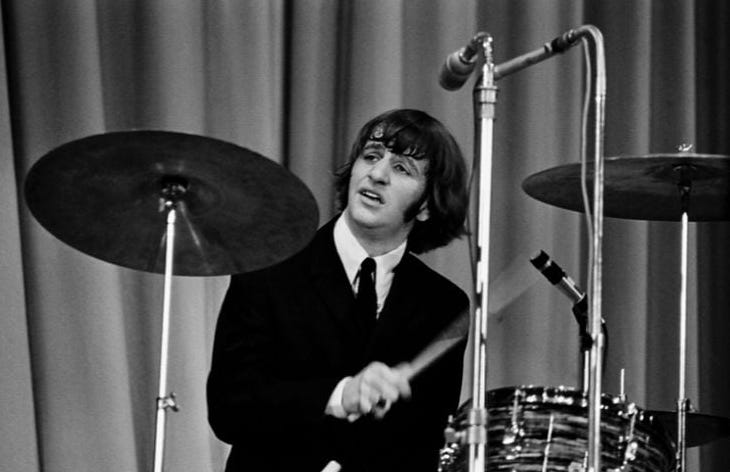
Ringo Starr occupies a peculiar place in rock history. As the drummer for the Beatles—arguably the most influential band of all time—he should be universally celebrated as one of the greats. Yet decades of jokes, misattributed quotes, and damning anecdotes have created a persistent narrative that Ringo was merely an adequate drummer, a lucky guy who happened to be in the right place at the right time. The most famous dismissal, attributed to John Lennon, claims Ringo “wasn’t even the best drummer in the Beatles.” There’s just one problem: Lennon never said it. The quote originated on a BBC comedy show in 1981 and has haunted Ringo’s reputation ever since.
So what’s the truth? Was Ringo Starr a good drummer, or was he just lucky enough to ride the Beatles’ coattails to fame? The answer, like most things in music, is more complicated—and more interesting—than simple yes or no.
The Quincy Jones Takedown 💥
Let’s start with the most damning evidence against Ringo’s drumming abilities. In 2018, legendary producer Quincy Jones gave a bombshell interview where he called the Beatles “the worst musicians in the world” and “no-playing motherf**kers.” About Paul McCartney’s bass playing, Jones was dismissive. About Ringo? He was downright brutal.
Jones recounted working with Ringo on his 1970 solo debut album Sentimental Journey, specifically on a cover of “Love Is a Many Splendored Thing.” The story Jones told became instant rock folklore:
“I remember once we were in the studio with George Martin, and Ringo had taken three hours for a four-bar thing he was trying to fix on a song. He couldn’t get it. We said, ‘Mate, why don’t you get some lager and lime, some shepherd’s pie, and take an hour-and-a-half and relax a little bit.’ So he did, and we called Ronnie Verrell, a jazz drummer. Ronnie came in for 15 minutes and tore it up. Ringo comes back and says, ‘George, can you play it back for me one more time?’ So George did, and Ringo says, ‘That didn’t sound so bad.’ And I said, ‘Yeah, motherf**ker because it ain’t you.’ Great guy, though.”
The image is devastating: Ringo struggling for three hours with something a professional jazz drummer knocked out in fifteen minutes, then being so oblivious to his own limitations that he didn’t even realize someone else had replaced him. Jones added that final “great guy, though” as if to soften the blow, but the damage was done.
This story spread like wildfire, seemingly confirming what Beatles skeptics had suspected all along—that Ringo was a competent timekeeper at best, hopelessly out of his depth when asked to play anything requiring real technical skill. Coming from Quincy Jones, who had worked with everyone from Count Basie to Michael Jackson, the critique carried enormous weight.
But there’s crucial context missing from this story. First, Jones was working on Sentimental Journey, an album of pre-rock standards that Ringo recorded as a tribute to his mother’s favorite songs. These were arrangements far outside Ringo’s wheelhouse—lush orchestral productions of songs from the 1940s and 50s, requiring a completely different drumming style than anything he’d played with the Beatles. Asking Ringo to drum on “Love Is a Many Splendored Thing” is like asking a blues guitarist to sight-read Paganini—the skill sets barely overlap.
Second, Jones was 84 years old when he gave this interview, and some of his other claims in the same conversation raised eyebrows among music historians. He also never worked with the Beatles as a group, only with Ringo on this single solo project. His sweeping dismissal of the Beatles’ musicianship was based on extremely limited exposure to their work.
This essay continues below:
The Moment Paul Knew ✨
If you want to understand Ringo’s value as a drummer, don’t ask a jazz producer who worked with him once on material completely outside his style. Ask the people who made history with him. Ask Paul McCartney.
In 2015, Paul inducted Ringo into the Rock & Roll Hall of Fame as a solo artist. During his speech, he told a story about the exact moment he knew Ringo was the perfect drummer for the Beatles. It’s worth quoting in full:
“One night, our drummer then, Pete Best, wasn’t available, so Ringo sat in. I remember the moment. Pete was great and we had a great time with him, but me, John, and George — God bless ‘em — were on the front line singing, which we usually were, and behind us, we had this guy we’d never played with before. And I remember the moment when he started playing, I think it was Ray Charles’ ‘What’d I Say,’ and most of the drummers couldn’t nail the drum part. It was a little difficult to do, but Ringo nailed it. Ringo nailed it. And I remember the moment, just standing there and looking at John and then looking at George, and the look on our faces was all like ‘F***. What is this?’ And that was the moment. That was the beginning, really, of the Beatles.”
This wasn’t nostalgic exaggeration. “What’d I Say” has a challenging, cymbal-heavy rhumba-style beat that trips up drummers who lack both technical skill and feel. Ringo didn’t just play it adequately—he nailed it so perfectly that three experienced musicians who had been playing together for years all stopped and looked at each other in amazement.
Paul elaborated in the Beatles Anthology:
“We really started to think we needed ‘the greatest drummer in Liverpool.’ And the greatest drummer in our eyes was a guy, Ringo Starr, who had changed his name before any of us, who had a beard and was grown up and was known to have a Zephyr Zodiac.”
Notice Paul’s phrasing: “the greatest drummer in Liverpool.” Not “a drummer who was available.” Not “someone good enough.” The greatest. And this wasn’t just Paul’s opinion—it was the consensus among Liverpool musicians. Ringo had already established himself as the best drummer in the city’s thriving music scene, playing with Rory Storm and the Hurricanes, one of Liverpool’s top bands.
More recently, Paul told MOJO magazine something even more revealing: “Ringo was the perfect drummer for The Beatles. But why? Impossible to say why – he just was.”
That “impossible to say why” is crucial. Paul, one of the most musically sophisticated popular songwriters of the 20th century, can’t fully articulate what made Ringo perfect for the Beatles. It wasn’t just technical ability—it was something deeper, something about feel, taste, and musical intelligence that defies easy explanation.
The Pete Best Problem 🚪
To understand what Ringo brought to the Beatles, you need to understand who he replaced. Pete Best was the Beatles’ drummer from August 1960 to August 16, 1962—nearly two years of the band’s formative period. He played with them through their grueling Hamburg residencies, where they performed eight-hour sets in seedy German clubs. He was there for the Cavern Club shows that built their Liverpool following. He was handsome, popular with female fans, and by most accounts, a decent guy.
And John Lennon, Paul McCartney, and George Harrison couldn’t wait to get rid of him.
On August 16, 1962, manager Brian Epstein called Best into his office and fired him. Two days later, Ringo Starr played his first official show as a Beatle. The timing was brutal—just as the Beatles were about to sign their first recording contract and release their debut single. Best went from being on the verge of stardom to unemployed in a single conversation.
Why? The official story involves producer George Martin telling the Beatles after their Parlophone Records audition that he liked what he heard but would use a session drummer for recordings. Martin wasn’t confident in Best’s ability to handle studio work. But this doesn’t fully explain why the Beatles didn’t just use Best for live shows and session drummers for records—they could have, but they chose to fire him completely.
John Lennon, never one to sugarcoat things, explained it bluntly in a later interview:
“By then we were pretty sick of Pete Best too because he was a lousy drummer, you know? He never improved... We were always gonna dump him when we could find a decent drummer. By the time we’d got back from Germany, we’d trained him to keep a stick going up and down. He couldn’t do much else. He looked nice and the girls liked him so that was all right... but we were always going to dump him when we could find a decent drummer.”
Paul was more diplomatic but no less clear:
“Pete had never quite been like the rest of us. We were the wacky trio, and Pete was perhaps a little more sensible; he was slightly different from us; he wasn’t quite as artsy as we were.”
George Harrison put it most simply:
“Pete kept being sick and not showing up for gigs so we would get Ringo to sit in with the band instead, and every time Ringo sat in, it seemed like ‘this is it.’ Eventually we realized, ‘We should get Ringo in the band full time.’”
The contrast between the Beatles’ assessment of Pete Best and their reaction to Ringo is stark. With Best, they were stuck with a drummer who was adequate for club gigs but couldn’t grow with them musically. With Ringo, they immediately felt something click into place. The rhythm section suddenly worked. The band suddenly felt complete.
This matters because it demolishes the “Ringo was just lucky” narrative. The Beatles fired their drummer and specifically recruited Ringo away from a more successful band (Rory Storm and the Hurricanes were actually better-known than the Beatles at the time). Ringo was hesitant to join because he had security with the Hurricanes. The Beatles had to convince him. This wasn’t a desperate grab for any available drummer—it was a calculated decision to bring in the best drummer they could get.
What the Drummers Say 🎵
If you want to know whether someone is a good drummer, ask other drummers. The verdict from Ringo’s peers is remarkably consistent and overwhelmingly positive.
The Percussive Arts Society—the premier organization for percussion professionals—inducted Ringo into their Hall of Fame. Their statement noted that “countless drummers” cited the Beatles as inspiring “their passion for drums when they first encountered the music of the Beatles.”
Drummer Steve Smith provided crucial context for understanding Ringo’s impact:
“Before Ringo, drum stars were measured by their soloing ability and virtuosity. Ringo’s popularity brought forth a new paradigm in how the public saw drummers.”
This is profound. Ringo changed what it meant to be a great drummer in popular music. Before him, the standard was Buddy Rich or Gene Krupa—virtuosos who took extended solos and dazzled audiences with technical displays. Ringo established that a great drummer could be measured by how perfectly they served the song, by the taste of their choices, by the feel they created. He made “less is more” not just acceptable but desirable.
Gregg Bissonette, another respected drummer, detailed Ringo’s specific innovations:
“He subscribed to the ‘less is more’ philosophy throughout the verses, and when there was a place for a fill, they said a lot. Like on ‘Help,’ ‘Ticket to Ride,’ or ‘Tell Me Why,’ they were often double stops at very brisk tempos. Ringo was also one of the first drummers I saw to bail on the traditional grip. For years drummers had to play everything traditional grip... Ringo brought the matched grip into the mainstream.”
That last point is historically significant. Matched grip—where both hands hold the sticks the same way—is now standard, but in the early 1960s, most drummers still used traditional grip, a holdover from military marching bands. Ringo’s adoption of matched grip influenced countless drummers and became the new standard.
Ken Micallef and Donnie Marshall, authors of Classic Rock Drummers, wrote: “Ringo’s fat tom sounds and delicate cymbal work were imitated by thousands of drummers.”
Notice what’s being praised here: not technical virtuosity, but sound, feel, and musical choices. Ringo tuned his drums lower than was fashionable, creating a fuller, rounder sound. His cymbal work was subtle and tasteful. His fills were melodic and memorable rather than flashy. He played for the song, not for himself.
The Man on the Riser 🎪
There’s a visual element to Ringo’s impact that’s easy to overlook but symbolically crucial. When the Beatles played large venues during the height of Beatlemania, Ringo wasn’t positioned on the same level as the other three Beatles. He was elevated on a riser, placed high above the stage floor where everyone in the arena could see him.
This wasn’t standard practice at the time. Most bands kept their drummers tucked in the back, barely visible behind the frontmen. But the Beatles put Ringo up high, literally elevating him to equal visual prominence with John, Paul, and George. The message was unmistakable: the drummer matters. The drummer is essential. The drummer deserves to be seen.
That riser was a physical manifestation of what the Beatles understood musically—that Ringo wasn’t just keeping time in the background, he was a full member of the band whose contribution was worthy of the spotlight. Millions of fans watching the Beatles perform saw Ringo elevated above the stage, and the statement was clear: in this band, the drummer is just as important as anyone else. It was a revolutionary statement that changed how rock bands thought about stage presence and the role of the rhythm section. The Beatles didn’t hide their drummer—they literally put him on a pedestal.
The Technical Reality 🔧
Here’s something that should settle the “was Ringo technically competent” question: Mark Lewisohn, who documented every Beatles recording session, noted in The Complete Beatles Recording Sessions that “there were fewer than a dozen occasions in the Beatles’ eight-year recording career where session breakdowns were caused by Starr making a mistake, while the vast majority of takes were stopped due to mistakes by the other Beatles.”
Read that again. In eight years of recording, including increasingly complex songs that pushed studio technology to its limits, Ringo screwed up fewer than twelve times. The Beatles recorded hundreds of songs. They tried multiple takes of almost everything. And the drummer was almost never the problem.
This directly contradicts the “Ringo couldn’t play” narrative. A technically incompetent drummer would be constantly causing takes to break down, requiring additional attempts, slowing down the recording process. Ringo did the opposite—he was the most reliable Beatle in the studio.
Consider what Ringo actually played on Beatles records:
* “Rain” (1966): Ringo’s personal favorite, featuring complex polyrhythms, open hi-hat flourishes, and a groove so perfect that the song was played backward on parts of the recording and still sounds musical.
* “Come Together” (1969): That iconic opening—a simple hi-hat pattern that creates hypnotic momentum. Any drummer can hit a hi-hat, but creating that specific feel is harder than it sounds.
* “A Day in the Life” (1967): The orchestral chaos of this song builds to an alarm clock moment where Ringo comes in with fills that are simultaneously bizarre and perfect, matched to the song’s surreal mood.
* “Tomorrow Never Knows” (1966): Ringo’s drumming on this experimental track—heavy, tribal, hypnotic—helped establish the psychedelic sound. It doesn’t sound like anything that came before it.
* “Ticket to Ride” (1965): That drum intro is one of the most recognizable in rock history. Simple, but try playing it with that exact feel and you’ll understand the difference between competence and mastery.
These aren’t the performances of a mediocre drummer keeping simple time. These are the performances of someone making sophisticated musical choices, creating sounds that hadn’t existed before, serving songs that were pushing the boundaries of what popular music could be.
The “Natural Genius” Factor 🌟
Paul McCartney described Ringo as having “natural genius,” which might sound like faint praise—the kind of thing you say about someone who can’t read music but has good instincts. But consider what Paul meant in context. Ringo was self-taught. He didn’t have formal training. He couldn’t read music (neither could Paul, John, or George, for that matter). Everything he knew came from listening, feeling, and experimenting.
And yet he created drum parts that are still being analyzed and imitated sixty years later.
That is a form of genius—not the technical genius of a classical virtuoso, but the musical intelligence of someone who instinctively understands what a song needs. Ringo had what drummers call “ears”—the ability to hear the whole picture and place himself perfectly within it.
Ringo himself was remarkably humble about his abilities. He once said his favorite Beatles track was “Rain” because “It’s the first time I think I was playing that ‘snatch’ hi-hat [’open’ punctuations]. And what helped me to do that was that I was born left-handed. I write right-handed, but if I throw or play cricket or do anything physical, I’m left-handed. So I’m sort of this left-handed guy with a right-handed kit.”
This is why Ringo’s fills often moved in unusual directions—he was a left-handed person playing a right-handed setup, creating patterns that felt slightly “wrong” but incredibly distinctive. That’s not a limitation—it’s a signature, a sound no one else could replicate.
Serving the Song 🎼
Perhaps the best defense of Ringo’s drumming comes from an unexpected source—critics who point out that you rarely notice Ringo’s drumming on Beatles records. This is framed as criticism: the drumming is so unremarkable it fades into the background.
But one writer for Varsity magazine turned this on its head:
“When I listen to The Beatles, I almost never notice Ringo’s drumming, and that’s a good thing: his drumming never distracts you from the most important part of the song, the singing. In this respect, he is a much better drummer and musician than some more technically proficient than him.”
This is the essence of Ringo’s genius. The Beatles were a songwriting band, not a jamming band. The vocals and melodies were paramount. Ringo understood that his job was to create a foundation that made everything else shine. He could have played flashier. He could have taken more solos. He could have demanded more space in the mix. Instead, he played exactly what each song needed and nothing more.
Consider what would have happened if the Beatles had recruited a technically superior drummer who wanted to show off their chops. The songs would have been worse. The balance would have been wrong. The Beatles worked because every member understood their role, and Ringo’s role was to be the heartbeat—steady, reliable, perfect, but never the focal point.
That’s not a limitation. That’s wisdom.
The Verdict ⚖️
So is Ringo Starr a good drummer? The question itself is flawed. Ringo wasn’t just “good”—he was the perfect drummer for the most important band in rock history, and his influence fundamentally changed how drummers thought about their role in popular music.
Could he play complex jazz charts? Apparently not, if the Quincy Jones story is accurate. Would he win a drum-off against Neil Peart or John Bonham? Almost certainly not. Was he the most technically proficient drummer working in the 1960s? Definitely not.
But ask any of the thousands of drummers who cite Ringo as their inspiration. Ask Paul McCartney, who knew instantly that Ringo transformed the Beatles. Ask professional drummers who inducted him into the Hall of Fame. Ask anyone who’s tried to play “Come Together” or “A Day in the Life” and discovered that what sounds simple is actually fiendishly difficult to get right.
Ringo Starr was exactly as good as he needed to be for the music he was making. He served the songs with taste, intelligence, and creativity. He innovated in ways both technical (matched grip, drum tuning) and musical (redefining what great rock drumming could be). He was reliable, professional, and musically intelligent enough to play on songs that ranged from “I Want to Hold Your Hand” to “Tomorrow Never Knows” without ever being the weak link.
The fact that we’re still arguing about this sixty years later—that the Quincy Jones anecdote matters enough to discuss, that people feel compelled to defend or attack Ringo’s abilities—is itself proof of his significance. Nobody argues about whether mediocre musicians were any good. We argue about Ringo precisely because he mattered, because the Beatles mattered, because what he did continues to influence how we think about rhythm in popular music.
Was Ringo even the best drummer in the Beatles? Well, he was the only drummer in the Beatles when it counted, and that band changed the world. That seems like answer enough. 🥁✌️