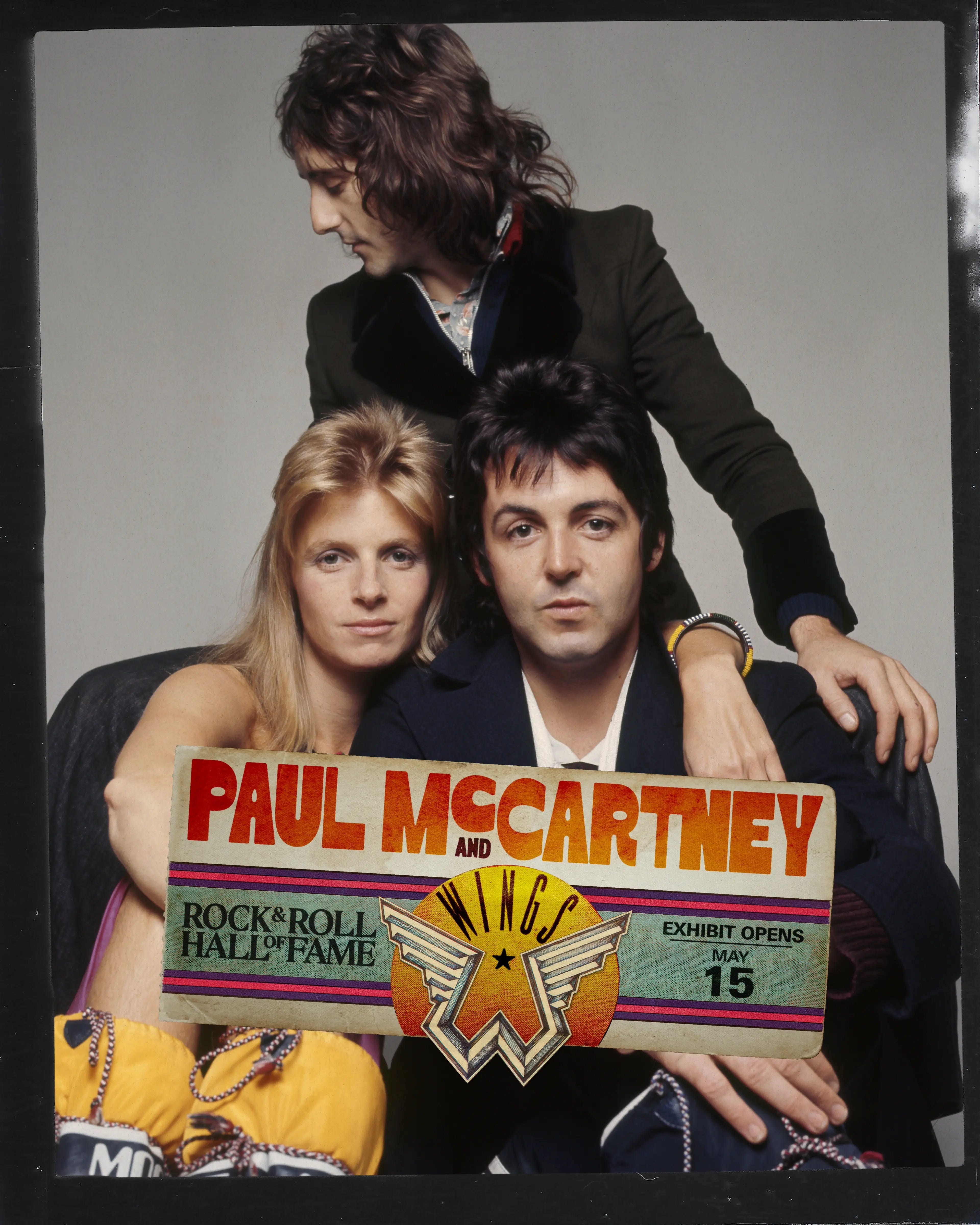
The Rock and Roll Hall of Fame will debut “Paul McCartney and Wings” on May 15th, 2026—the first major museum exhibition dedicated to exploring Wings’ decade-long journey from 1970 through 1981.
It’s about damn time. For years, Wings has been treated as rock history’s awkward stepchild: too successful to ignore, too uncool to celebrate properly, forever overshadowed by what came before. This exhibition, featuring never-before-displayed artifacts from Paul’s personal archives, handwritten lyrics, instruments from recording sessions, and previously unseen photography, finally gives Wings the serious institutional recognition the band earned but rarely received.
Here’s the context younger fans might not know: Wings dominated 1970s commercial radio with seven top 10 hits including “Band on the Run,” “Listen to What the Man Said,” “Silly Love Songs,” and “With a Little Luck.” This wasn’t Paul desperately clinging to relevance—this was a legitimate juggernaut that sold millions of albums and filled stadiums. The exhibition traces this arc of reinvention, from Paul’s self-titled 1970 debut through Wings’ formation to the band’s 1981 dissolution. 🏆
The timing couldn’t be better. Morgan Neville’s documentary Man on the Run will debut February 27th on Amazon Prime Video. The documentary focuses on Wings’ 1970s ascension, particularly the dramatic Lagos sessions that produced Band on the Run—one of the craziest near-disasters in rock history.
Obviously, Paul looks back at Wings’ run with great fondness, recently telling Rolling Stone:
Starting from scratch after the Beatles felt crazy at times. There were some very difficult moments, and I often questioned my decision. But as we got better I thought, ‘OK, this is really good.’ We proved Wings could be a really good band.”
Why This Exhibition Actually Matters
The Rock Hall promises “the most extensive collection of items from Paul’s personal archives to be made accessible to the public,” including instruments, stage clothing, handwritten lyrics, original artwork, and tour memorabilia. Paul’s exhibition is taking over the space previously occupied by “Bon Jovi: Forever” which closed recently after a two-year run at the Cleveland museum.
But what makes this significant isn’t just the artifacts themselves—it’s what they represent about who gets credit for defining the 1970s sound.
After the Beatles’ breakup, the narrative stuck for decades that John Lennon had been the major creative force behind the Beatles, and Paul was the lightweight, dragging his untalented wife around. Never mind Wings’ album sales. Never mind Band on the Run is legitimately brilliant. Never mind “Live and Let Die” became one of the decade’s most iconic performances. The critical consensus dismissed Wings as inconsequential, and that judgment persisted for forty years.
This exhibition challenges that narrative not through argument but evidence: the handwritten lyrics demonstrating Paul’s craft, the instruments that created those massive hits, the tour memorabilia from sold-out stadium shows. You can’t examine Wings’ creative output and commercial success while maintaining this was some vanity project. This was a major band that defined a significant chunk of 1970s rock, whether critics admitted it or not. Any objective critic who looks back at Paul’s body of solo work has to concede this: he was prolific, successful, and on the whole, pretty darned good. 🎯
Paul was inducted into the Rock Hall twice: as a Beatle in 1988 and as a solo artist in 1999. Wings has not been inducted separately.
What Happened in Lagos (A Masterpiece Made from Chaos)
In 1973, McCartney’s first three Wings albums had received brutal critical reception, and the pressure to deliver something great was existential. Paul’s solution: record in Lagos, Nigeria—partly for tax advantages, partly to immerse himself in a different musical culture. Then everything went sideways. 🌍
Just before sessions began, guitarist Henry McCullough and drummer Denny Seiwell quit, leaving McCartney with only Linda and guitarist Denny Laine. The skeletal lineup forced Paul to play nearly every instrument himself. Shortly after arriving, Paul and Linda were mugged at knifepoint—the thieves stole his notebooks of lyrics and demo tapes, meaning Paul had to reconstruct everything from memory. The studio equipment malfunctioned constantly. The heat was unbearable. Nigerian musician Fela Kuti publicly accused him of cultural appropriation. Political unrest simmered throughout the city. 🌡️
The smart move would’ve been abandoning the project and flying home. Instead, Paul sweated through his clothes playing bass, then drums, then piano, then guitars, overdubbing parts until the album took shape. Band on the Run topped charts worldwide, won a Grammy, and silenced critics who’d written him off. Sometimes the best revenge is a triple-platinum album that people discuss fifty years later. And that story—that moment of crisis and creative determination—deserves museum recognition alongside the actual artifacts from those sessions. 💔
Linda McCartney’s Contributions (The Historical Record Needs Correction)
One aspect the exhibition must address properly is Linda McCartney’s role—a subject distorted by decades of sexist criticism and lazy assumptions. Critics dismissed Linda as dead weight who only had a career because she married a Beatle. The Man on the Run documentary shows Linda not just playing keyboards and singing backing vocals, but actively shaping creative decisions.
There’s footage of Paul struggling with vocal arrangements for “Band on the Run,” and Linda suggests a different approach, demonstrating a vocal line Paul builds upon. The finished version blends both their voices so seamlessly it’s impossible to separate them.
If the Rock Hall exhibition includes artifacts showing Linda’s contributions—her keyboard parts, her vocal arrangements, her creative input—it would help correct the historical record. Linda McCartney was more than “Paul’s wife in the band.” She was a legitimate creative collaborator whose contributions have been systematically undervalued. 💕
The Immersive Experience (Making History Feel Alive)
The exhibition promises an “immersive experience incorporating archival video, audio and images,” which matters more than it might seem. Rock history shouldn’t be experienced like Renaissance paintings—reverently staring at static objects behind glass. Rock history should feel chaotic, sweaty, dangerous, thrilling. You should hear the music while examining artifacts. You should see footage of Paul working out Lagos arrangements while viewing the actual instruments he played.
This is particularly crucial for Wings because so much of the story is about process—about rebuilding from scratch, about band members who came and went, about creative evolution from simple rock to complex arrangements. Static artifacts alone can’t tell that story. You need to hear how the sound evolved album by album. You need concert footage to understand why they filled stadiums. 🎬
Why Now? (The Slow Process of Reassessment)
Paul’s documented his career for decades, each project serving different purposes. Wingspan (2001) attempted rehabilitating Wings’ reputation. McCartney 3, 2, 1 (2021) with Rick Rubin explored songwriting craft. The Man on the Run documentary focuses specifically on crisis—on that 1973 moment when everything was collapsing and Paul had to prove himself. And now this Rock Hall exhibition synthesizes everything, presenting Wings not as a Beatles footnote but as significant creative achievement in its own right.
This timeline shows the slow process of historical reassessment. Wings didn’t suddenly become good retroactively—the albums were always there, the hits were always massive, the creative achievement was always real. What changed is the critical lens through which we view the 1970s and the willingness to take Wings seriously rather than dismissing them as uncool. 📖
What You’ll Actually See (If You Make the Trip)
The exhibition opens May 15th, and will display Paul’s basses, guitars, and keyboards. You’ll see clothing worn by the band, documenting their visual evolution from simple rock band to elaborate stage productions. You’ll see handwritten lyrics revealing Paul’s creative process. You’ll see original artwork and tour memorabilia from stadium shows. You’ll see previously unseen photography documenting the band’s decade-long journey. 📷
But most importantly, you’ll see evidence that Wings mattered—that this wasn’t some vanity project or desperate attempt at relevance, but a legitimate creative enterprise that produced remarkable music under often impossible circumstances. You’ll see proof that Paul McCartney didn’t coast on Beatles nostalgia, but fought to prove he could still create something extraordinary. And examining those artifacts, understanding that determination and creative resilience, should be absolutely riveting. 🌟
Finally, this exhibition proves Wings was the real deal. The Rock Hall got this one right.