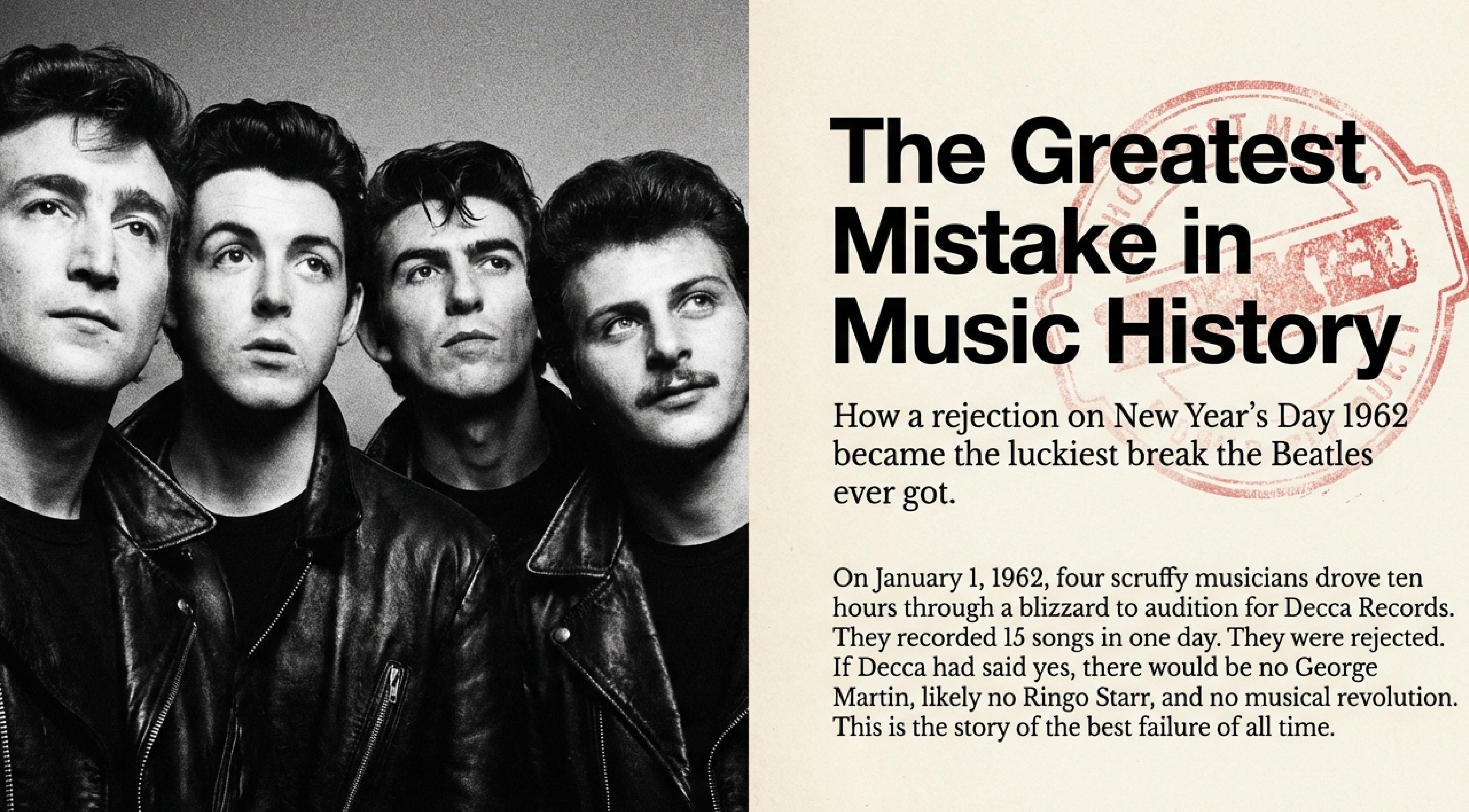
Here’s a story that should make anyone who’s ever bombed a job interview feel a little better about themselves: On January 1, 1962, four scruffy musicians from Liverpool drove ten hours through a blizzard to audition for one of Britain’s biggest record labels. They were nervous, sleep-deprived, and forced to use unfamiliar equipment. They recorded fifteen songs in a single afternoon. And then they got rejected cold. 🎸
That band, of course, was The Beatles. And the rejection? It’s gone down as one of the most catastrophic mistakes in the history of the music business. Decca Records not only passed on the Fab Four, but declared that they had “no future in the music business.” (Oops 😆).But hindsight is always 20/20, huh?
And the delicious twist: getting turned down by Decca might have been the best thing that ever happened to them. Because if Decca had signed them that day, we might never have gotten the Beatles as we know them. No George Martin. Possibly no Ringo Starr. And perhaps no revolution in popular music.
So how did four future legends end up playing what would become the most famous failed audition of all time? Buckle up. This is a story about ambition, bad luck, worse timing, and the kind of persistence that changes the world. ✨
This is Part 1. Part 2 comes tomorrow.
Act One: Brian Epstein’s Mission Impossible
Let’s rewind to late 1961. The Beatles had been together for years, playing dingy clubs in Liverpool and rowdy bars in Hamburg, Germany. They’d built a devoted local following, but outside of Merseyside, they were still nobodies. They needed two things desperately: a proper manager and a recording contract. In November 1961, they got the first one when Brian Epstein walked into their lives.
Epstein was an unlikely savior. He managed his family’s record store, NEMS (North End Music Stores), one of the biggest in Northern England, but he’d never managed a band before. He had no real show-business connections. But he instantly realized something more valuable: unshakeable belief that the Beatles were going to be huge. And he did had some leverage in the music biz—as the manager of a major record retailer, the labels needed to keep him happy.
First, Epstein made securing a recording contract his number-one priority. And he threw himself into it with the fervor of a man possessed. He started making trips to London, knocking on every door he could find. And getting rejected. A lot.
Columbia said no. His Master’s Voice (HMV) said no. Pye, Philips, and Oriole all passed. It must have been maddening. Here was Epstein, convinced he was managing the next big thing, and nobody in London would give him the time of day.
But then, in early December 1961, he got a foot in the door at Decca, one of the two biggest labels in the United Kingdom (the other being EMI). And Decca actually agreed to send someone up to Liverpool to see the band perform live.
Enter Mike Smith, a Decca A&R assistant. On December 13, 1961, Smith made the trip north to watch the Beatles perform at the Cavern Club, the cramped, sweaty basement venue where they’d become local legends. Smith was impressed—not necessarily by the music itself, but by the audience reaction. The kids were going ape for the Beatles. That was enough to convince him they were worth a studio test.
So Smith offered them an audition. New Year’s Day, 1962. 11 am. Decca Studios in West Hampstead, London.
The Beatles were thrilled. Epstein was confident. This was it—their big break was finally coming.
They had no idea what they were walking into. 🚗💨
Act Two: The Worst Road Trip Ever
New Year’s Eve, 1961. While most of Britain was preparing to ring in 1962 with champagne and celebrations, four young musicians were climbing into a battered van for a nightmare journey to London.
Neil Aspinall—their driver and roadie (and future head of Apple Corps, but that’s another story)—was behind the wheel. John Lennon, Paul McCartney, George Harrison, and drummer Pete Best piled in with all their gear. Epstein, ever the gentleman, chose to travel separately by train. Much more civilized. 🚂
The trip from Liverpool to London should have taken four, maybe five hours. But this was New Year’s Eve. In a snowstorm. And Neil got lost.
The journey took ten hours.
Imagine being crammed in a freezing van, navigating through a blizzard, knowing you have the most important audition of your life the next morning. The Beatles finally rolled into London around 10 pm and checked into the Royal Hotel in Russell Square (Woburn Place). Despite the “royal” name, it was far from palatial—just a basic hotel for a band that was still scraping by.
New Year’s Eve in London. Naturally, the Beatles decided to explore. They asked their way to Soho and ended up in a pub near Trafalgar Square, where they drank in the New Year with strangers. John Lennon later remembered arriving “just in time to see the drunks jumping in the Trafalgar Square fountain.” 🍺
Not exactly the ideal preparation for an audition that could make or break their careers. But hey—they were young, excited, and in the big city. How could they resist?
As Pete Best recalled in a 2012 interview with the BBC:
Brian Epstein read the riot act to us before we went down—you know, ‘be good little boys, you mustn't be out after ten o'clock, you know.’ And there we were in the middle of Trafalgar Square, drunk as skunks, you know, the advent of New Year's Day.
Act Three: New Year’s Day at Decca
January 1, 1962. The Beatles show up at Decca Studios at 165 Broadhurst Gardens in West Hampstead, ready to play their hearts out. The studio itself had history—this was Studio 2, the same room where Lonnie Donegan had recorded “Rock Island Line” in 1954, the song that had inspired virtually every British musician of the era, including the Beatles themselves. If they’d known that detail, it might have given them courage. Or made them even more nervous. 🎙️
They arrived at 10 am, an hour early. Eager. Prepared. Ready to rock.
Mike Smith was not.
Smith rolled in late, looking rough. He’d spent New Year’s Eve partying hard—and it showed. The poor guy was nursing a brutal hangover. Worse, he was still recovering from injuries he’d sustained in a car crash three days before Christmas. Cuts and bruises covered his face.
The Beatles were not amused. They’d driven ten hours through a blizzard, spent the night in a mediocre hotel, and now the guy who was supposed to be evaluating them couldn’t even show up on time? Not a great start. 😤
But it gets worse.
Smith took one look at the Beatles’ equipment and declared it “substandard.” He insisted they use Decca’s in-house amplifiers instead of their own gear. If you know anything about musicians, you know this is a nightmare. Your equipment is your sound. It’s what you’re comfortable with. Being forced to use unfamiliar amps is like asking a chef to cook in someone else’s kitchen with someone else’s knives.
The Beatles were already nervous. This just cranked the anxiety up to eleven.
The Songs They Chose
For the set list, Epstein had carefully selected fifteen songs designed to showcase the Beatles’ versatility. The audition included three Lennon-McCartney originals—a bold move for 1962, when most bands stuck to covering hits by other artists or “professional” songwriters:
“Like Dreamers Do” (Paul on vocals) - a hopeful, romantic number Paul had written“Hello Little Girl” (John on vocals) - actually the very first song John Lennon ever wrote“Love of the Loved” (Paul on vocals) - another McCartney composition
The rest were covers, ranging from rock and roll standards to, well, some eclectic yet head-scratching choices:
* “Money (That’s What I Want)” - they’d later record this for With The Beatles
* “Till There Was You” - the Broadway ballad from The Music Man
* “Bésame Mucho” - a Spanish bolero standard
* “The Sheik of Araby” - a 1920s jazz standard
* Plus songs by the Coasters, Buddy Holly, Chuck Berry, and more
Paul sang seven songs. John sang four. George sang four. (Reportedly, George, the junior partner, delivered the best vocal performance of the day, despite the nerves.)
Here’s where things get controversial. Years later, Lennon second-guessed Epstein for playing it too safe with the song choices. He felt they should have stuck to tunes from their live sets—the raw, energetic rock and roll numbers like “Long Tall Sally” that made audiences go crazy. Instead, they were singing “Bésame Mucho” and “The Sheik of Araby”—songs that showcased their range, but were a bit corny and didn’t showcase much power.
Years later, Lennon emphasized the point, telling author Bob Spitz for his book The Beatles:
“We should have rocked like mad in there and shown what we’re like when we’re roused.”
Whether that mattered remains debatable. Epstein was trying to prove the Beatles were more than just another rock band. He wanted to show they could handle different styles, different eras, different moods. And he wanted to prove they could write their own material—still a rarity in 1962 pop music. 📝
McCartney, looking back years later, was diplomatic:
“Listening to the tapes, I can understand why we failed the Decca audition. We weren’t that good, though there were some quite interesting and original things.” (From The Beatles Anthology.)
The Session
Here’s how recording sessions typically worked at Decca: You came in, you recorded two to five songs, and then they hustled you out the door. Quick evaluation. Next.
The Beatles recorded fifteen songs.
The session stretched from late morning into the afternoon, with a break for lunch. According to Mark Lewisohn’s reporting in The Complete Beatles Chronicle, it’s unlikely the Beatles were given the opportunity to do more than one take of any song. Everything was recorded live on two-track tape. No overdubs. No second chances. Just play it, move on.
In retrospect, the fact that Decca let them record fifteen songs and extended the session into the afternoon suggests they were seriously considering signing them. Standard procedure would have been to record three songs and show them the door. But Decca invested time and tape. If they’d said yes, they might have released some of these recordings as the Beatles’ first singles.
Despite the nerves and the unfamiliar equipment, the Beatles thought it went reasonably well. When it was over, Mike Smith told Pete Best the tapes were “terrific.” Epstein was confident enough to take the boys out for a celebratory dinner that night. He even let them order wine. 🍷
They headed back to Liverpool believing they’d crushed it. Now it was just a matter of waiting for the contract to arrive.
Act Four: The Waiting Game
Mike Smith told them he’d be in touch in “a few weeks.” Don’t call us, we’ll call you.
The Beatles went back to their regular schedule—playing gigs around Liverpool, performing at the Cavern, continuing their relentless routine. Meanwhile, Epstein waited by the phone.
Days passed. Then weeks.
It turned out that on the same day the Beatles auditioned, Decca had also auditioned another band: Brian Poole and the Tremeloes, a group from Dagenham in East London.
Now the decision fell to Dick Rowe, Decca’s head of A&R for singles. Rowe was a veteran of the industry—he’d discovered Billy Fury, he’d worked with some of the biggest names in British pop. He’d later become known as “the man with the golden ear” for signing the Rolling Stones, the Animals, the Moody Blues, the Zombies, and a string of more successful acts.
But in early February 1962, Dick Rowe had a choice to make: the Beatles or Brian Poole and the Tremeloes.
According to Rowe’s own account (as reported by The Beatles Bible and other sources), he left the decision to Mike Smith:
“I told Mike he’d have to decide between them. It was up to him—The Beatles or Brian Poole and the Tremeloes. He said, ‘They’re both good, but one’s a local group, the other comes from Liverpool.’ We decided it was better to take the local group. We could work with them more easily and stay closer in touch, as they came from Dagenham.” 🎸
Yep. The deciding factor wasn’t the music. It was geography and gas money.
Decca chose convenience over genius. And in early February 1962, they officially rejected the Beatles.
The Infamous Quote
Now here’s where the story gets muddy—and legendary.
In Epstein’s 1964 memoir A Cellarful of Noise (ghostwritten by Derek Taylor), he claimed that Dick Rowe delivered the rejection with these now-immortal words:
“Guitar groups are on their way out, Mr. Epstein.”
And: “The Beatles have no future in show business.”
And, just to twist the knife: “You have a good record business down there, Mr. Epstein. Why don’t you go back to that?”
But, as people who make horrible decisions sometimes do, Dick Rowe denied this narrative for the rest of his life (although George Harrison later confirmed his exact words in a 1995 interview for Beatles Anthology.)
Until he died in 1986, Rowe insisted he’d never said it. He argued that Epstein was either embellishing to make the story more dramatic for his book, or he was simply so pissed about the rejection that he misremembered it.
Who’s telling the truth? Perhaps we’ll probably never know. But consider this: Decca did sign Brian Poole and the Tremeloes—who were also a “guitar group.” So if Rowe really believed guitar groups were finished, why would he sign another one? 🤔
The most likely explanation? The “guitar groups are on the way out” line was either a polite brush-off—the 1960s equivalent of “it’s not you, it’s me”—or it was invented later to spice up the story. Because let’s face it: “We chose the other band because they lived closer” doesn’t have quite the same ring to it.
Epstein Refuses to Give Up
On February 6, 1962, Epstein had a lunch meeting with Dick Rowe and Decca’s head of marketing. When they told him the Beatles had been rejected, Epstein, at the end of his rope, reportedly exclaimed: “You must be out of your tiny little minds!”
But he didn’t stop there. Brian Epstein wasn’t finished.
He continued making trips to London for more meetings with Decca. He even made an extraordinary promise: he would personally buy 3,000 copies of any Beatles single Decca released. He was so confident in the Beatles that he was willing to guarantee sales out of his own pocket. 💰
Dick Rowe didn’t learn about this promise until much later. When he finally heard about it, he admitted:
“I was never told about that at the time. The way economics were in the record business then, if we’d been sure of selling 3,000 copies, we’d have been forced to record them, whatever sort of group they were.”
Decca also made a final offer: they’d let Epstein fund a recording session himself—costing about £100—with producer Tony Meehan (the former drummer for the Shadows). But after a meeting with the proposed producer went poorly, Epstein declined.
At this point, Epstein had two things: crushing disappointment and a reel-to-reel tape containing fifteen professionally recorded Beatles songs. He left that meeting determined to use those recordings to find another label.
And that’s when fate intervened. 🍀
Act Five: The Road to EMI
Epstein took his tape to HMV on Oxford Street in London—the flagship record store owned by EMI. On the first floor, they had a Personal Recording Department where customers could pay to have recordings transferred to 78 rpm acetate discs. Epstein figured he could use acetates to pitch the Beatles to other labels (much easier than lugging around a reel-to-reel tape machine.)
Enter Jim Foy, the disc-cutter working at HMV that day.
As Foy was cutting the acetates, he listened and he liked what he heard. When Epstein mentioned that three of the songs were original Lennon-McCartney compositions, Foy perked up even more. He asked Epstein if he’d like to meet Sid Colman, the general manager of Ardmore & Beechwood—a music publishing company that happened to be an EMI subsidiary, located right upstairs on the top floor of the HMV building.
Epstein went upstairs. Colman listened to the recordings and expressed interest in publishing the original Beatles compositions. But Epstein made it clear: he wasn’t looking for a publishing deal. He wanted a recording contract.
Colman made Epstein an offer: he’d broker a meeting with George Martin, the A&R manager at Parlophone (an EMI subsidiary label), in exchange for a promise. If the Beatles did sign with EMI, Ardmore & Beechwood would get the publishing rights to their songs.
Epstein agreed. Just like that, a chance encounter with a disc-cutter who happened to like what he heard led to the connection that would change everything. 🎵
Meeting George Martin
On February 13, 1962, Brian Epstein walked into EMI’s head office on Manchester Square in London for a meeting with Martin, who was an interesting choice to evaluate the Beatles. He was the head of Parlophone, EMI’s comedy and novelty label. Martin had produced records for Peter Sellers, Spike Milligan, and Beyond the Fringe. He wasn’t exactly a rock and roll guy. But he was willing to listen.
Martin later described that first meeting in his memoir. Epstein played him acetates of “Hello Little Girl” and “Till There Was You.” And Martin was... underwhelmed. Here’s how he remembered it:
“To start with, he gave me a big ‘hype’ about this marvellous group who were doing such great things in Liverpool. He told me how everybody up there thought they were the bee’s knees. He even expressed surprise that I hadn’t heard of them—which, in the circumstances, was pretty bold … Then he played me his disc, and I first heard the sound of the Beatles. The recording, to put it kindly, was by no means a knockout.”
The meeting ended with no firm commitment from Martin. Epstein left feeling cautiously optimistic, but Martin hadn’t actually agreed to anything.
So what changed?
The Plot Twist
Nobody knows exactly what tipped the scales. Some accounts suggest Martin was impressed by Epstein’s conviction—the man’s unshakeable belief that the Beatles would be huge. And as Martin later recounted, he was impressed by the personalities of the Beatles much more than their music. The bottom line was that Martin was struck with the confidence the Beatles had in their own songwriting, particularly the inclusion of three original compositions on the Decca tape. Again, that was rare in 1962.
Whatever the reason, on May 9, Martin told Epstein the news he’d been chasing for six months: the Beatles had a record deal. 🎉
The Contract
The paper was dated June 4, 1962, signed by Epstein and later by EMI’s Thomas Humphrey Tilling. The terms were... not exactly generous:
The Beatles would receive a penny (1d) for each record sold, split four ways. That meant each member earned one farthing per copy. For singles sold outside the UK, the rate was even worse: half a penny, split four ways.
But Epstein didn’t care about the money. He’d gotten what he wanted: a recording contract with a major label. He could negotiate better terms later. (And he did—in January 1967, the Beatles signed a new nine-year contract with much better royalty rates.)
The first recording session was scheduled for June 6, 1962, at Abbey Road.
Immediately after the May 9 meeting, Epstein hurried to the post office on nearby Circus Road and sent two telegrams. One went to the Beatles, who were in Hamburg performing at the Star-Club:
“Congratulations Boys. EMI request recording session. Please rehearse new material.”
George Harrison, who woke up first that day, read the telegram and shared the news with the others. After six months of rejection, disappointment, and waiting, they’d finally done it. 💪
The Pete Best Situation
But there was one more twist.
The June 6 session went reasonably well, but afterward, Martin expressed a concern to Epstein:he didn’t think Pete Best was good enough. This wasn’t personal—it was standard practice in the industry to use experienced session drummers for recordings rather than the band’s regular drummer. Martin wanted to bring in someone more polished for the actual records.
So Epstein had a problem. The Beatles had been playing with Pete Best for two years, he was part of the group. But now Martin was suggesting a change. And Epstein knew that if he wanted the Beatles to succeed with EMI, he needed to keep Martin happy.
There was another drummer the Beatles knew: Ringo Starr, who’d been playing with Rory Storm and the Hurricanes, then the top band in Liverpool. Ringo had filled in for Pete a few times when Best was ill, and he’d played on some Hamburg recordings with the Beatles. They liked him. He was experienced. And, it turned out, he was available.
Finally, on August 16, 1962—more than two months after that first EMI session—Epstein called Pete Best and Neil Aspinall to his office on Whitechapel Street and delivered the news: Pete was out. Ringo was in.
Brutal. Pete Best had driven through a blizzard for the Decca audition. He’d played on those recordings that eventually got them the EMI deal. He’d been there through the Hamburg days, the Cavern performances, the grinding years of building an audience. He was popular with fans. And now, right on the cusp of success, he was being axed. 💔
Here’s the strange silver lining to the Decca rejection: if the Beatles had signed with Decca in January 1962, they might never have ended up with Ringo. The drummer change only happened because George Martin raised concerns after that EMI audition. A different label, a different producer, and the Beatles might have stayed a four-piece with Pete Best on drums. Would they have become the Beatles we know? We’ll never know. But it’s hard to imagine “A Hard Day’s Night,” “A Ticket to Ride” or “Abbey Road” and so much more without Ringo’s distinctive drumming.
But by September 1962, the lineup was set: John, Paul, George, and Ringo. And on October 5, 1962, they released their first single on Parlophone: “Love Me Do.” It reached number 17 on the charts.
Three months later, in January 1963, they released “Please Please Me.” It hit number one.
And the rest, as they say, is history. 🌟
Part 2 comes tomorrow.
SOURCES & REFERENCES:
* The Complete Beatles Chronicle by Mark Lewisohn
* A Cellarful of Noise by Brian Epstein (ghostwritten by Derek Taylor), 1964
* Tune In: The Beatles: All These Years by Mark Lewisohn
* The Beatles Bible (beatlesbible.com) - comprehensive Beatles history resource
* Beatles Anthology documentary (1995) and accompanying album
* Multiple interviews and accounts from George Martin, Paul McCartney, John Lennon, Pete Best, and Dick Rowe published over the decades