Live! at the Star-Club 🎸🍺
How a bootleg recording from a German nightclub captured the Beatles at their most unpolished—and why it took 15 years to find someone “greedy and shameless enough” to release it 🎤💀
A Drunken Recording of Drunks 🍻
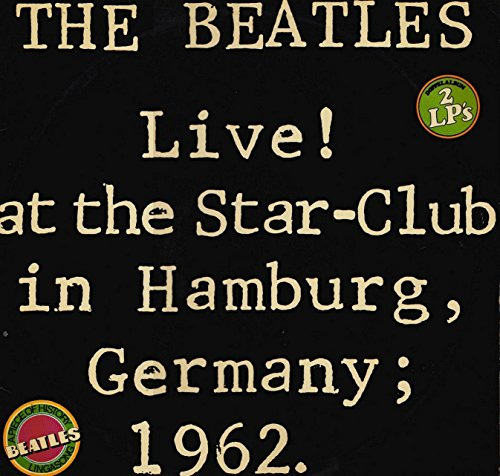
On their final nights in Hamburg in late December 1962, The Beatles were recorded performing at the Star-Club—a gritty German venue where they’d been honing their act for years. The tapes, captured on a cheap Grundig home recorder with a single microphone, sat forgotten for over a decade before being released as Live! at the Star-Club in Hamburg, Germany; 1962 in 1977. 📼
The album provides a rare window into The Beatles as a raw club band—after Ringo Starr joined in August 1962 but before Beatlemania transformed them into polished pop icons. And it sounds absolutely terrible. 😅
When the vinyl was released, I bought it, using money I’d earned as a paperboy. My interest was piqued because the album had been written about in newspapers—the Beatles fought like hell to prevent it from being released, arguing that it would damage their reputation as professional musicians. And, listening to it then, when I was 15 years old, I was severely disappointed, and I only listened to it once. It sounded awful, I didn’t know most of the songs, and ultimately, I was sorry I’d spent my money on it. But since then, as I’ve grown older, I’ve grown to appreciate it much more.
Hamburg: The Beatles’ Boot Camp 🇩🇪
Between 1960 and 1962, The Beatles made five trips to Hamburg, where marathon performances at clubs like the Indra, Kaiserkeller, Top Ten Club, and Star-Club forced them to develop their stage presence and expand their repertoire. They did everything they could think of to expand their repertoire—they had to, because they had to play eight-hour sets—they had to take speed to be able to just stand up for that long, let alone playing music and luring people off the street to come into the club, buy some beers, and listen. They played 48 nights straight at the Indra, 58 at the Kaiserkeller, and three months at the Top Ten Club. 🎭
The Star-Club opened on April 13, 1962, with The Beatles booked for the first seven weeks. Their final engagement came in December 1962—a two-week booking that started December 18. By then, they were reluctant to return. “Love Me Do” had just charted in Britain, and Hamburg felt like a step backward. But the contract had been signed months earlier, and they honored it. 💼
The Recording: Beer for Tapes 🎵
The club’s stage manager, Adrian Barber, recorded portions of the final performances using basic home equipment—a tape speed of 3¾ inches per second with a single microphone placed in front of the stage. According to bandleader Ted “Kingsize” Taylor (whose group the Dominoes was also playing the club), John Lennon verbally agreed to being recorded in exchange for Taylor providing beer during their performances. 🍺
The tapes captured at least 33 different songs over what’s believed to be multiple sessions during the last week of December. Of the 30 songs eventually released, only two were Lennon-McCartney compositions—the rest were cover versions, 17 of which The Beatles would later re-record for studio albums or Live at the BBC. ✨ Of course, at that point in their career, the Beatles had to do cover songs, they hadn’t written enough songs of their own by then.
This essay continues below. As an Amazon Associate, I earn from qualifying purchases.
Live! At The Star-Club In Hamburg, Germany; 1962
What’s On The Tapes? 🎶
The arrangements are similar to later studio versions but less refined—and sometimes dramatically different. “Mr. Moonlight” (perhaps the worst Beatles song in history) has a much quicker tempo, a guitar-based instrumental break, and an intentionally altered lyric with Lennon proclaiming he’s on his “nose” instead of his “knees.” “Roll Over Beethoven” was described as “never taken at a more breakneck pace.” 🏃💨 Back then, Lennon would handle the vocal on that song, though when the Beatles finally made it, George took over the lead vocal on that Chuck Berry cover.
The sound quality is unmistakably awful. Even in the best cases, vocals sound “somewhat muffled and distant.” On some songs, the vocals are so indistinct that early releases incorrectly identified who was singing and what song was being performed. 😬
But the between-song banter is audible—and revealing. The Beatles address the audience in both English and German, joke among themselves, and display the irreverent, coarse humor that manager Brian Epstein would soon polish away. This was The Beatles unfiltered. 🗣️ After all, Epstein wanted to clean up the Beatles, and have them appear in suits and ties, not horsing around on stage with toilet sets hanging off their necks, swearing on stage while eating sandwiches and drinking beer.
The Long Road to Release 💰
Taylor claimed he offered the tapes to Epstein in the mid-1960s, but Epstein saw no commercial value and offered only £20. Taylor kept them at home, largely forgotten until 1973. (Allan Williams, their booking agent back then, tells a different story involving tapes recovered “from beneath a pile of rubble” in an abandoned office in 1972.) 📦
When news of the tapes broke in July 1973, Williams was reportedly asking Apple for at least £100,000. He later met with George Harrison and Ringo Starr to offer them for £5,000, but they declined, citing financial difficulties. 💸
Paul Murphy, head of Buk Records, eventually bought the tapes and formed a new company called Lingasong specifically for the project. He sold worldwide distribution rights to Double H Licensing, which spent over $100,000 on elaborate audio processing to make the recordings listenable—but with the technology available at the time, the sound couldn’t be improved very much. In any case, songs were rearranged, edited to bypass flawed sections, and in some cases pieced together from incomplete recordings. 🎚️
Legal Battles and Bootlegs ⚖️
After The Beatles’ unsuccessful effort to block its release, the 26-song album was released in West Germany in April 1977, followed by UK release the next month. The US version (June 1977) swapped four songs for four different ones from the tapes. 🇺🇸🇬🇧🇩🇪
Over the next two decades, the recordings were licensed to multiple companies, resulting in numerous releases with varying track selections. In 1979, Pickwick Records released First Live Recordings over two volumes—mistakenly including “Hully Gully,” which was actually performed by Cliff Bennett and the Rebel Rousers, another act on the Star-Club bill. 😅
In 1985, a notorious bootlegger known as “Richard” issued The Beatles vs. the Third Reich—an unedited version directly parodying The Beatles vs the Four Seasons in both name and cover. 💀
When Sony Music released the recordings on CD in 1991, The Beatles (represented by Paul McCartney, Harrison, Starr, and Yoko Ono) renewed legal action. Sony withdrew the titles in 1992 as the lawsuit progressed. Another lawsuit followed Lingasong’s 1996 CD release. 📀
The case was decided in 1998 in favor of The Beatles, who were granted ownership and exclusive rights. Harrison appeared in person to testify, and his testimony was cited as crucial to the judge’s decision. He characterized Taylor’s claim that Lennon gave permission as “a load of rubbish,” adding: “One drunken person recording another bunch of drunks does not constitute business deals.” 🍺💥 Yeah, George was the “quiet” Beatle, but also, he was usually bluntly honest.
Reception: Historic But Horrible 📊
The album peaked at No. 111 during a seven-week run on the US Billboard 200—hardly a commercial triumph. 📉
Critics consistently weighed the abysmal sound quality against the historical significance. Rolling Stone’s John Swenson called it “poorly recorded but fascinating,” showing The Beatles as “raw but extremely powerful.” AllMusic’s Richie Unterberger noted that “despite The Beatles’ enormous success, it took Taylor fifteen years to find someone greedy and shameless enough to release them as a record.” Q magazine remarked: “The show seems like a riot but the sound itself is terrible—like one hell of a great party going on next door.” 🎉 Or, perhaps, a few blocks down the street.
Harrison himself assessed: “The Star-Club recording was the crummiest recording ever made in our name!” 😤
The Future? Maybe... 🔮
In 2022, Get Back director Peter Jackson speculated that the technology used to enhance audio from his Let It Be work could improve the Star-Club tapes. In 2023, Jackson confirmed he and his staff recently located and purchased the original tapes and plan to use machine learning to clean them up—though Apple currently has no plans for release. 🤖
Perhaps one day we’ll hear The Beatles’ rawest performance without having to strain through the sonic equivalent of listening to “one hell of a great party going on next door” while sounding like it’s also underwater. Until then, the Star-Club recordings remain what they’ve always been: historically priceless, sonically terrible, and proof that even The Beatles had to start somewhere. 🌟
And that somewhere involved a lot of beer. 🍻
Now that I’ve learned a lot of those songs on the Star Club recordings, my listening appreciation has improved. After all, they aren’t making very many new Beatles records these days. So, we have to take what we can get and be thankful.