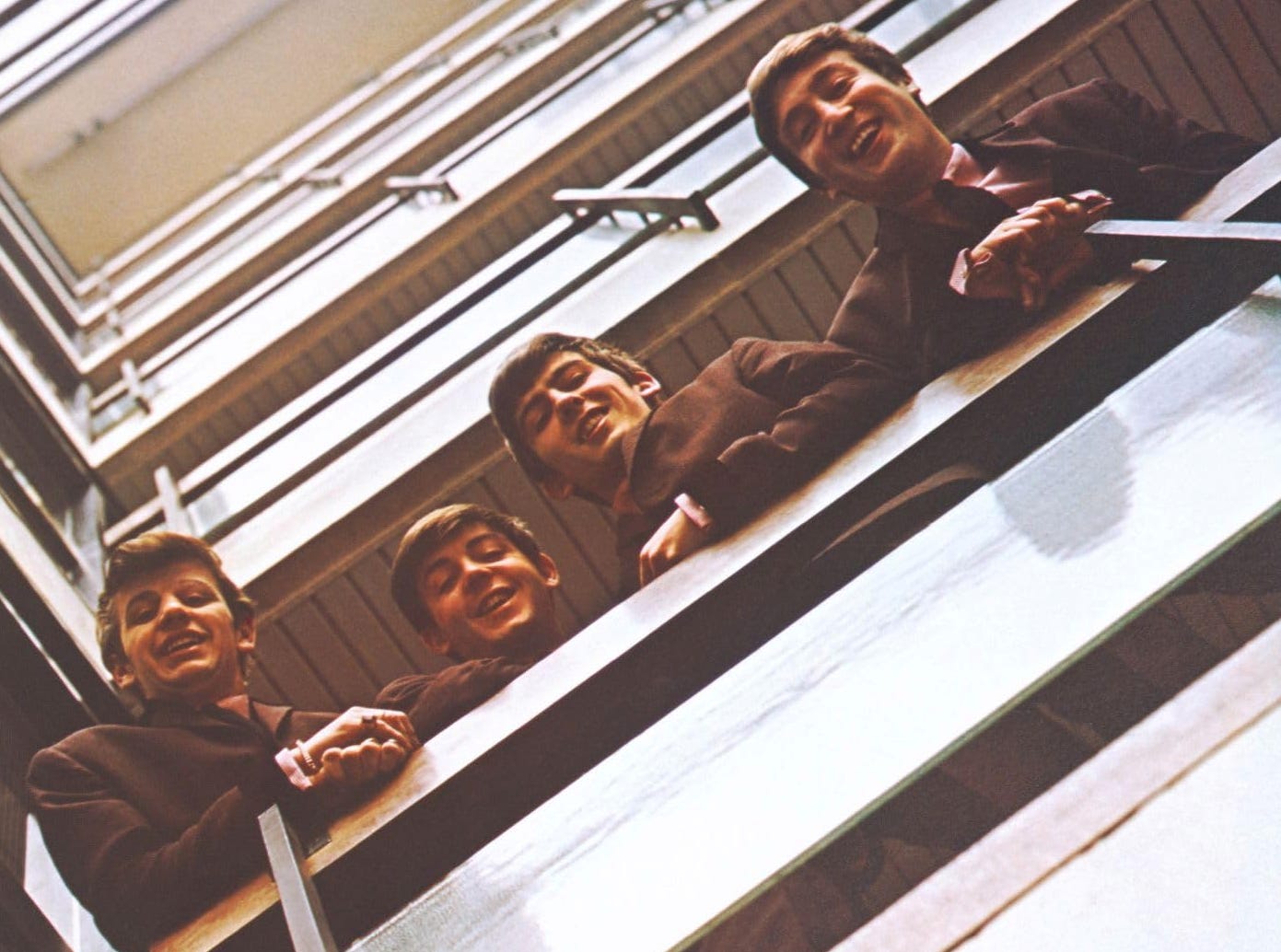
February 16, 1963. EMI House, Manchester Square, London. A man in a nice suit is crumpled on his back on the floor of an office stairwell, staring up at the ceiling with a camera. Four amused young men from Liverpool are peering down at him from the balcony above. Nobody knows if this is going to work. 🎬
This is how one of the most famous album covers in music history got made—almost by accident, in about 20 minutes, by a photographer who was totally unprepared.
But let’s rewind, because the real story starts with bugs.
The Zoo Said Nope
The well-connected producer George Martin was a fellow of the Zoological Society of London, of course. And when it came time to shoot the cover for the Beatles’ debut album, Please Please Me, Martin had a clever idea: photograph the Beatles at the London Zoo’s insect house. Beatles. Beetles. Get it?
The zoo said no.
Martin, undeterred, rang up Angus McBean (no relation to Mr. Bean, the British comedian). McBean was a theatrical photographer whose résumé included Audrey Hepburn, Marlene Dietrich, and Laurence Olivier. Martin asked if McBean could swing by EMI House and do something in a stairwell.
McBean arrived, spotted the stairwell, and flopped onto the floor. He had to be on the floor because he’d brought the wrong lens. “I only had my ordinary portrait lens,” he later recalled, “so to get the picture, I had to lie flat on my back in the entrance. I took some shots, and I said, ‘That’ll do.’” 📸
The Eye Behind the Lens
McBean wasn’t an obvious choice for a pop album cover. He’d built his reputation shooting the great theatrical stars of mid-century Britain—surrealist-influenced portraits with a dreamlike quality that made him the go-to photographer for anyone who wanted to look simultaneously glamorous and slightly otherworldly.
The shoot was done in an almighty rush. Martin later described it as being executed with the same breathless energy as the album’s recording sessions (also dashed off in a day)—fast, instinctive, yet somehow exactly right. The outtakes from the photo session proved so useful that they were repurposed across multiple releases, including the Red and Blue compilation albums that became millions of people’s introduction to the Beatles’ catalog.
Six Years Later: Same Stairwell, Different World
In 1963, while McBean had the boys looking down at him, he asked John Lennon how long they thought they’d stay together as a group. Lennon’s answer: “Oh, about six years, I suppose—who ever heard of a bald Beatle?” 🤣
It was, give or take a few months, almost exactly right.
So in May 1969, the Beatles commissioned McBean to return to EMI House and recreate the shot for the cover of their planned Get Back album. Same location. Same photographer. Same stairwell. The intention was to create a deliberate bookend—here’s where we started, here’s where we are now—and to let the visual contrast do the talking.
The contrast did not disappoint. The four clean-cut mop-tops of 1963 had become four very hairy men in their late twenties, wearing the rumpled, slightly frayed look of a band that had been through just about everything. Where the 1963 photo radiates uncomplicated delight—four young men who can’t quite believe their luck—the 1969 version carries a different weight entirely. They’re still smiling. But they know things now.
McBean arrived to find that EMI had built a new porch since 1963, which prevented him from getting into the same floor position. Rather than improvise, EMI simply tore down the porch and rebuilt it after the shoot. The session itself produced one more memorable image: John Lennon, fascinated by cameras as always, lying down next to McBean to peer through his viewfinder, while EMI office staff streamed down the stairs around both of them. The snapshot of Lennon and McBean on the floor has never been publicly released.
The 1969 cover photo was ultimately used not for Get Back (which became Let It Be and got a different cover entirely) but for the Blue Album compilation—placed alongside the 1963 image on the sister Red Album, so that anyone who bought both could see exactly how much six years had cost and given in equal measure. 🎵
Enter Robert Freeman: The Artist
The McBean stairwell shot launched the Beatles visually, but it was Robert Freeman who transformed their album covers from pop product into something approaching art.
Freeman was a Cambridge-educated photojournalist and jazz photographer whose portraits of John Coltrane and Dizzy Gillespie had impressed manager Brian Epstein enough to bring him in for the second album. He arrived in Bournemouth in August 1963, where the band was playing a summer residency, and improvised a studio in a hotel corridor—a dark passageway with natural light flooding in from windows at one end and a deep maroon curtain behind them.
The result was the With The Beatles cover: four faces half-submerged in shadow, unsmiling, staring directly at the camera with the focused intensity of people who knew exactly what they were doing and didn’t need to fake enthusiasm.
George Harrison later said that the Please Please Me cover had been “crap” and that With The Beatles was “the beginning of us being actively involved in the Beatles’ artwork—the first one where we thought, ‘Hey, let’s get artistic.’” 🖤
Harrison was being slightly harsh on McBean, who had done excellent work with limited notice and a lobby floor. But the point stands: Freeman was operating in a different register entirely. He was drawing on the black-and-white Astrid Kirchherr photos from Hamburg that the band already loved, bringing a jazz musician’s sense of mood and shadow to a pop context that had no idea what to do with either. EMI vetoed his original idea—to run the With The Beatles image edge-to-edge on the cover, with no text or logo. Apparently, the Beatles weren’t yet famous enough to carry a nameless cover.
Freeman went on to shoot five consecutive British album covers—With The Beatles, A Hard Day’s Night, Beatles For Sale, Help!, and Rubber Soul—and each one tracked the band’s evolution with an almost uncanny precision. The Rubber Soul cover came about by accident: Freeman was projecting the photographs onto a piece of cardboard to show the band how they’d look, the card fell backwards, and the image stretched. Instead of straightening it, everyone shouted “can we have that?” Freeman said yes. The slightly elongated, vaguely psychedelic faces of Rubber Soul arrived at exactly the moment the music started going somewhere new.
He was paid £75 for With The Beatles. Three times the standard fee, Epstein had negotiated. Freeman himself noted this was a remarkable bargain for what became one of the most imitated album covers in rock history. 💷
What the Stairwell Knows
The old EMI building was demolished years ago. But the stairwell itself was preserved—physically removed and reinstalled at EMI’s new headquarters — which is either a touching act of cultural preservation or evidence that large corporations understand the value of mythology better than they’re generally credited for.
Two photographs. The same stairwell. Six years apart. One taken by a theatrical photographer lying on a lobby floor who spent 20 minutes on the job. The other taken by the same man, six years later, after the whole porch had to be dismantled to recreate his original vantage point.
Somewhere between those two images is the entire story of the Beatles—the giddy ascent and the complicated arrival at the top, the boys who became men who became legends, the band that Lennon predicted would last about six years, and did.
Who ever heard of a bald Beatle, indeed. 🎸