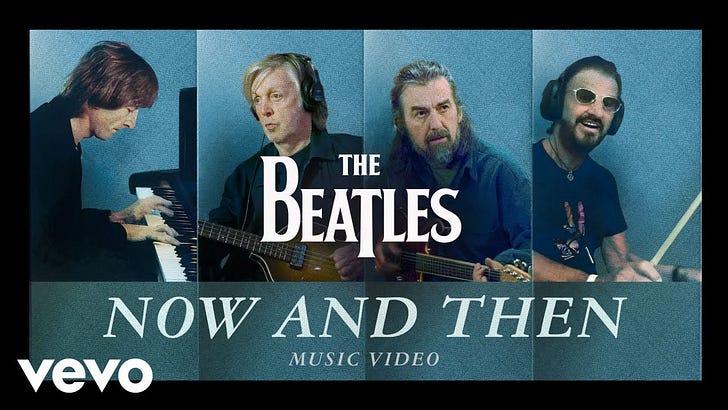
If you're a Beatles fan of a certain age, you already know the ache of it—the awareness that the music stopped. Two of the four are gone, and what you have is finite. No more first-time discoveries. No reunion. No lost album waiting to be finished. That's been the reality since April 1970, and most of us made our peace with it decades ago.
But artificial intelligence has suddenly changed that—and Beatles fans are now the test case of a question the music industry hasn't figured out yet:Where does the music end and the machine begin?
The Beatles, more than any other artist, are ground zero. Their catalog is the most valuable in the world. Their dead members are the most recognizable voices in recorded music history. And right now, you can find dozens of "new Beatles songs" on YouTube—some made with extraordinary care, some made with none at all—and the only thing separating them from each other is a disclaimer. Or not. 🔍
The Mal-Function: Why the Beatles Are Still Winning Grammys 🤯
Last year the Beatles won a Grammy Award. Not a Lifetime Achievement trophy. Not a ceremonial nod to the past. An actual competitive Grammy produced with AI—Best Rock Performance—for “Now and Then,” beating out Pearl Jam, Green Day, IDLES, and St. Vincent. Sean Ono Lennon accepted on the band’s behalf and said something that cut to the heart of it: “Play the Beatles’ music to your kids. I feel like the world can’t afford to forget about people like the Beatles.” 🎙️
And here’s the twist: when Paul McCartney first announced the song in June 2023, fans were livid. They assumed AI meant a fake John Lennon—some digital ghost conjured from training data. McCartney had to go back out publicly and clarify:
“To be clear, nothing has been artificially or synthetically created. It’s all real and we all play on it. We cleaned up some existing recordings—a process which has gone on for years.”
Ringo Starr told Rolling Stone the Beatles would “never” fake Lennon’s voice, adding: “It was the closest we’ll ever come to having him back in the room. So it was very emotional for all of us.”
The “Good” AI: MAL, the Machine That Listens 🤖
What Paul and Ringo were actually describing is something called stem separation—a machine-learning technology developed by Peter Jackson’s team while producing the Get Back documentary. The Beatles had tried to finish “Now and Then” back in the ‘90s during the Anthology sessions, but gave up in frustration. The music’s source was a low-fidelity cassette Lennon had recorded at his Dakota apartment. John had written a note on the cassette: “To Paul.” George Harrison reportedly hated the muddy sound so much, the project was shelved. 🎹
Jackson’s AI didn’t invent anything. It extracted—isolating Lennon’s actual voice from the noise around it (primarily Lennon’s piano accompaniment), cleaning the signal, handing it back to McCartney and Starr so they could finish the job. The result was a genuine four-way collaboration: John’s voice, George’s guitar parts (recorded before his death in 2001), Paul’s new contributions, Ringo’s drums. Real performances. Just separated from the murk of a cheap tape—by a machine that had learned how to listen. This is extractive AI—it takes what’s already there and makes it usable. Nothing synthesized, nothing invented. 🎚️
The Other AI: The Unauthorized Deepfake Reunion ⚠️
Then there’s the other world. A YouTube creator named Dae Lims became Patient Zero for this phenomenon in May 2023. Using generative AI trained on Lennon and McCartney’s vocal characteristics, Lims produced two tracks that went viral. The first was McCartney’s 2013 solo single “New”—reimagined as a Beatles recording, complete with de-aged Paul vocals and AI-generated John Lennon harmonies on the bridge. The second was Lennon’s posthumous “Grow Old With Me,” expanded into a full Beatles-style arrangement with McCartney’s voice added in. Fan comments read like grief therapy: “I start crying every time.” “I never thought we’d get a proper ending to the Beatles’ story.”
Here’s the crucial thing about intent: Dae Lims labeled both tracks explicitly—“We love you, lads. No copyright infringement intended. This is an AI creation.” The goal was emotional tribute, not deception. Nobody was trying to pass these off as real Beatles recordings. They were fan love letters made audible. Many Beatles fans regarded it as an interesting exercise—a novelty, not blasphemy. But lawyers got involved, and Universal Music Group issued takedown notices, and most of the videos vanished.
So most of Lim’s Beatles videos are gone, but here’s an interesting one that has survived:
My take: it’s an interesting, amusing experiment. Does it diminish the Beatles’ legacy or hurt their commercial interests? Hell no. It’s like book-banning: a tone-deaf takedown is publicity money can’t buy.
The What-If Factory 🏭
Dae Lims wasn’t operating alone. A sprawling cottage industry of “what if” Beatles projects has emerged, each one probing a different kind of absence. There are covers where “AI-Paul” sings John’s songs and “AI-John” sings Paul’s—letting fans hear what the 1970s might have sounded like if the Beatles’ split never happened. There are “Black Album” projects that use AI stem separation on the 1970-71 solo material—Imagine, All Things Must Pass—to remix the instruments as though all four men were recorded in the same room. There are attempts to “Beatle-ize” George Harrison’s solo debut by adding AI-generated Lennon and McCartney backing vocals to the tracks. 🎸
And there’s at least one version of a reversed “I Wanna Be Your Man”—fans using AI to have the Beatles sing the song back using the Rolling Stones’ rawer arrangement, essentially reclaiming the gift they handed their rivals in 1963. These projects exist in a complicated ethical middle ground. The technology is generative—it adds data that was never there, creating performances these men never gave. McCartney’s concern is legitimate. When the technology gets good enough that fans can’t distinguish real from fabricated without a disclaimer, the disclaimer becomes the only ethical load-bearing wall. 🧱
The Line in the Sand 🏖️
So here’s the framework that actually makes sense of all this. Extractive AI works on what exists—cleaning, separating, restoring, revealing. That’s what Peter Jackson’s MAL technology does. That’s what gave us “Now and Then.” It honors the original performance because it is the original performance, just cleaned up. It’s the same moral category as a digital remaster. ✅
Generative AI invents—synthesizing new performances from patterns learned from old ones. That’s what produced Dae Lims’ “New,” the Black Album projects, the AI-Paul-singing-John experiments. It can be done with love, transparently, with no intent to deceive. It can also be done badly, anonymously, and with every intention of misleading and profiteering. The technology doesn’t know the difference. Intent and transparency are doing all the ethical work here. ❌
The Question Nobody’s Answered Yet 🤔
The deeper issue isn’t whether AI can replicate a Beatle. It clearly can—convincingly enough to make grown adults cry (while other listeners detest it because it’s “bogus.”) The deeper issue is what a performance actually is. Is it the pattern of frequencies produced by a particular voice? Or is it the irreducibly human moment of a person choosing to sing something, at a specific time in their life, with everything they were at that moment baked into it? MAL recovered one of those moments from a cassette tape. Generative AI constructs a plausible simulation of such a moment from data. Those are not the same thing—even when they sound identical. 🎵
Food for thought: If you could hear a flawless AI version of Lennon singing a song he never recorded—transparent, labeled, made with love—would that feel like a gift, or a ghost that shouldn’t be?