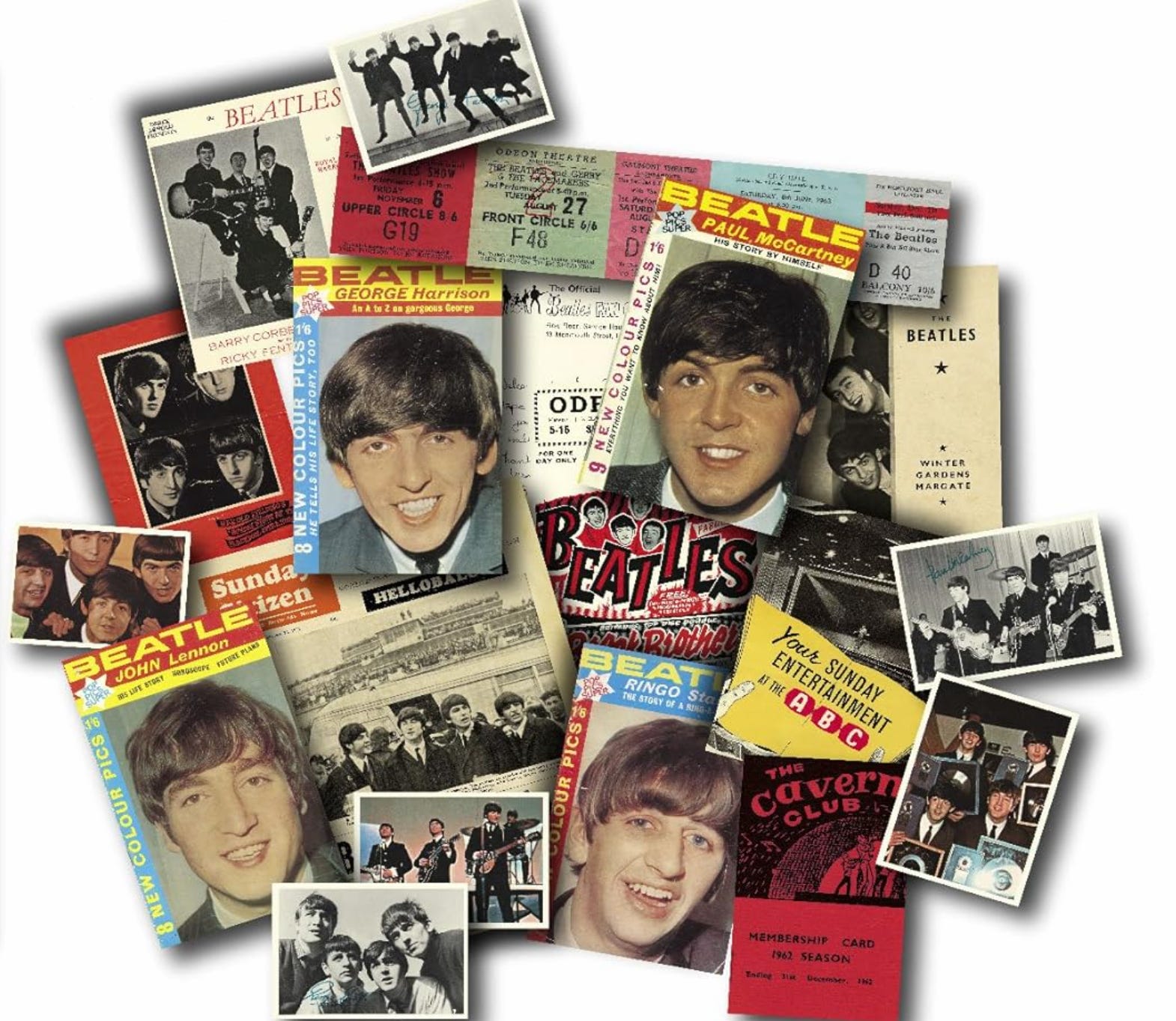
In May 2024, the music world watched in awe as a 12-string Hootenanny acoustic guitar, once owned by John Lennon and lost in an attic for fifty years, sold at auction for a staggering $2.9 million. It set a world record, reinforcing a long-held truth: the Beatles are the gold standard of cultural relics. Pretty soon, a huge auction of Beatles memorabilia will happen at Christies in March, and will surely realize tens of millions when the hammer strikes the block.
To own a piece of the Fab Four is to own a piece of history, but fortunately you don’t necessarily need a bank account with six or seven figures.
We’re talking about a world made of thin, musty cardboard, blue ink, and the lingering scent of artificial strawberry. While the high-rollers battle over million-dollar guitars, a different kind of fan is scouring eBay for 1964 Topps trading cards—relics of the same era that can often be acquired for less than the price of a movie ticket.
Those Beatles trading cards, primarily from Topps in 1964 during the height of Beatlemania, feature black-and-white (and, more rarely, color) photos of the band with blue facsimile autographs. The cards came in three series totaling 165 cards with portraits and candid shots. These vintage curios (which closely resemble baseball cards, except the focus is the Beatles, naturally) include images from concerts, group shots, and individual members, with quaint backsides identifying the series, the number, and assorted trivia. Like any collection of antifacts, the value of your set depends on its condition and completeness.
The fun thing about the cards is that they feature lots of interesting, unfamiliar images that you don’t typically see in Beatles books. Perhaps because the images were lesser-known, they were more affordable for Topps to license.
The discrepancy between the million-dollar guitar and the five-dollar trading card reveals a fascinating story about how the Beatles were sold to the world, why some objects become “fine art” while others remain ephemera, and how a rectangular slab of pink bubble gum fueled the greatest marketing bubble in history.
The Birth of the “Wax Pack”
In early 1964, the United States was in the throes of a fever for which there was no cure. When the Beatles landed at JFK, they weren’t just a band; they were a phenomenon that required physical proof of participation. The Topps Chewing Gum company, headquartered in Brooklyn, was the first to realize that the same mechanism used to sell slugger Mickey Mantle could be used to sell Paul McCartney.
Topps began churning out millions of “wax packs.” For just five cents, a child could walk into a corner drugstore and walk out with a handful of cards and that stiff, brittle, barely chewable plank of pink bubble gum. These weren’t just pictures; they were a social currency. In schoolyards across the country, the air was thick with the sound of snapping gum and the frantic negotiation of “I’ll give you two Georges for one Ringo.”
Topps released several distinct series, each designed to keep the “fever” high:
* The Black & White Series: These featured “candid” shots of the boys in suits, often with facsimile signatures in blue script. They felt like official press photos shrunk down to pocket size.
* The Color Series: These were the “prestige” cards, featuring vibrant, saturated images of the band in their iconic collarless suits.
* The “Beatles Diary” Cards: These were perhaps the most ingenious. The backs of the cards featured faux-handwritten entries that gave fans the illusion of intimacy. To a thirteen-year-old in 1964, reading “John’s” thoughts on his favorite color (black) or his favorite food (steak and chips) felt like receiving a secret letter from London.
The Economy of Scale: Why Aren’t They Million-Dollar Assets?
If the Beatles are the most collectible band in history, why can you still find an original 1964 Topps card for $5 or $10? The answer lies in the fundamental laws of scarcity and the nature of “mass-produced nostalgia.”
When Lennon played his Hootenanny guitar, he created something singular. There’s only one. It carried his fingerprints; it resonated with his voice. It is a “primary relic.” In contrast, the Topps cards were “secondary relics.” They were industrial products, chuned out by the millions on high-speed presses.
During the height of Beatlemania, Topps was reportedly printing 250 million cards per month. Because they were so ubiquitous and so cheap, they were treated as disposable. They were stuck into the spokes of bicycle wheels to make a motor-like sound; they were taped to bedroom walls; they were carried in back pockets until the corners turned to fuzz.
This leads to the “Great Condition Divide.” While a common, “circulated” Beatles card is inexpensive because so many survived in shoe boxes, a PSA 10 (Gem Mint) card—one that looks as though it was printed yesterday, with no gum stains or soft edges—can still command thousands of dollars. The value isn’t in the image itself, but in the improbable survival of a fragile piece of cardboard in a pristine state.
The “Gum Stain” Aesthetic: The Charm of the Low-End
There is something poetic about the “cheap” Beatles card. A million-dollar guitar lives in a humidity-controlled vault, seen only by the elite. But a 1964 Topps card with a faint brown stain from a sixty-year-old piece of gum is a democratic object.
The gum itself was part of the experience. It was famously terrible—hard as a shingle and dusted with a white powder to keep it from sticking to the cards. Ironically, that sugar and moisture often seeped into the cardboard, leaving a permanent mark on the card it rested against. To a serious “investor,” that stain is a flaw. To a historian, it is a chemical signature of 1964. It proves the card was there, in a child’s hand, part of the frantic rush of the British Invasion.
The low price of these cards on sites like eBay allows the “everyman” fan to touch the history. You don’t need an auction house representative to buy a Topps card; you just need a few dollars and a sense of wonder.
Many of the original cards in good condition have shown up on the TV program “Antiques Roadshow”, but they don’t get much attention. Beatles concert programs and ticket stubs are sometimes valued in the hundreds of dollars, but the cards usually appraise for a paltry $5 to $15, simply because so many of them still survive in fans’ shoeboxes in basements and attics.
The Modern Cash Grab
However, the true evolution from “five-cent hobby” to “high-stakes asset” arrived with the 2023 Topps Transcendent collection. This wasn’t a product meant for bicycle spokes or schoolyard trades; it was a luxury product designed for the elite tier of the hobby. This release bridged the gap between the humble five-dollar vintage card and the million-dollar auction block, often featuring rare finishes and extremely limited production runs. These modern iterations prove that while the 1964 originals were built on the “democratic” idea that every kid should own the Beatles, the new era of cardstock treats the band as a blue-chip commodity, ensuring that rare editions of these contemporary cards will undoubtedly rack up tens of millions when the gavel finally falls in the decades to come.
These modern releases functioned as high-gloss tributes to the “youngsters from Liverpool,” commemorating seismic cultural shifts like the 1964 Ed Sullivan appearance. By weaving vintage photography into contemporary sets between 2014 and 2019, Topps transformed the band from a standalone teenage craze into a permanent fixture of historical “news,” effectively treating the British Invasion with the same reverence as a moon landing or a presidential election.
Conclusion: The Value of the Inexpensive
The contrast between the $2.9 million guitar and the $5 trading card tells us that we value the Beatles in two different ways. We value them as Art (the instruments, the handwritten lyrics, the original master tapes), and we value them as Experience (the posters, the buttons, and the trading cards).
The cards aren’t expensive because they were meant for everyone. Their value isn’t financial; it’s emotional. They represent the moment when the world turned from black-and-white to Technicolor, when the British invasion began, when a generation found a voice, and when a five-cent pack of gum offered a ticket to a revolution.
While the high-end collectors chase the “holy grails” of the auction world, the humble Topps card remains the most honest piece of Beatles memorabilia. It hasn’t been locked away in a vault. It’s still out there, trading hands, smelling faintly of old paper and vanished sugar—a reminder that the “Fifth Beatle” wasn’t just George Martin or Billy Preston; it was the millions of kids who kept a piece of cardboard in their pocket and never let go.