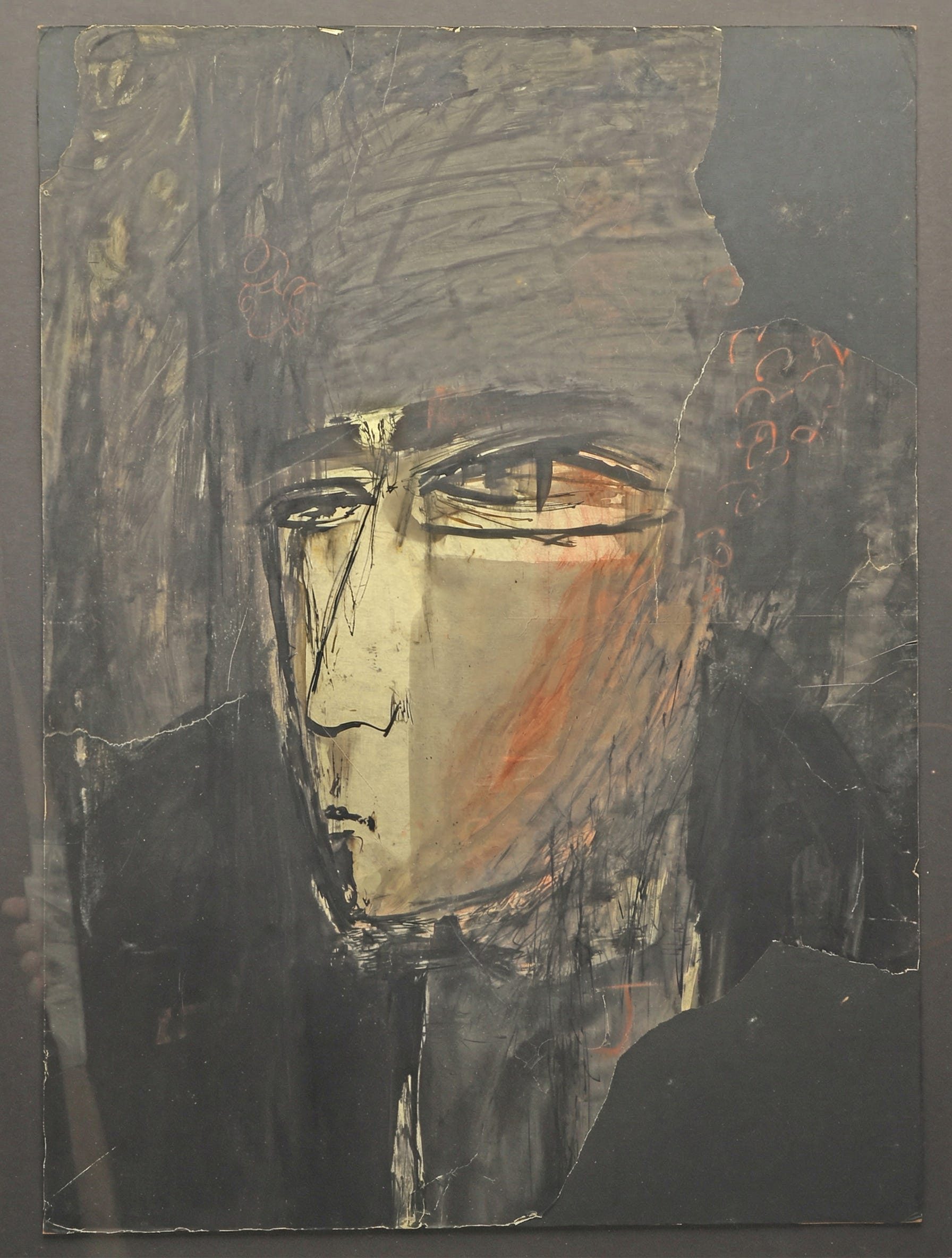
Picture this. It’s 1968. John Lennon is at Kenwood, his sprawling home on the St. George’s Hill estate in Weybridge, Surrey. He’s in the middle of one of the most turbulent periods of his life—his marriage to Cynthia is falling apart, Yoko has arrived, and the world he’d carefully built is coming undone around him. He’s burning it all down—the house, the marriage, the version of himself that had lived here—and anything connected to that old life has become impossible to look at.
Including, apparently, a painting on the wall.
That painting was a portrait of Lennon himself, made by his closest friend, Stuart Sutcliffe—dead at twenty-one and never gotten over. It had hung in the sunroom at Kenwood throughout the Cynthia years, a quiet reminder of the young man John had been before all of this. And now, in the middle of all that chaos and grief and upheaval, he’s standing there tearing it apart.
Bernard Clark, the director of a local photo studio, happened to be at Kenwood that day delivering gear—a task he handled personally to spare the Beatles from being mobbed. Seeing Lennon in mid-tear, Clark stepped in with a beautifully simple request: "Can I have it?" Without a second thought, Lennon handed over the pieces.
Bernard had no idea what he was walking out with.
Two Boys from Liverpool 🎸
To understand why that painting matters, you have to go back about a decade—back to Liverpool College of Art, where John Lennon met Stuart Sutcliffe in 1957. The two were inseparable almost immediately. Beatles historian Mark Lewisohn put it simply: “They inspired each other and they laughed, drank, painted and read together.” They pushed each other in ways that only the best of friends can.
Sutcliffe was, by many accounts, the more naturally gifted visual artist of the two. When Lennon was pulling together the band that would eventually become The Beatles, he wanted his best friend along for the ride. The fact that Stuart couldn’t really play bass was treated as a minor detail. Stu sold a painting, bought a guitar, and joined the band. 😄
Hamburg changed everything. The Beatles went there for their legendary residencies, and it was there that Sutcliffe met photographer Astrid Kirchherr, fell completely in love, and made a decision that felt inevitable: he left the band to study painting at the Hamburg College of Art under the legendary Eduardo Paolozzi. Lennon understood. The friendship didn’t just survive, it deepened.
The portrait is believed to have been painted in 1961 or 1962, in the attic studio of the Kirchherr family home in Hamburg—the same house where the whole band was welcome, where Astrid fed them English breakfast and introduced them to ideas that were quietly reshaping who they were. Sutcliffe captured Lennon in a highly stylized head study—pen, ink, watercolor, and mixed media—abstract enough to be serious art, but specific enough that every single person who sees it says the same thing: that’s John Lennon. A simple “J” is inscribed to the left of the sitter’s neck. That’s the only signature the painting needs.
Then, on April 10, 1962, Stuart Sutcliffe died of a brain hemorrhage. He was twenty-one years old. Lennon was devastated—the kind of grief he rarely let show, but that people close to him recognized immediately. He had lost his closest friend, his artistic conscience, the person who perhaps knew him better than anyone.
On the Wall at Kenwood
Lennon kept the portrait, of course. It hung in the sunroom at Kenwood — his favorite room in the house — for years. And here’s where the story gets genuinely thrilling for anyone who loves this kind of historical detective work.
A photograph taken sometime between June and December 1967 shows John lying on a couch in that sunroom. And there, just above his head, on the wall behind the sofa, is a painting. A face.
The Attic, the Box, and the Discovery
After Bernard brought the torn pieces home and had the painting repaired, it had one more long chapter before the world got to see it. His wife, who had been close friends with Cynthia Lennon, was deeply unhappy about the way John and Cynthia’s marriage had ended. She didn’t want the reminder of that era on the wall. The painting was banished to the attic—like a portrait of Dorian Gray, sealed away and forgotten.
In 2024, after Bernard and his wife passed away, their son, Stephen, was clearing the family estate when he opened a box and found the portrait. When the painting came up for auction, the photograph of John in his sunroom was used to authenticate the painting. John Silk of Ewbank’s Auctions performed a gloriously nerdy piece of art forensics. He took the image of the painting they’d been consigned for auction, “parallelogramtized” it (his word)—squished it, angled it, reduced the opacity, and overlaid it on the photograph.
Perfect match. 🔍
The painting that Bernard Clark had walked out of Kenwood with in 1968 was the same one that had hung above John Lennon’s head the year before, while he was recording Sgt. Pepper and Magical Mystery Tour and living inside the most creative period of his life. A portrait of John, painted by the friend he’d lost, watching over him from the wall.
The Sale 🏛️
When the portrait went to Ewbank’s Entertainment & Memorabilia, the pre-auction estimate was cautiously set at £3,000 to £5,000. It sold for £19,500 (about $26,500 in today’s U.S. dollars)—nearly four times the auction estimate—which surprised exactly no one who understood what the painting actually represented.
This wasn’t just a piece of Beatles memorabilia. It was a painting made by a twenty-one-year-old artist for his best friend, kept by that friend for years after his death, nearly destroyed in a moment of grief and upheaval, saved by a simple act of kindness, hidden in a loft for decades, and finally brought back into the world. Every one of those layers is visible in the torn, reassembled surface of the thing itself.
Stuart Sutcliffe left The Beatles to become the artist he believed he was meant to be. He never got the chance to find out how the story ended. But the portrait survived. And in the end, that feels like exactly the right outcome. 🎶