At Shea Stadium on August 15, 1965, something extraordinary happened. The Beatles took the stage in front of 55,600 screaming fans, plugged into their 100-watt amplifiers, and proceeded to play a concert that nobody—including the Beatles themselves—could actually hear. The screaming registered on seismographs. George Harrison’s guitar amp was turned up full blast and he still couldn’t hear a single note. Ringo had to watch John and Paul’s backsides to figure out when to smack the drums.
John Lennon griped that they were becoming “the world’s best show band, but nobody’s listening.”
Those fans had paid good money to see the Beatles, then screamed so loudly they couldn’t hear a word or note. So, what was happening? 🎸
Why Do Humans Scream?
Before we had language or tools, we had screaming. A scream is one of the oldest sounds in the human repertoire—a primal alarm system hardwired into our biology. When early humans saw danger, they didn’t have time for complete sentences. They screamed, triggering immediate fight-or-flight response. Even today, a scream bypasses the rational parts of our brain and goes straight to the emotional core.
We don’t just scream when we’re afraid—we scream when we’re overwhelmed with joy or excitement. When an emotion becomes too big for normal processing, we scream. It’s an emotional release valve. And screaming is contagious. In a crowd, screaming becomes social bonding—a shared emotional experience that creates group identity. 😱
Why Scream at Performers?
Screaming at entertainers didn’t start with the Beatles. In the 1940s, Frank Sinatra drove teenage girls crazy. They were called “bobby-soxers,” and newspapers ran headlines about “mass hysteria.” In the 1950s, Elvis caused riots. Even religious revivals featured people overcome with spiritual ecstasy, screaming emotions too powerful for speech.
Performers become fantasy objects—perfect projections of whatever we need them to be. They’re close enough to feel real but far enough to remain perfect and untouchable. Screaming bridges that impossible distance. You can’t actually reach them, but you can scream, and your voice becomes part of the collective roar they definitely hear. 📣
Enter the Beatles: The Perfect Storm
The Beatles were perfectly designed to trigger maximum screaming. Four cute, safe-looking boys with shaggy hair and matching suits. Unlike Elvis with his dangerous sexuality, they seemed non-threatening. They were funny, self-deprecating, charming. There were four of them, which meant every girl could have her favorite. Paul, John, George, Ringo—take your pick.
They arrived in America at exactly the right moment. On February 9, 1964—less than three months after Kennedy’s assassination—73 million people (40% of the US population) watched them on The Ed Sullivan Show. America was grieving, desperately needing something joyful. And here came four British boys singing “I Want to Hold Your Hand,” grinning like they didn’t have a care in the world.
Fans also enjoy screaming at sporting events, but interestingly, the intent behind the noise is different—at a sporting event, the scream is a functional tool; it is an attempt to influence the outcome, whether by "fueling" the home team or "distracting" the opponent at the free-throw line. Screaming at music concerts is a purely expressive release. Fans weren't screaming to help John Lennon hit a high note or to make Paul McCartney play faster; they were screaming because the music had already "won." 🏟️
Who Was Screaming?
Here’s something interesting: while the screaming is remembered as a female phenomenon, boys were at Beatles concerts too—they just expressed enthusiasm differently. Contemporary estimates suggest that early Beatles concerts in 1964 were roughly 70-80% female, but by 1965-66, the gender ratio had shifted somewhat as the Beatles’ musical credibility grew. Boys showed their appreciation by forming bands, buying guitars, and trying to copy the music rather than screaming at concerts. 🎸
The Screaming Escalates
At Carnegie Hall on February 12, 1964, nearby residents complained to police about the noise. At the Hollywood Bowl, recordings were considered unusable for years because you literally could not hear the music over the screaming. But nothing compared to Shea Stadium. On August 15, 1965, 55,600 fans generated sound measuring around 130 decibels—louder than a jet engine.
The Beatles couldn’t hear themselves at all. George said he couldn’t hear a single note of his own guitar solos. Ringo watched John and Paul’s “bums wiggling” to figure out where they were in songs. Songs got faster because without hearing themselves, the Beatles’ internal tempo would speed up from adrenaline. Nobody in the audience noticed. Nobody could hear. 🥁
What the Fans Experienced
Contemporary accounts describe girls hyperventilating, fainting, crying so hard they made themselves sick. Medical literature actually documented fans losing bladder control from the sheer physical intensity of prolonged screaming. Ambulances at every concert carried out dozens of fans suffering from dehydration to broken limbs. Some had temporary hearing loss lasting days.
But here’s the thing: they didn’t care. The experience was worth it. These weren’t stupid or hysterical girls. They were participating in something extraordinary—a mass emotional experience that gave them permission to lose control in a world that demanded they maintain it. 💕
The Beatles’ Frustration
At first, the screaming was thrilling. But as it continued, the frustration set in. “They’re not listening to the music,” John Lennon complained. “They’re just screaming at us.” By 1965, Beatles concerts weren’t concerts—they were spectacles. Paul would shout lyrics into the microphone and his voice would disappear. George’s intricate guitar solos were completely inaudible.
On August 29, 1966, the Beatles played their final concert at Candlestick Park. They didn’t announce it—they just knew they were done. Paul: “We’d had it with the hysteria.” George: “It wasn’t fun anymore. It was frightening.” The thing that made them the biggest band in the world had made it impossible to do what they loved most: play music. 🎵
The Paradox and the Legacy
They retreated to Abbey Road Studios and made Revolver, Sgt. Pepper’s, The White Album, and Abbey Road—albums so complex they couldn’t have been performed live anyway. The screaming had inadvertently freed them.
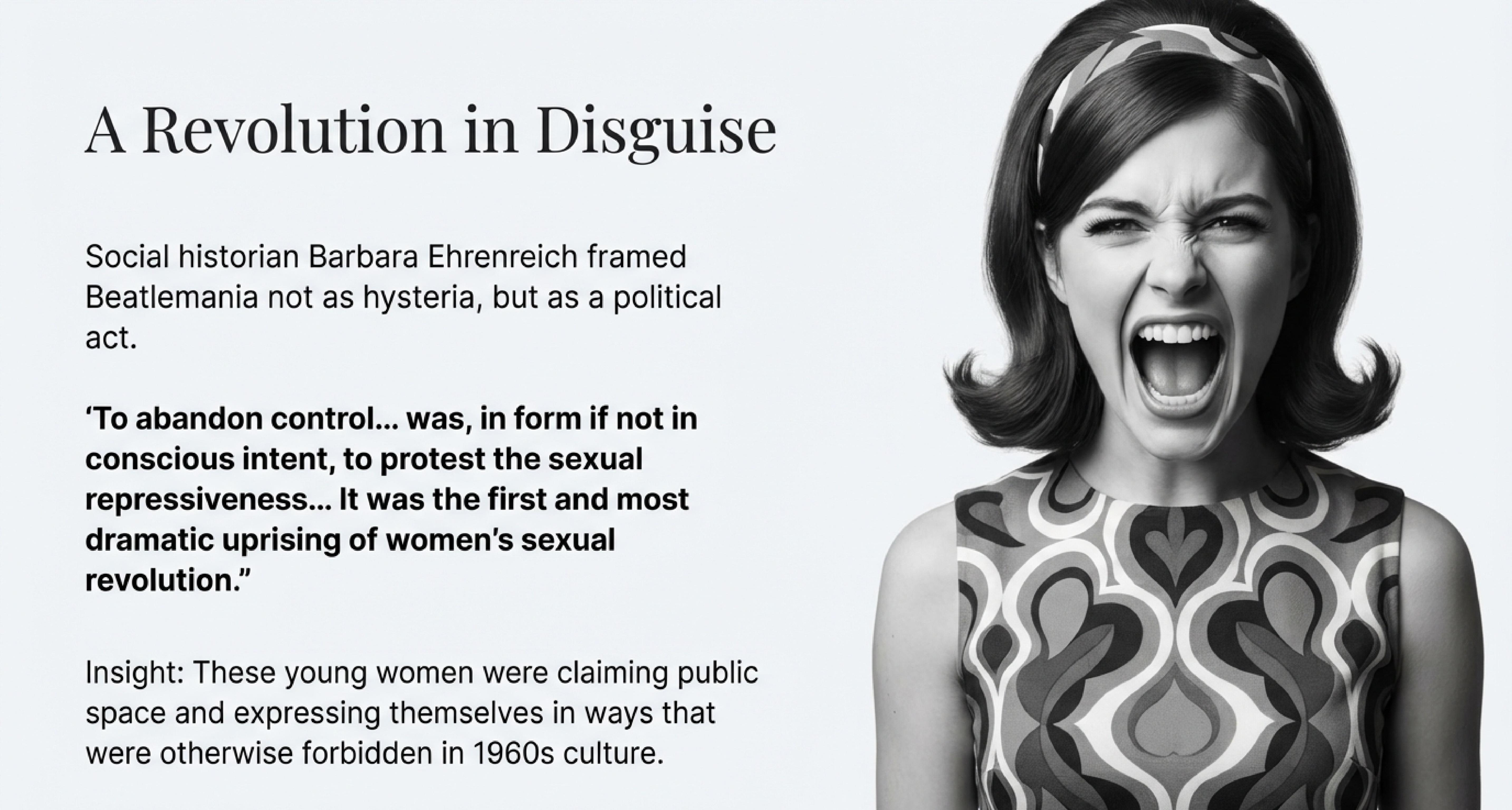
More recently, feminist scholars have reexamined those screaming girls and found something contemporary coverage missed: those young women were claiming public space and expressing themselves in ways otherwise forbidden. It was liberation. 🗽
The social historian and critic Barbara Ehrenreich, in her influential 1992 essay “Beatlemania: A Sexually Liberating Rite,” frames the screaming not as “hysteria,” but as a profound political and social act.
She wrote:
“To abandon control—to scream, faint, dash about in mobs—was, in form if not in conscious intent, to protest the sexual repressiveness, the rigid double standard of female teen culture. It was the first and most dramatic uprising of women’s sexual revolution.”
And the phenomenon never stopped. Every generation has had its version: the Rolling Stones, Jackson 5, One Direction, BTS. Each time, the fans are mostly young women. Each time, their emotions are dismissed. And each time, those fans are doing what humans have always done—expressing feelings too big for words.
Here’s the beautiful paradox: The Beatles were brilliant musicians creating innovative music. Their fans loved them so much they made it impossible to hear that music. But without touring, they had time and freedom to experiment. They became even better. The Beatles said they never heard themselves play at most concerts after 1964. But sixty years later, we can hear what those fans were screaming about. The genius was always there, under all that noise. Maybe those fans knew it, even if they couldn’t hear it.
After all, love can be loud. And sometimes the loudest love makes you scream. 🎸✨