For decades, the “Greatest” Beatles songs were a list determined by middle-aged white men in suits at EMI and Capitol Records. Even though the Beatles were constantly churning out ear candy, if the suits decided against putting a song on a 7-inch vinyl with a fancy picture sleeve, and shipping it to radio stations, it wasn’t a “hit.” Case closed.
But today’s digital era has pulled back the curtain, revealing a massive gap between what was marketed to the masses and what is actually loved by the listeners. 🕵️♂️ Today, music fans are voting with their ears, and the verdict is clear.
The 20th-Century Scarcity Era: When a ‘Single’ Was a Gamble
In the 1960s, releasing a single was a heavy-lift industrial operation. The record company had to invest big money in physical record manufacturing, distribution to thousands of record shops, and a huge PR blitz to secure one of the few precious slots on the BBC or American AM radio. The record label was a gatekeeper. They looked at the songs like assets—they decided which tracks were “A-side” singles (the moneymakers) and which songs were buried on an LP. 💰
There was also a “value for money” rule in the UK: fans felt ripped off if they bought a single and then found the same song on an album later. To avoid being seen as “cheats,” the Beatles often kept their best songs off their LPs entirely. This created a fractured history where “Hey Jude” and “Strawberry Fields” were treated as separate entities from the albums themselves. It was a strategy based on physical scarcity.
Fast forward to 2026, and the horse has left the barn. On Spotify or Apple Music, every track on Revolver has the exact same digital real estate as “Let It Be.” In this new Digital Democracy, listeners have spent the last decade “voting” with their attention. They could care less which song appeared on a 45 RPM record a half-century ago; they care about what sounds good today. The result: a total rewriting of the band’s legacy. 🗳️
The ‘Organic’ Top 10: The High-Volume Deep Cuts
Using the Streaming Audit methodology, here are the top 10 songs that have achieved “hit” status purely through audience obsession.
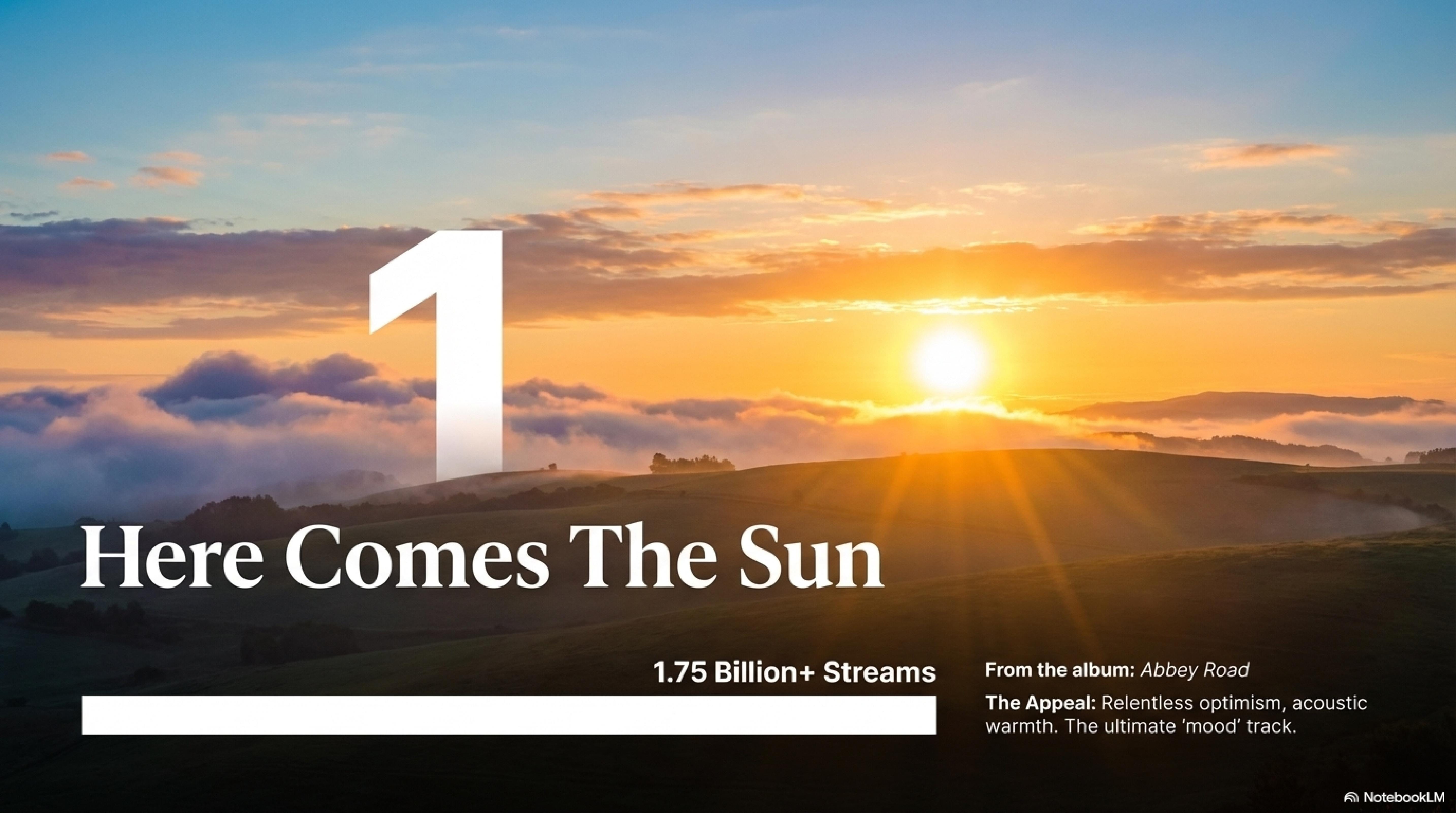
1. Here Comes The Sun (Abbey Road) — 1.75 Billion+ Streams
* The Appeal: Its relentless optimism and acoustic warmth make it the ultimate “mood” track for morning playlists. Plus, the song never gets old.
* The Mistake: In 1969, George was still viewed as the “junior” partner. Today, it’s pretty obvious that the failure to release this tune as a single was a massive marketing blunder; since it’s now more popular than any Lennon-McCartney “official” hit. ☀️ But hey, hindsight is always 20-20. 😂
2. Blackbird (The White Album) — 640 Million+ Streams
* The Appeal: Simple, intimate, and stripped-back. One of those occasions when McCartney knew better than to show off. It’s the ultimate “chill” song for a generation that loves lo-fi aesthetics.
* The Logic: In 1968, a solo acoustic track was seen as an “album fragment,” not a radio powerhouse. Today, its brevity makes it incredibly “repeatable.” 🐦
3. In My Life (Rubber Soul) — 580 Million+ Streams
* The Appeal: It’s the quintessential “nostalgia” song. It has become a staple for weddings and milestones.
* The Logic: The label prioritized the upbeat “Day Tripper” for the 1965 holiday rush. They viewed “In My Life” as a “prestige” album track rather than a commercial product. ✍️ In retrospect, as one of Lennon’s first great first-person songs, this looks like a boo-boo.
4. While My Guitar Gently Weeps (The White Album) — 350 Million+ Streams
* The Appeal: George again, aided by a gritty, bluesy, legendary solo by Clapton. It bridges the gap between pop fans and “serious” guitar geeks.
* The Logic: At nearly 5 minutes, it was too long for 1968 pop radio, which preferred two-minute “snackable” songs. 🎸
5. Ob-La-Di, Ob-La-Da (The White Album) — 340 Million+ Streams
* The Appeal: It’s a rhythmic, family-friendly earworm. It dominates kids’ playlists and party mixes.
* The Logic: John Lennon famously hated this song, calling it “granny music.” Internal band politics likely kept it from being the global #1 single it clearly would have been. 💃 Not for lack of effort by Paul—he beat everyone’s brains out about this song.
6. Across The Universe (Let It Be) — 210 Million+ Streams
* The Appeal: Ethereal, “Zen,” and deeply hypnotic. It appeals to a modern audience interested in mindfulness and psychedelic folk.
* The Logic: The band couldn’t agree on an arrangement for years. It was essentially a “lost” masterpiece until fans “found” it decades later. ✨ Ultimately, charity.
7. A Day In The Life (Sgt. Pepper) — 190 Million+ Streams
* The Appeal: Critically regarded as a masterpiece. It’s the “intellectual” choice for people who want to hear the Beatles at their peak.
* The Logic: You couldn’t play an avant-garde orchestral swell ending in a 40-second piano chord on 1967 AM radio. Too “weird.” 🗞️
8. Lucy In The Sky With Diamonds (Sgt. Pepper) — 185 Million+ Streams
* The Appeal: The definitive face of psychedelia.
* The Logic: The BBC essentially banned it due to the “LSD” rumors. The label knew a single would be dead on arrival at radio stations, so it stayed buried on the LP to avoid controversy. 💎 That this song was essentially ignored was one of John’s biggest beefs about his Beatles career. Ask Elton John.
9. Golden Slumbers / Carry That Weight (Abbey Road) — 150 Million+ Streams
* The Appeal: An emotional “grand finale.” It feels like the end of a movie.
* The Logic: It’s part of a medley; it doesn’t have a traditional start or end, which made it technically impossible to sell as a standalone 45 RPM record in the 60s. 💤
10. I Will (The White Album) — 110 Million+ Streams
* The Appeal: At under two minutes, it is short, sweet, and perfectly sized for viral social media clips and reels.
* The Logic: In the 60s, anything under two minutes was considered “filler.” In the 2020s, it’s the perfect length for a “TikTok-able” hit. ❤️ Even though the bongos are a bit too loud, IMHO.
Why This Matters: The George Harrison Vindication
The most glaring takeaway from the 2026 data? George Harrison has officially conquered the streaming era. For decades, the narrative was the “Lennon-McCartney Powerhouse,” but “Here Comes the Sun”—a song the label didn’t even think was worth a single—is now the most-streamed Beatles song of all time. It has eclipsed “Yesterday,” “Hey Jude,” and “Let It Be.” 👑 I guess George was a good songwriter after all.
This proves that when you remove the record company’s investment bias, the public gravitates toward songs that feel personal and timeless rather than “loud and catchy.” We used to call these songs “Deep Cuts”, or “Album Cuts,” but they aren’t deep anymore. In the digital age, the audience has become its own A&R department. The songs that were once hidden in the middle of a 12-inch vinyl are now the true leaders of the Beatles’ legacy.
Deep Dive: The ‘Early Hit’ Decline
Here’s a surprise: today’s streaming data shows that the Beatles’ earliest #1 hits—songs that were the foundation of Beatlemania—are among the most skipped or ignored by modern listeners.
* “From Me to You”: This was the band’s first undisputed UK #1. In 1963, it was the biggest song in the country. By early 2026, it has plummeted to the bottom of the Top 60 most-streamed Beatles songs.
* “She Loves You” & “I Want to Hold Your Hand”: While these are still iconic, their daily streaming volume is significantly lower than later album tracks like “Blackbird” or “In My Life.” (Even though “I Want to Hold Your Hand” is the greatest song of all time, IMHO.)
* The “Skip” Logic: Modern listeners often find the “mop-top” era hits to be too “straight-ahead” or repetitive. Maybe too cute. On a playlist, a song like “She Loves You” can feel like a high-energy relic, leading casual listeners to skip forward to the more “mood-based” later period. 🛻💨
2. The “Granny Music” Filter
There is a specific category of hits that listeners in 2026 seem to have a low tolerance for. These are the “novelty” or “music hall” style tracks that Paul McCartney loved, but modern audiences find jarring. The “granny” thing.
* “Hello, Goodbye”: An official #1 hit that now sees a high skip rate compared to its peers on Magical Mystery Tour.
* “Yellow Submarine”: One of their biggest-ever singles, but data suggests it is often skipped by adult listeners who find it too “nursery rhyme-ish” for a serious listening session. Maybe it sounds like a cartoon?
* “Ob-La-Di, Ob-La-Da”: As we discussed, it has high streams (thanks to kids’ playlists), but it also has one of the highest active skip rates among listeners over 25 years old. 💃🚫
3. The “Revolution 9” Paradox
The most “skipped” track in the whole canon is “Revolution 9.”
* The Data: It sits at a relatively low 10–19 million streams, and its skip rate is nearly 80% within the first thirty seconds. Honestly, I get it.
* The Comparison: To put this in perspective, nearly half of the Beatles’ output from 1963 and 1964 (including some former hits) currently performs worse than John Lennon’s “sound collage” experiment. People might skip “Revolution 9” after listening for a bit, but they are still seeking it out more often than some of the early, “official” hits. 🤯
4. The “Length” Factor
Songs like “Hey Jude” face a unique streaming challenge. While the song is a massive hit, it has a high skip rate during the long “Na-na-na” outro. Modern listeners, accustomed to brief TikTok sounds, often bail around the 4-minute mark. They get the emotional “hit” of the song and then move on before the four-minute fade-out finishes. ⏱️. I get it.
The Bottom Line:
The “Skip Rate” data proves that longevity isn’t about how many copies you sold in 1964; it’s about how well you fit into a 2026 mood. The early hits were designed for the radio “sprint,” topping Billboard for a few weeks, but the deep cuts were designed for the long-distance “marathon” of the human heart. Staying power.
As an Amazon Associate I earn from qualifying purchases.
Anthology Collection (2025 Edition)