In 1978, a mockumentary appeared on television that did something remarkable: it skewered the Beatles so perfectly, so lovingly, and with such musical brilliance that even the Fab Four themselves couldn’t look away. All You Need Is Cash, the story of the “Pre-Fab Four” known as the Rutles, became one of rock’s most memorable acts of comedic homage—a parody so sharp it actually liberated its subjects from the weight of their own mythology.
The Rutles were the brainchild of Monty Python’s Eric Idle and musician Neil Innes, who had already crossed paths with the Beatles when his band, the Bonzo Dog Doo-Dah Band, appeared in Magical Mystery Tour. The idea started small—a sketch on Idle’s obscure BBC show Rutland Weekend Television in 1975—but George Harrison saw something in it. He encouraged Idle and Innes to expand it into a full film, suggesting it could help deflate the myths surrounding the Beatles’ legacy. Harrison even appeared in the finished product as a reporter interviewing people outside the plundered offices of Rutle Corps, oblivious as the microphone was stolen from his hand. 🎤
The film itself was a masterclass in detailed parody. The cast included:
Dirk McQuickly = Paul McCartneyRon Nasty = John LennonStig O’Hara = George HarrisonBarry Wom (formerly Barry Womble) = Ringo Starr
The name “Barry Wom” was actually a play on how Ringo had changed his name from Richard Starkey to Ringo Starr—a truncated stage name just like Barry Womble becoming Barry Wom!
So, the film traced the career of our antiheros through familiar territory: their discovery in Liverpool, their manager Brian Thigh (who turned them down before signing them), their psychedelic masterpiece Sgt. Rutter’s Only Darts Club Band, the animated film Yellow Submarine Sandwich, and their eventual bitter breakup after the release of Let It Rot. Every Beatles milestone had its Rutles equivalent, rendered with uncanny attention to detail that only true fans could fully appreciate.
But the real genius was in Neil Innes’s music. He wrote twenty original songs that captured the essence of Beatles music across different eras without directly copying any specific track. His approach was intuitive rather than analytical—he relied on his memory of how Beatles songs felt and sounded, creating pastiches that were eerily accurate yet legally distinct. Songs like “Hold My Hand” echoed early Beatlemania, “Piggy in the Middle” channeled psychedelic experimentation, and “Cheese and Onions” captured that ineffable Beatles melody magic. The soundtrack was nominated for a Grammy for Best Comedy Recording. 🎵
But, sadly, no funny deed goes unpunished:
Even though Neil Innes wrote completely original songs that were parodies of Beatles music rather than direct copies, ATV Music sued him for copyright infringement. ATV owned the publishing rights to the Beatles catalogue at the time, and they claimed Innes’s songs were too similar to the originals.
Innes hired a musicologist to defend the originality of his compositions, but he ultimately settled out of court for 50% of the royalties on the fourteen songs that appeared on the original 1978 album. This was a pretty hefty price to pay for what were legally distinct compositions.
And here’s the ironic twist: John Lennon himself had warned Innes that “Get Up and Go” sounded too close to “Get Back” and advised him to be careful about getting sued. Lennon was right to be concerned—that’s exactly what happened, though “Get Up and Go” had already been omitted from the vinyl release based on Lennon’s warning.
The film bombed spectacularly when it premiered in America on March 22, 1978—it finished dead last in that week’s ratings. But those who actually watched it were almost universally enthusiastic, and when it aired on BBC a week later, it found a much warmer reception. The cast was studded with comedy royalty: Dan Aykroyd, John Belushi, Bill Murray, Gilda Radner, Michael Palin, Mick Jagger, Paul Simon, and Bianca Jagger all made appearances, lending the production a surreal legitimacy that blurred the line between parody and documentary.
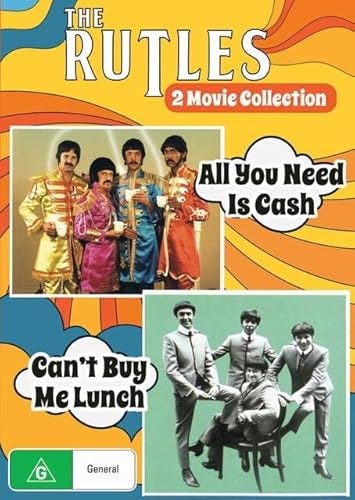
This essay continues below. Click on the title of this product to view on Amazon. As an Amazon Associate, I earn from qualifying purchases.
The Rutles: 2-Movie Collection (All You Need Is Cash / Can’t Buy Me Lunch)
The real test, of course, was what the Beatles themselves thought. George Harrison was predictably enthusiastic, later saying the film “sort of liberated me from the Beatles in a way“ and calling it the best, funniest, and most scathing thing ever made about them—done with the most love. He praised John Belushi’s portrayal of Ron Decline (the Allen Klein parody) and clearly enjoyed the film’s willingness to mock the band’s excesses while celebrating their genius. 💚
And John Lennon absolutely loved it. He was sent a videotape and soundtrack for approval and simply refused to return them. He kept singing “Cheese and Onions” to journalists who asked about the film and praised the cleverness of the parody songs. However, Lennon did offer one crucial piece of advice to Neil Innes: he warned that “Get Up and Go” sounded too close to “Get Back” and that ATV Music, which owned the Beatles catalogue, would likely sue. Lennon was right—the song was omitted from the vinyl release, and eventually ATV did sue Innes, settling for 50% of the royalties on the fourteen songs from the original album.
Ringo Starr had a more conflicted response. He appreciated the funnier moments but found the scenes depicting the band’s breakup and legal battles hit too close to home. The wounds were still relatively fresh in 1978, and watching a comedic recreation of painful memories proved difficult. He later joked that the Beatles and Rutles should have combined to form “the Brutles.” 🥁
Paul McCartney, perhaps unsurprisingly, was the holdout. His initial response was consistently “no comment.” According to Innes, an encounter between McCartney and Idle at an awards dinner was “a little frosty.” Paul had just released London Town and seemed to view the Rutles as an unwelcome reminder of the Beatles at a time when he was trying to establish his post-Beatles identity. However, according to Idle, McCartney eventually softened his stance when his wife Linda told him she found it funny—particularly because her character was played by Bianca Jagger.
The Rutles’ legacy proved surprisingly durable. The soundtrack spawned two UK hit singles, and in 1996, the band released Archaeology, a parody of the Beatles’ Anthology series. The film itself became a cult classic, often mentioned in the same breath as This Is Spinal Tap (which it actually predated by several years) as a pioneering mockumentary. For Beatles obsessives, it remains a treasure trove of inside jokes and affectionate needling—a reminder that even the most sacred cultural monuments benefit from being taken down a peg. 🎬
The beauty of the Rutles was that they managed something almost impossible: they were simultaneously reverent and irreverent, loving and mocking, serious and silly. They understood that the Beatles story had become so mythologized, so surrounded by awe and hagiography, that it desperately needed someone to point out the absurdity of four lads from Liverpool accidentally becoming the most important cultural force of the twentieth century. And in doing so with such musical sophistication and comic precision, they created something that stands on its own—not just as parody, but as a genuine contribution to the Beatles’ story, told from an angle no one else dared to attempt.