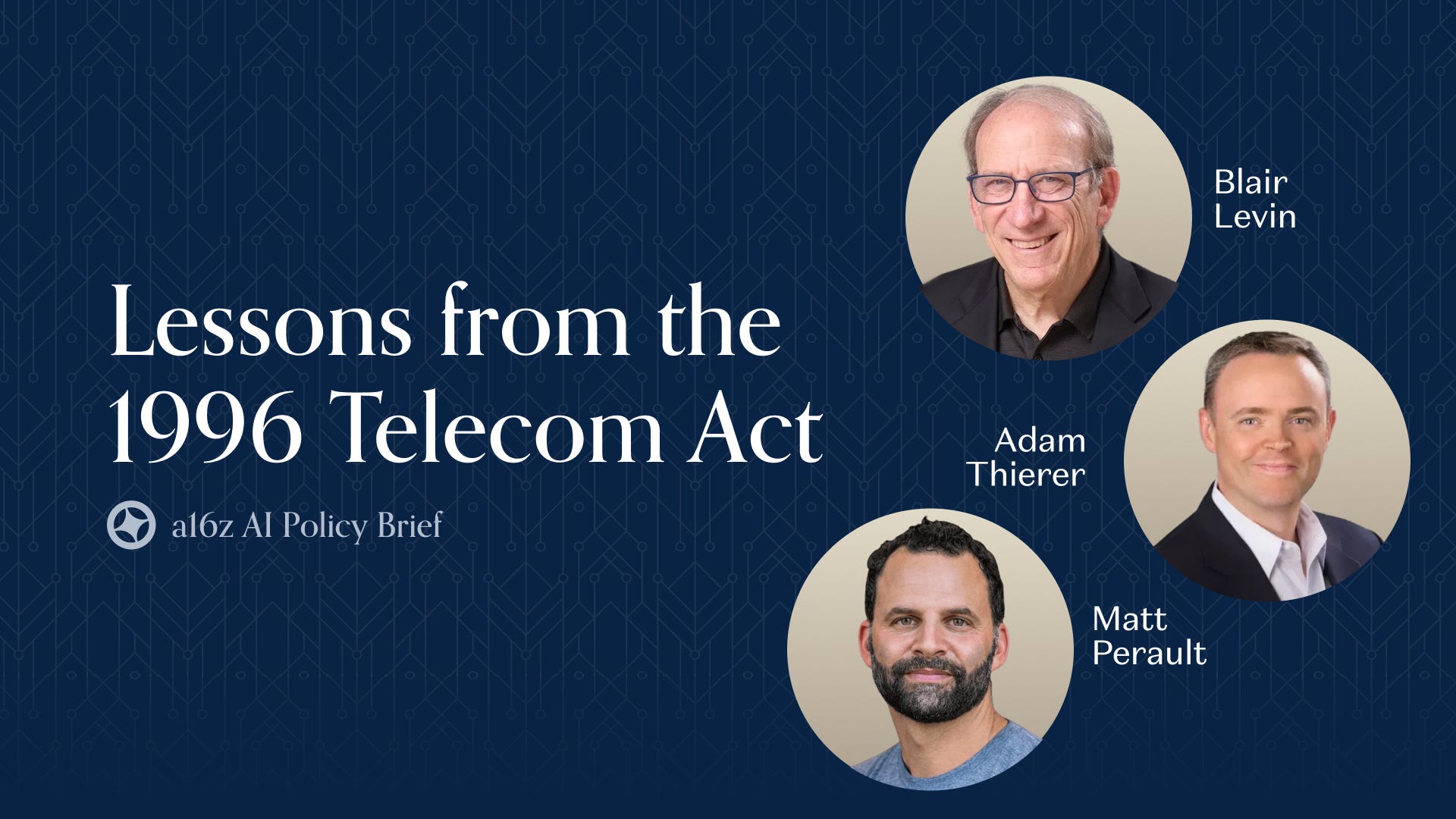
If you squint at today’s AI policy debates, you may see the Telecommunications Act of 1996 in the distance.
In this conversation, Matt Perault, head of AI policy, a16z, sits down with Adam Thierer, resident senior fellow, technology and innovation, R Street Institute, and Blair Levin, policy analyst, New Street Research and non-resident senior associate, Center for Strategic and International Studies, to revisit their first-hand experience tackling a similarly significant moment in tech policy: a small number of incumbents with entrenched market power, a messy patchwork of federal and local rules, and misaligned governing authority. The result then was federal preemption coupled with a comprehensive national framework for telecommunications—all through a bipartisan deal.
Topics Covered:
00:00: The Telecom Act’s “big bargain”
02:05: Competition as the heart of the deal
04:26: Telecom’s regulatory thicket and move to a national framework
07:39: Preemption, ambiguity, and the FCC’s role
11:58: How the Telecom Act got done: politics, persuasion, and public opinion
17:39: Terminating access charges and “regulating on behalf of” the internet
21:13: Federal vs. state authority and lessons for AI
26:09: Leadership, vision, and a new “constitutional moment” for tech policy
34:57: Institutional capacity and the missing expert home for AI
39:55: What a “Telecom Act for AI” might look like
Resources:
Follow Matt Perault: https://x.com/MattPerault
Subscribe to the a16z AI Policy Brief: https://a16zpolicy.substack.com/
Please note that the content here is for informational purposes only; should NOT be taken as legal, business, tax, or investment advice or be used to evaluate any investment or security; and is not directed at any investors or potential investors in any a16z fund. a16z and its affiliates may maintain investments in the companies discussed. For more details please see a16z.com/disclosures.