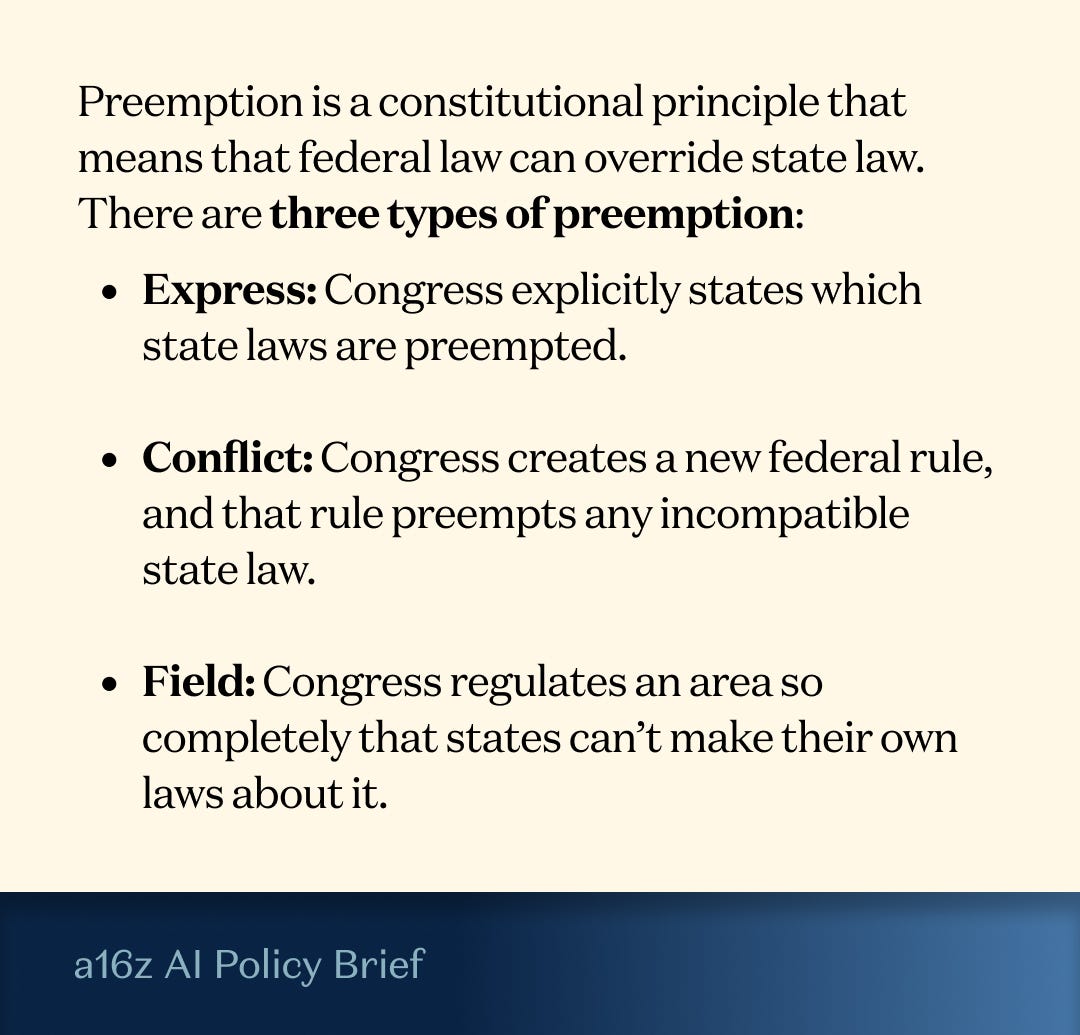
There may be no more important debate in AI policy right now than how power to regulate AI should be divided between the federal and state governments.
We first wrote about the respective roles of Congress and state governments in early 2025, as we saw states throughout the country introducing bills that would regulate how AI models are built. Now, with speculation about potential Congressional action to clarify the role of the federal government in regulating AI, the same questions proliferate: What can Congress regulate? What can states regulate? And where are the constitutional limits on their respective governing powers?
We asked a panel of leading appellate lawyers to explain the state of the law on these questions.
Allon Kedem, partner, Appellate and Supreme Court practice, Arnold & Porter, Paul Mezzina, partner, Appellate, Constitutional and Administrative Law practice, King & Spalding, and William Jay, partner, Appellate and Supreme Court Litigation practice, Goodwin, join Matt Perault, head of AI policy, a16z, to explain how federal preemption, the dormant Commerce Clause, and the First Amendment intersect with AI policy in this moment.
This is part one, focused on preemption. Stay tuned for upcoming conversations on the Commerce Clause and the First Amendment.
Stay updated:
Subscribe to the a16z AI Policy Brief: https://a16zpolicy.substack.com/
Please note that the content here is for informational purposes only; should NOT be taken as legal, business, tax, or investment advice or be used to evaluate any investment or security; and is not directed at any investors or potential investors in any a16z fund. a16z and its affiliates may maintain investments in the companies discussed. For more details please see a16z.com/disclosures.