Act I: The Conclave of the Condemned
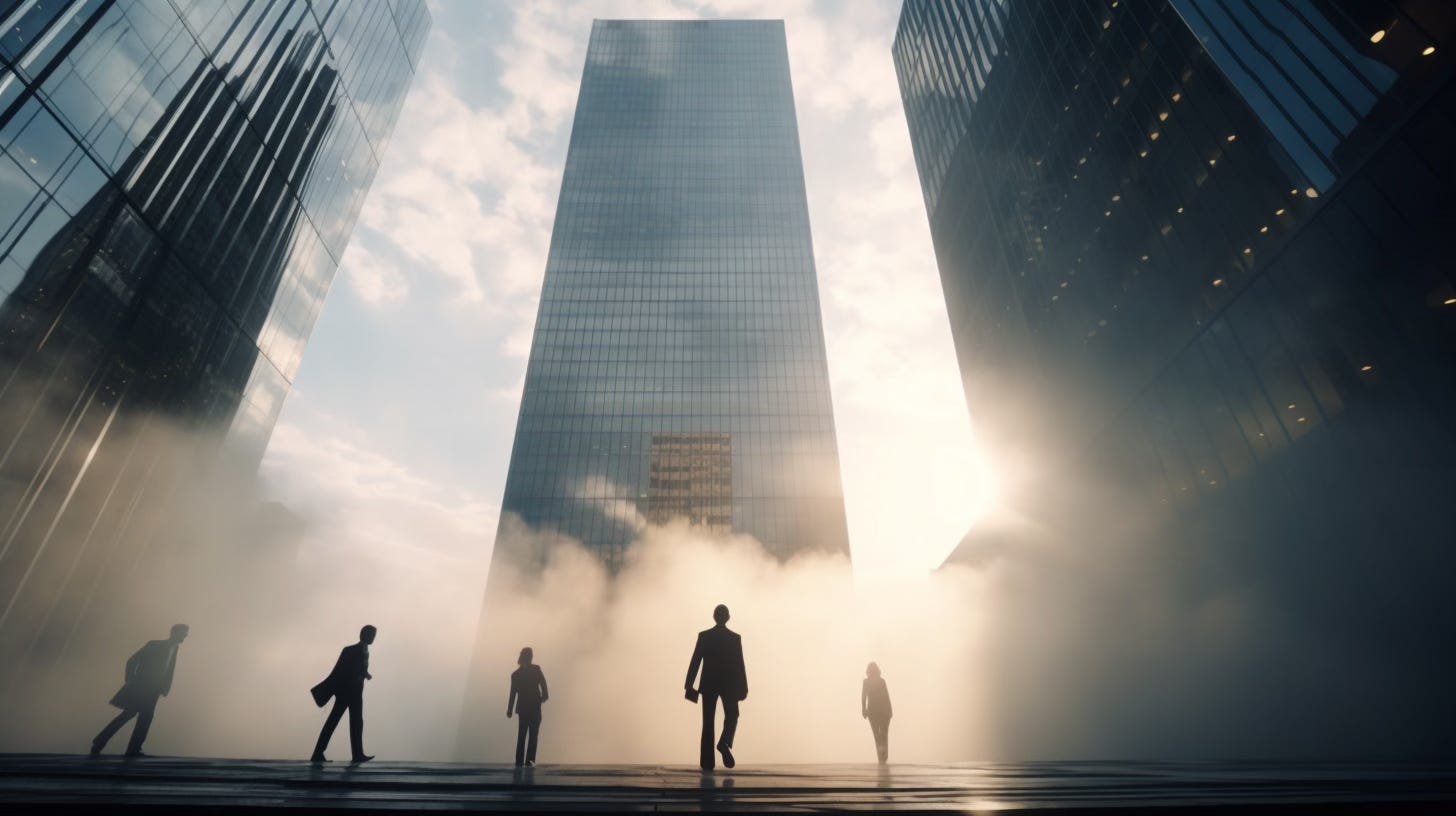
Rising like an obelisk amid the San Francisco fog—which could never quite decide if it wanted to be a whimsical mist or an impenetrable veil—Quantamora Labs stood sentry over Market Street. The skyscraper seemed to be caught in eternal contemplation, as though mulling over some grand existential question, a Socratic dialogue rendered in steel and glass. This architectural titan was less a building and more a cathedral to the unyielding ambitions of tech, a sanctum where venture capital was the incense and IPOs the gospel.
Yet, on this particular morning, as the sun mustered the courage to pierce the San Francisco brume, the atmosphere within Quantamora’s hallowed halls was anything but reverential. The mood was more akin to a Samuel Beckett play—absurdist and tinged with existential ennui. Here, in the cavernous expanse of an office that could have doubled as a minimalist art exhibit, empty chairs gathered like mourners at a funeral where the deceased had no next of kin. Rows of monitors, all dark and vacant, seemed to peer into the souls of the few occupants like the bottomless eyes of a cosmic creature from a Lovecraftian tale.
In this sea of emptiness, Dorian found himself adrift but oddly focused. He was a digital Da Vinci, a designer whose skill at the art of pixels and vectors was nothing short of alchemy. His workstation was his atelier, a place where each click and drag transformed digital clay into sculptures of graphic wonder. Dual monitors spread before him like a diptych of endless possibilities, one screen filled with vibrant color palettes, the other with intricate wireframes. His fingers danced on his trackpad with the grace of a ballet dancer and the precision of a surgeon, each movement carefully choreographed to a silent rhythm only he could hear.
Amidst his focused flurry, the ambient noise of his surroundings seeped in. Slack notifications popped up like annoying gnats, each one breaking his concentration and pulling him back into the corporeal world. These digital nudges were often messages from upper management, pontificating about the “immense value of serendipitous collaboration.” It was the company’s favorite buzz phrase, recited like a mantra but understood by few. Yet, here he was—alone in a room designed for hundreds, surrounded by emptiness, and serendipitously collaborating with no one.
It was in this paradoxical moment that Dorian felt both isolated and part of something larger—an intricate tapestry of corporate absurdity, woven with threads of ambition, irony, and a looming sense of rebellion. Little did he know that this day, this peculiar moment of solitary reflection, was merely the prologue to an odyssey of unforeseen alliances and audacious undertakings.
Act II: The Intervention of the IT Sorceress
Dorian was immersed in his craft, his fingers working like a virtuoso playing a demanding concerto, when a soft knock at the door broke his reverie. The door creaked open with the timidity of a first-time actor stepping onto the stage, and in sauntered Madeline—the grand sorceress of the IT realm. Her arrival was as inconspicuous as her role was indispensable. She was the guardian of the digital realms, the one who could wield a hex key like a wizard’s staff and conjure solutions from lines of esoteric code.
Madeline’s toolbox was her grimoire, a Pandora’s box of technical curiosities. It was filled to the brim with an assortment of cables that resembled arcane runes, screws that were more like alchemical symbols, and scripts that held the incantations to exorcise the most stubborn of digital demons. Her attire was a pastiche of casual wear and tech swag—jeans paired with a t-shirt that declared her allegiance to Open Source. This ensemble hid the magnitude of her powers, her ability to make the inanimate animate, to turn mere machines into willing accomplices of human enterprise.
With a smile that could charm even the most recalcitrant motherboard, Madeline spoke. “Ah, it appears that your desk’s motor has joined the corporate resistance. It seems to be yearning for emancipation from its mechanical drudgery. May I?”
Dorian looked up, his eyes momentarily disengaging from the hypnotic glow of his screens. “By all means,” he replied, sweeping his desk clean of an assortment of designer trinkets, limited-edition action figures, and a bonsai tree that was more zen garden than office decoration. “Let’s not stifle its burgeoning quest for mechanical self-determination.”
Unfurling her toolkit with the flair of a magician revealing her props, Madeline selected her screwdriver. It was no ordinary tool but her wand of the modern age, capable of both tightening loose ends and unraveling existential conundrums. She knelt beside the rebellious desk, peering into its mechanical innards as if trying to understand its soul.
As Madeline commenced her ritual of repair, their conversation took an unexpected turn. It meandered from the banality of office life to the existential pitfalls of adulthood, each topic dissected with the kind of analytical vigor usually reserved for philosophical treatises. Then, as though guided by some cosmic joke—or perhaps by the algorithm of serendipity—they stumbled upon a shared passion. A passion so arcane and whimsical that it transcended the bounds of conventional hobbies.
Potato portraiture.
Yes, you read that right. This was the art of using the humble, earthy spud as a canvas upon which they sculpted likenesses of historical figures and modern icons. From Winston Churchill to Beyoncé, each potato became a vessel for their artistic and somewhat absurd aspirations. In a world filled with high-res screens and 3D printers, here was a pursuit that was as delightfully pointless as it was profoundly engaging.
Both paused, realizing that this newfound commonality was not just another line on their resumes of quirky interests, but a potential catalyst for something far more revolutionary. Little did they know that this serendipitous meeting, sparked by a rebellious desk motor and sealed by the mutual love of potato portraiture, was the first note in a symphony yet to be composed.
Act III: The Arrival of the Ghost Town’s Guardian.
No sooner had Madeline executed the final twist of her magical screwdriver, sealing the pact between human and machine, than the atmosphere in the room changed. It was as though someone had flipped a switch in the very fabric of reality, sending ripples through the ether. And then, in a moment that would have made a lesser writer resort to clichés about apparitions, Leonard materialized.
Leonard was the building’s security patrol person, but that title scarcely did him justice. He was more like the guardian spirit of this deserted corporate cathedral, the Cerberus at the gates of this Hades of high-rises. His job description may have read ‘security,’ but his essence was that of a multifaceted renaissance man. Leonard was a janitor of the physical and metaphysical, sweeping away not just the detritus of daily operations but also the existential cobwebs that cluttered the corners of Quantamora Labs.
Yet, there was another layer to Leonard that few knew or even suspected. Unbeknownst to his co-workers, who barely acknowledged him as they rushed past him on their self-important errands, Leonard was also a clandestine composer of electronic music. His badge, that laminated piece of bureaucratic mundanity, was in fact his talisman—a shield that protected him from the existential maelstrom that swirled through the hallways like a tempest seeking an outlet.
Madeline looked up from her toolkit, her eyes meeting Leonard’s as if recognizing a kindred spirit. “Ah, Leonard, the lone guardian of this ghostly realm,” she greeted, her voice laden with a reverence that one might reserve for a celestial apparition. “Your appearance is as stark and mysterious as a Banksy mural suddenly materializing on a barren wall. What brings you to this corner of our corporate netherworld?”
Leona…