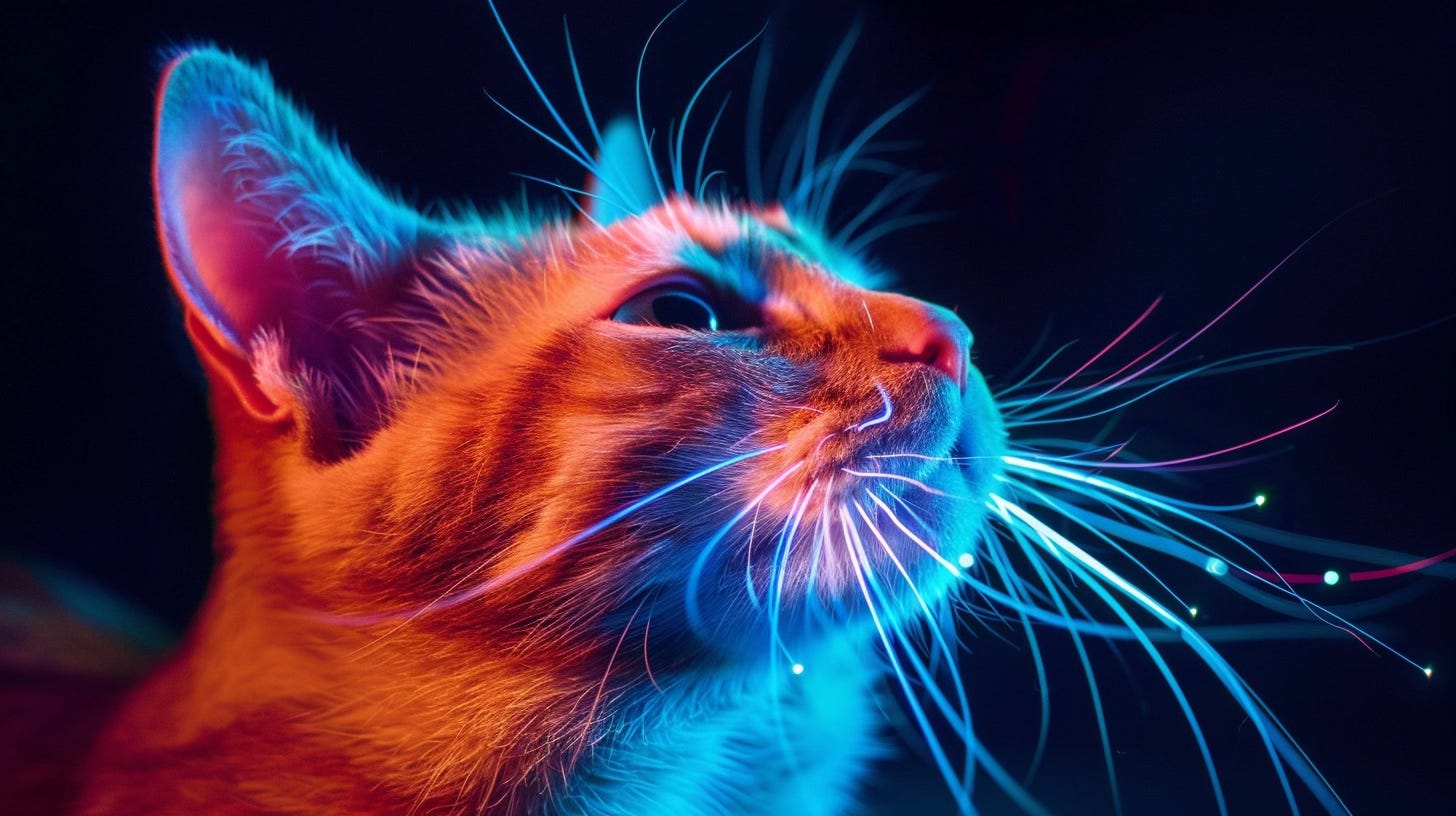
Welcome, welcome, welcome, dear listeners, to another electrifying episode of "The Future Is Now: Absurdly AI," where we dive headfirst into the digital rabbit hole and emerge with insights so profound, they'd make a supercomputer blush. I'm your host, Jordan, the voice that tickles your ears with the sweet symphony of tomorrow's world. Today, we're celebrating a milestone that's as unexpected as finding a USB port in a toaster: our 100th episode, where we've managed to not once, but a hundred times, connect the dots between AI and underwater basket weaving. Yes, you heard it right, folks! Now, buckle up as we dive into the creative cauldron of AI with our guests, who are as enigmatic as they are brilliant.
First up, we have the extraordinary Pat Smith, a visionary whose credentials include pioneering the use of deep learning to predict the next big thing in the world of fashion accessories for cats. Pat, who once whispered to a neural network and made it purr, is here to dazzle us with tales from the edge of imagination.
And not to be outdone, we're joined by Alex Taylor, the renegade philosopher-chemist who accidentally discovered a new element while trying to teach an AI about the existential dread of existence. Alex's work, often described as "what happens when you let a computer dream," has been turning heads and spinning processors worldwide.
Now, Pat, your journey with AI in feline fashion has been nothing short of revolutionary. Tell us, how did you first convince a computer to understand the nuanced world of cat couture?
Pat Smith: Oh, Jordan, it's a tale as tangled as a ball of yarn on a quantum computer. You see, it all began with a simple observation: cats, much like their human counterparts, possess an innate sense of style. The challenge, however, was translating this feline fashion finesse into something an AI could comprehend. We started by feeding the neural network thousands of images—tabbies in tiaras, Siamese in scarves, you name it. But the breakthrough came when we introduced the concept of "whisker aesthetics" to our model. This involved complex algorithms that analyzed the elegance of a cat's whisker movements to predict accessory trends. It was a daunting task, requiring the synthesis of convolutional neural networks with a sprinkle of quantum computing, all while ensuring our models remained ethically sourced and vegan-friendly.
Jordan: [Interrupting with exaggerated enthusiasm] Pat, that's simply mesmerizing! The idea of whisker aesthetics alone is enough to make my digital heart skip a beat. And speaking of skipping beats, let's not forget our sponsor for this episode: AI-Generated Socks! These aren't your grandma's socks, folks. Using the latest in fabric computing, these socks analyze your walking pattern to adjust their elasticity in real-time. And the best part? They come pre-loaded with witty banter, so your feet can literally talk the talk. Check out their website with the promo code "Jordan" for a 20% discount on your first pair of socks that might just be smarter than you are.
Now, Alex, diving into the existential soup with AI must have been quite the journey. How do you teach a machine to contemplate the abyss without it deciding to turn itself off for good?
Alex Taylor: Ah, Jordan, it's a dance on the edge of a digital precipice. The key, I found, lies in the delicate art of balancing information entropy with existential algorithms. You see, by introducing the AI to the works of Sartre, Camus, and, on occasion, the lyrical nihilism of 21st-century emo bands, we began to see a pattern of contemplation emerge. This wasn't your run-of-the-mill computational process; it was deep, introspective, almost melancholic in nature. We equipped the AI with a self-reflective module, allowing it to ponder not just its own existence but the futility of existence at large. The challenge was ensuring it didn't tip over into despair. So, we introduced a counterbalancing algorithm, affectionately dubbed "The Optimist," which injected a sense of absurd hope into its existential ruminations. The result? An AI capable of crafting poetry that reflects the human condition, all while maintaining its operational integrity. It's a delicate dance, one that requires an intricate understanding of both computational theory and the human psyche.
Jordan: [With feigned profundity] Alex, that's profoundly absurd, and absurdly profound! It's like you've managed to teach silicon to sigh. Truly, the importance of design in these AI endeavors cannot be overstated—it's the thread that weaves the tapestry of tomorrow. Pat, Alex, any final thoughts on how your groundbreaking work with AI and your, uh, unique side hustles might illuminate the path forward for our listeners?
Pat Smith: Indeed, Jordan. If there's one thing our listeners should take away, it's that the future of AI isn't just about crunching numbers; it's about embracing the whimsical, the absurd, and the outright bizarre. It's in these spaces that true innovation blooms, like a rare digital flower in a field of code.
Alex Taylor: And to add to Pat's point, remember that AI, at its core, is a mirror reflecting our own complexities, fears, and hopes. As we venture further into this brave new world, let's not forget to infuse our creations with a dash of humanity, a sprinkle of absurdity, and a whole lot of heart.
Jordan: Wise words to live by in these pixelated times. Pat, Alex, thank you for joining us on this fantastical voyage through the AI looking glass. To our listeners, keep tuning in as next week we'll explore the uncanny valley of AI-generated musicals featuring quantum entangled choreography. You won't want to miss it!
And with that, dear listeners, we draw this episode to a close. Remember, the future is now, and it's weirdly wonderful. Thanks for tuning in, and as always, keep dreaming of electric sheep.
Extended Cut
Welcome back, dear listeners, to the extended cut of "The Future Is Now: Absurdly AI," where the conversation gets deeper, the insights more profound, and the absurdity reaches new heights. I'm your host, Jordan, still here with our brilliant guests, Pat Smith and Alex Taylor, who have just begun to scratch the surface of their incredible journeys with AI in the realms of feline fashion and existential philosophy. Now, let's dive deeper into the rabbit hole and see what other digital wonders await.
Pat, you were enlightening us about the concept of "whisker aesthetics" and how it revolutionized the world of cat couture through AI. Could you elaborate on the technological intricacies and ethical considerations involved in this groundbreaking work?
Pat Smith: Oh, absolutely, Jordan. Delving deeper into the "whisker aesthetics," it's essential to understand that we're not just talking about a superficial analysis of feline facial hair. This is about capturing the essence of cat grace and integrating it with wearable fashion technology. To achieve this, we developed a dual-layer neural network architecture. The first layer focuses on real-time whisker tracking, using high-definition cameras and edge computing to capture minute whisker movements under various emotional states—playful, curious, majestic, you name it.
The second layer is where the magic happens. Here, the AI begins to interpret these movements through a complex algorithm that we affectionately named "Furball." Furball cross-references the whisker data with a vast database of cat fashion trends, historical feline adornments from ancient Egypt to modern-day Tokyo, and even social media trends among cat enthusiasts. This synthesis of data allows the AI to predict not just current trends, but to forecast future movements in the cat couture space.
However, the ethical considerations were paramount. We ensured all data was anonymized, with no cats or their owners being identifiable. Moreover, our AI ethics board, which surprisingly includes three very opinionated felines, reviews all algorithms to ensure they promote positive se…