Should The Information Exchange be renamed Interoperability Office Hours? Last episode we graded TEFCA. This time we’re reviewing homework of our good friends Quinn Emmanuel and Cravath in Particle v. Epic and answering some of the meatiest health information exchange questions of our time.
After Judge Buchwald let some claims survive Epic’s motion to dismiss last fall, she did something unusual: rather than open the floodgates to full discovery, she carved out a limited Phase I focused entirely on market definition. But when time was up at the end of May and that didn’t really solve the problem, she doubled down and handed both Particle and Epic a take-home exam.
So Pryce, Brad, and I sat down to read each student’s answers:
* What is a payer platform, and is there even a market for one (that just includes Particle and Epic)?
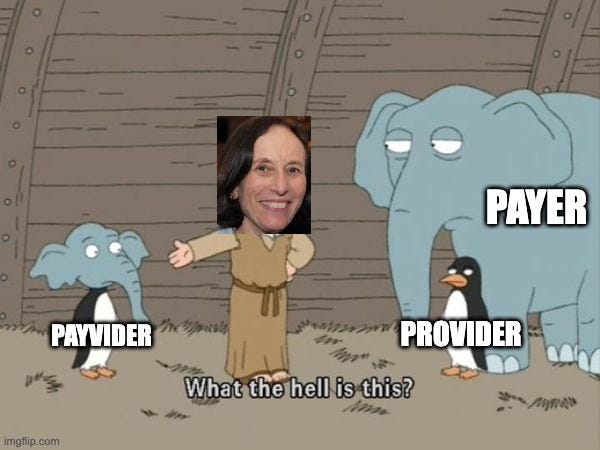
* What separates a payer from a payvider from a provider, and does anyone actually like the word “payvider”?
* When do operations and treatment converge, and why does the pricing gap between the two distort everything around it?
We work through all ten questions, the redactions hiding the spicy parts, and what we think Buchwald does next.
Fair warning: none of us are lawyers and none of this should be construed as legal advice. However, there’s a sustained rant about arbitrage, and at least one antitrust doctrine gets renamed the “Pryce Ancona break-things” test.
Let’s dig in.
Relevant Articles
* The Take-Home Exam: Summarizing the assignment from Judge Buchwald to Particle and Epic a few weeks ago.
* The Doggy-Bag Era of Content: On LLM verbosity and the need for brevity in this era
* Particle v. Epic: The Grandaddy Lawsuit Returns: The first post after Phase I concluded, looking ahead at what’s to come
* Older related content
* Epic v. Particle: The original summary of Epic and Particle’s Carequality dispute
* Epic v. Particle 2: The Problem of Secondary Use: A followup to the above that focused on secondary use and its role in the conflict
* The Particle v Epic Casebook:A summary of the case proceedings in October
* Amber, Stenotypes, and Antitrust: Epic losing its motion to stay discovery in CureIS, which we were sure Epic was jealous of
Chapters
* Intro and the Take-Home Exam (0:00 – 4:49): The crew swaps the usual format for a graded exam. Background on Particle v. Epic since September 2024, the surviving antitrust and tortious interference claims, and why Buchwald, skeptical of the alleged market, wants five pages from each side in plain English.
* Q1: What Is a Payer Platform? (4:49 – 11:39): Whether Epic Payer Platform and Particle’s product are substitutes in a single market. Pryce’s CDA-to-chart-summary walkthrough, payers paying out the wazoo for treatment-rail data, and the hammer-versus-mallet question of whether a product market exists at all.
* Q2: Payer, Payvider, Provider (11:39 – 16:31): Provider is the easy one, payer is the financial risk bearer, and payvider is the term nobody will commit to under oath. Epic disowns the word, the Apple hardware-or-software analogy, and the two-instances-of-Epic compliance boundary.
* Q3–Q5: Customer Mix and Active Role (16:31 – 21:24): Particle claims 100% VBC payers and payviders; Epic backdates 23 payer customers plus provider users as a wrinkle. Q4 discovery is a wash, and Q5 on whether a pure payer takes an active role in member health is really question two in disguise.
* Treatment, Operations, and the Arbitrage Rant (21:24 – 29:38): The trench-coat problem with payvider, the HIPAA operations definition and HEDIS, and Pryce’s river separating treatment from operations. Brendan’s side quest on pricing treatment exchange at zero while operations pays market rate, and the incentive to abuse the networks.
* Q7–Q8: Same Customers, Same Products? (29:38 – 33:44): Whether EPP and Signal serve different customers in different ways. Particle says any differences are implementation detail; Epic says Signal runs one-way over Carequality for treatment while EPP can’t even reach Oracle or Athena. Barrier to entry and whether explaining it this simply undercuts the two-player market.
* Q9–Q10: Purpose of Use and the Break-Things Test (33:44 – 37:18): Whether HIPAA purpose of use defines a product market. The Pryce Ancona break-things test on reasonable interchangeability, Epic turning Particle’s Innovaccer argument back on EPP, and the extra-credit treatment question buried under redactions.
* Grading the Exam (37:18 – 40:46): Buchwald as philosopher of treatment and operations. Brad finds Epic’s market definition more compelling, Pryce thinks they’re splitting hairs, and Brendan predicts summary judgment against the antitrust claim with the tortious interference count surviving to narrower discovery.
* Spurs, Knicks, and Sign-Off (40:46 – End): Playoff trash talk and a closing nod to the underdog in both the court case and the NBA.
Transcript
We ran the transcript through an LLM to smooth it out. So it’s a rough approximation of the conversation (and in many cases significantly clearer than our rambling), but notably diverges from the word-by-word blows quite a bit.
Brendan Keeler (00:00): Right. We’re back. And you know, we did the TEFCA episode last time. We’re gonna change up the format. We’re gonna do an exam. Namely Judge Buchwald’s exam, which she gave to two of the leading health tech companies out there today, Particle and Epic.
This is a long time coming. This case has been progressing since September 2024. Made it through a motion to dismiss, with some of the claims being knocked out, but the antitrust claim, some of the antitrust claims, and a tortious interference claim making it through to the next phase. However, Buchwald scrunched it and said, hey, discovery is not gonna progress in full. Instead, you’re just gonna prove to me that we can actually figure out what a payer and a provider are, what treatment is, whether there’s an actual market here for a payer platform. Because the key assertion from Particle in their antitrust claims is what is the relevant product market, and the product market asserted is this payer platform that they asserted only Epic and Particle had.
That’s been going since last September, 2025. We’re exiting Phase 1 and there’s still a fight. And Particle and Epic are pushing for motion for summary judgment by Epic, pushing for actual full discovery by Particle. And Judge Buchwald has concluded that they’re just restating the same things that they did last fall, and she needs a five-pager from each of them on these key questions, with as little industry jargon as possible. So what do you guys think it means when a federal judge has to ask these tech companies to explain their own products in plain English? What does that say to you?
Brad Thorson (01:48): I mean, I don’t know how long the typical litigation process is in healthcare, but it’s pretty clear she doesn’t want to be caught in this for another five years. And that there’s, you know, circular definitions. It just screams of like, can we just call X X and Y Y, and nobody is willing to say we agree on these, except for, we will say treatment is specifically this particular clause in HIPAA. Aside from that, let’s all just create our own definitions. So you can just hear her frustration. And as somebody who’s not involved in this at all, it’s pretty funny.
Brendan Keeler (02:26): Pryce, what do you think?
Pryce (02:26): This is a teacher to me. I’m getting a teacher who’s like, that’s an interesting explanation. Make it an eighth as many words and make it much clearer and then maybe I’ll think that you did a good job.
Brad Thorson (02:29): It did not feel gentle. This felt very much like everybody shut up and just say what you want to say. I’m reading “See Me After Class.”
Pryce (02:55): Yeah, exactly. Which is awesome. Nowadays, you know, with generative LLMs and things like that, everyone can say everything all the time, as many words as they want, as confusing as they want. SAT words are a dime a dozen. But when someone says, I want you to be able to explain this to my mom or something like that, I know I’m doing a good job of teaching if I can explain a concept from our industry to my mother who doesn’t care about our industry. And so I love the idea that it’s like, let’s distill this. I want you to say this as plainly as possible, because it’s giving a hint of like, both of you are trying to mask what you actually believe. So now choose your words carefully. And I’m excited to dive in.
Brad Thorson (03:45): Have either of you seen Succession?
Pryce (03:48): A little bit.
Brad Thorson (03:49): There can be like seven-minute scenes where multiple characters are talking about something and there’s no way to discern what the hell they’re talking about. It is just word buzz salad. Whatever happens with LLMs in the legal profession, I’m betting that Quinn Emanuel lawyers have an opportunity to write on the Succession reboot whenever we’re ready.
Brendan Keeler (04:12): One, “brevity is the soul of wit” is now “brevity is the soul of liveliness.” And Judge Buchwald is internalizing that and hoping that gets us through here. I’m also just, before we dive in, doubtful, right? The whole case is predicated on them having different opinions about what the product market definition is and being like, hey, please just come to an agreement about it. Doesn’t seem likely.
Pryce (04:31): Well, did she expect agreement, or did she expect them to actually just have to paint with primary colors and then we’re gonna see that one is red and one is orange? I guess those probably aren’t both primary colors, but they’re different. And that’s worth seeing.
Brendan Keeler (04:49): For sure. They have responded, but before we do that, let’s just walk through the questions and talk through it. The first question is “What is Particle’s definition of the relevant product market?” I don’t know if anyone has thoughts there.
Pryce (05:03): Interesting too, the wording there is what is Particle’s definition? But then both Epic and Particle have to answer that.
Brendan Keeler (05:09): They’ve kind of skated all over the rink with this one. The judge is like, all right, we’ve already been going for a long time. Let’s agree about what the original assertion was, which is wild to your point.
Brad Thorson (05:22): I mean, are we getting into the definition of a payvider? ‘Cause that’s where this all comes down to.
Brendan Keeler (05:27): Well, that’s exactly question two. How do the parties define payer, payvider, and provider?
Brad Thorson (05:33): Okay, so going back to question one in defining what the market is, maybe a question for Brendan, ‘cause I don’t know how closely I read this. When they list the number of customers that they have, was that at the point of the lawsuit or is that today?
Brendan Keeler (05:48): Yeah, Epic backdated their customers. But it was also said that they’ve progressed in selling their payer platform.
Brad Thorson (05:55): One takeaway from this is EPP is bigger than I thought it was, if that’s backdated. What Particle’s definition of the market is doesn’t really matter outside of what a payvider is, because that’s where this all to me kind of fell apart. And I don’t know if that’s a law firm thing because they were forced to speak in plain English, or if we really just want to have this aggressively broad definition of payvider. But Epic’s lawyers came in strong, expecting what Particle was gonna say and just saying like, everybody cannot be a payvider.
Brendan Keeler (06:32): Is a payer platform a thing in your guys’ mind?
Brad Thorson (06:37): I mean, if we’re talking that payments and operations are a separate rail of requests, then yes.
Brendan Keeler (06:42): Pryce, you’re shaking your head.
Brad Thorson (06:45): You can do the queries over the same rails, but it’s outside of the spirit of, well, we’re gonna get into Carequality in a second.
Pryce (06:52): The payer platform as defined, like Epic’s answer to number one, is that it facilitates record retrieval at scale. And what this really means is, we can help collect CDA documents, which is the clinical document architecture standard. All of the electronic health records should be able to grab the problems list, the allergies, the medications, the immunizations, some encounter details, hopefully some labs, jam them into a chart summary, and exchange these on nationwide networks, right? And that happens in the billions today for the purpose of treating providers seeing these documents to treat patients. And of course, or maybe not of course if you didn’t know, payers will pay out the wazoo for this type of data. They want to know: of my 100,000 sickest patients, if I could get all of those chart summaries, I’m willing to pay Athena. I’m willing to pay Datavant to go fetch them. And I’m a covered entity, I’m allowed to access these things. They’re just not supposed to be doing it over the rails of some of these nationwide networks that say “we only exchange for treatment purposes right now.” But that’s what they’re aggregating, so that they can do analytics and say, of my sick patients, how do I make them healthier? How do I spend less money and make them happier? Hopefully retain their business or their employer’s business.
That’s too amorphous of a job to me. It sounds like I just described it simply, but there’s a hundred different protocols that you could use to communicate those documents. There’s a hundred different standards that you could use to communicate the same type of data in those documents, even though I was calling out one standard. There’s a hundred different entities and rails. So to me, this is like, is there a product market? Well, I don’t know. Would you say there’s a hammer product market? Or is there like a heavy metal thing that you whack nails with? Sometimes it’s like a hammer, sometimes it’s like more of a mallet, sometimes you use the butt of your drill if you’re in a pinch, or you’ve got an impact drill on your belt. That’s what’s happening.
Brendan Keeler (09:00): That’s right. Are they substitutes? And that, for question one, is the tough part for Particle. They need to say, okay, these are substitutes, right? There’s Epic Payer Platform and the way we’re doing it, even though they do it different hows, one’s the butt of the drill and one’s a more fit-for-purpose tool potentially, but they’re the same. But at the same time they need to say it’s only the two of us. There’s not these other things.
Pryce (09:26): That’s the hard part to me.
Brendan Keeler (09:29): But they’re trying. So their answer for question one, let’s go through it. Particle said payer platforms are software enabling healthcare payers to collaborate with providers in value-based care models, defining features of real-time, bidirectional, at scale, clinical data plus alerting, analytics, and longitudinal storage. Well, why, if you squint at it, is that a clearinghouse? Is that a population health tool? Innovaccer is named in the case.
Pryce (09:48): That’s a clearinghouse.
Brendan Keeler (09:56): There’s a tough look there. It’s also interesting that they’re saying VBC so prominently, right? That VBC is one of the defining characteristics for these payer platforms.
Pryce (09:57): That there’s some aspect of risk bearing and the potential to capitalize by avoiding that risk. That’s what they’re saying there. It’s not just for the purposes of processing claims, it’s also for the purposes of avoiding future claims.
Brendan Keeler (10:25): They say if a payer takes an active role in improving the health quality of its members, that is their primary angle of attack.
Pryce (10:34): Which, again, I don’t disagree with what they said about a payer platform. I’m just gonna come out and say the same thing is true of a delegated authority who only manages your patients’ or members’ medication adherence. And it’s a completely different type of company. And the same thing is true of an entity who uses telehealth to manage all of your musculoskeletal members’ needs. It’s just way too broad in my opinion.
Brad Thorson (11:08): It’s also a bold set of letters to lean on when I don’t think that we could get the three of us to agree on what the clear definition of value-based care is. This to me felt like, we’re just opening up a different drain for Dino to swirl around for a while, because the three of us will have different definitions, and when we go ask three hundred strangers on the street, they’re not gonna know what it means. But we’ll also probably describe it differently as well. Reading VBC in this definition, I was like, no.
Brendan Keeler (11:39): So question two: payer, payvider, and provider. What do those mean to you guys?
Brad Thorson (11:45): Okay, so provider’s straightforward, right? We can all get to the same definition of provider. The delivery of care. And where we’re gonna end up having to argue is what happens when United owns Optum, or any of these other payers have a care delivery arm. But to me, not a lawyer. Somebody put a really big warning on this podcast that none of us are lawyers.
Brendan Keeler (12:11): IANAL.
Brad Thorson (12:13): I really struggle with the idea that providers in value-based care arrangements are not typically looking at the long-term risk of that population. They’re looking at like a defined period, 90 days after surgery, a year of enrollment or whatever. And for many payers, one of the major things that they’re doing is risk pooling across an enormous population. That is, if they have any function at all, it is that. And so that to me is where I feel pretty confident drawing the line on what’s a payer.
Pryce (12:47): Particle says a payer is an organization that assumes the financial risk of paying for a patient’s health care. And to your point, the reason you can do that is through actuarial sciences and grouping a bunch of people together and saying, on average, they’ll be this sick and we’re gonna have more money than that to care for them.
Brad Thorson (13:01): Yeah, but my problem is that feeds into their use of VBC, of like somebody who has an ACO and is accepting a fixed fee for their patients for the year. Yes, they are doing some sort of risk analysis of whether or not they think they’re gonna be able to deliver care at a lower cost than that. But it’s not at the level of, what do I think my oncology risk is across 30 million patients. They’re not doing the level of modeling to offer an insurance product. That’s my assumption: there is an order of magnitude difference in what those types of risk-calculating orgs are doing.
Brendan Keeler (13:39): In the interest of time, I’ll say the responses from Epic and Particle agree with you. They kind of land in the same spot where payer is a financial risk bearer, provider delivers care, and both of them say, well, payvider, in Particle’s terms, is just semantics. Like, what if instead of payvider we said payers engaged in value-based care as the group we’re talking about? Which is funny, because then you probably should start by saying that in your opening brief. Typically it’s not great to throw twists into these nuanced five-pager briefs as like, we’ve been talking about this the whole time. And then Epic is like, we disagree with the use of payvider as industry jargon. Which is interesting, because I remember that being a term when I was at Epic. Or maybe I’m hallucinating and it’s come into vogue since then. To me it always has described like Providence before they got rid of their operated plan. That was a payvider.
Pryce (14:39): I like Epic’s take. They say Epic did not endorse the term payvider. Which I kind of agree with. I would use the term payvider with you two. If I was giving a presentation, or if I was, I don’t know, maybe submitting documents to a judge, I don’t think I would say payvider. Is Apple a hardware or software company? Well, it’s both. And there are times that they’re completely separate and there are times that they’re inextricably intertwined.
Brad Thorson (15:08): A services company. That’s the answer. Pardon the divergence.
Pryce (15:11): Yeah. So it’s tricky though.
Brendan Keeler (15:13): Thank you, Tim Cook. What’s interesting is there’s some interesting stuff in the Epic letter that we haven’t really seen before. They say, well, when we have a payvider customer, they may have two instances of Epic, basically. They’re gonna have the provider group Optum and the payer group United on separate instances of Epic. And I wonder if that’s true for all payviders. I thought I remember there being one where it’s a merged instance and just, you know, UPMC is on one big old both-insurance-and-healthcare side. But maybe not. Maybe Epic does segment them in that way and thus keeps a clean boundary when allowing for certain functions.
Pryce (15:57): That’s not a function of technology. It’s a function of compliance. These people are not supposed to be allowed to see this data. And that’s normal. It’s probably smart of them, very calculated. But the whole point is, being a payer shouldn’t allow you access to crisis behavioral health notes, right? Just because. That’s gonna be in the weeds of state privacy laws and federal privacy laws and HIPAA and blah blah blah. We don’t know enough about that, but very interesting that they create that dichotomy.
Brendan Keeler (16:31): Question three. What percentage of EPP and Signal’s customer bases are payers, payviders, and/or providers? So what do we think? Are they selling to payers? Are they selling to providers? Are they selling to payviders? Any guesses on what shook out in these responses?
Brad Thorson (16:51): I mean, Particle said all of their customers at time of suit were payviders of the Signal product, which is also a can of worms I don’t want to open with you guys, but on-ramp product names are not something I’m fluent in the way that I know Spanish when I’m drinking.
Brendan Keeler (17:08): Signal is new. They added Signal to the mix after they filed the case. Once they filed the case, they were kind of like, okay, we’re selling Signal to payers. Prior to then, a little bit more behind the scenes. Pryce, any guesses?
Brad Thorson (17:19): And their delegated authorities. Sorry, go ahead.
Pryce (17:27): I guess out of the gate, none of these are providers. They have to be either payers or payviders, and there’s a mix. There’s gotta be a mix. You can’t have even up to three different customers and be like, they’re all payviders. I would be like, well, Aetna is a payer. I understand it’s owned by CVS Health, but let’s just, I think that goes back to Epic’s assertion that payvider is a nice term to use on the fly when you’re talking to someone. If we’re gonna define things, let’s define them black and white. So to me, yeah, you could call them payviders, you could call them payers, but there’s no way that you can call them exclusively payviders, in my opinion.
Brendan Keeler (18:11): So as you guys predicted, Particle says a hundred percent of payers for Epic Payer Platform are engaged in VBC. Signal, hundred percent payviders, same market, selling to the same people. That’s Particle’s take. Epic said we got twenty-three payer customers as of the time of the complaint. We have more now, but we’re backdating this thing. And then we also have provider customers. This was the twist. Because Epic Payer Platform is on both sides, right? You’re connecting over Epic Payer Platform to provider customers who must have it installed and set up to participate. They haven’t really talked about it from that angle, and it might give Judge Buchwald some reason to pause and be like, are these the same product? Are they the same users? Is the alleged market correct?
Brad Thorson (18:40): Three hundred plus?
Brendan Keeler (19:01): It’s kind of a smokescreen, I think, from Epic, but it was interesting to see them mention provider users as a wrinkle in this take-home exam. Question four we can kinda skip over. What further discovery does Particle need? Full merits. Let us get in there and see what we can dig up. ‘Cause that’s the whole point.
Brad Thorson (19:17): All of it. Yeah. And Epic, obviously they’re totally aligned with Particle on that one.
Brendan Keeler (19:29): Particle is super jealous of CureIS, because CureIS got moved to Madison in Wisconsin court by Epic’s push. And then because it did, that’s a rocket docket. They move very quick. And so they’re already doing discovery there, even though they’re still ruling on motion to dismiss and stuff. So I bet you they’re squinting like, man, the jurisdiction here, the venue here kind of handicapped them in their case.
Brad Thorson (19:56): To your point, question four, probably not a whole lot for us to discuss.
Brendan Keeler (20:01): Well, the last thing is Epic had like one sentence. No further discovery is necessary. What did you think they were gonna say? Question five: does a pure payer take an active role in member health through value-based care?
Brad Thorson (20:15): It’s a bad question. It’s a question that should have been asked as an addendum. Once we’ve graded the exams and we have to decide which one of you, if you’re both equal, then we’ll ask you this question. This is just a derivation of the answer to question two. I didn’t get much from it.
Brendan Keeler (20:31): Should a payer be trying to push a provider to do the right thing, push patients to do the right thing? Yes, that’s distinct in some ways from treatment. That’s the crux of the issue. Is oversight over care towards the right alternatives, the right care pathways, ownership of financial risk, does that equate to treatment based on the activities? That’s behind this question. And Particle says yes, payers bear the financial cost, so they’re self-interested to improve health, and that care coordination is treatment enough. And Epic says no, only providers can conduct treatment. They quote HIPAA very directly, the 2000 privacy rule, and payers can help improve care, but only a provider can provide care. That’s their angle, and they try and make the question irrelevant by virtue of that.
Brad Thorson (21:24): And I think that’s what you’re saying, Pryce. The use of payvider for people like us puts multiple people in a trench coat, but really there are multiple people under there. There’s also the definition of payer. There’s just too many strings to pull here. Why do employers have EAP programs? Sometimes it’s that they don’t think their TPAs are providing the right types of services. Sometimes it’s for retention. There’s all sorts of reasons that an employer, when they’re self-insured, may decide to introduce a bunch of services. I don’t think that we would consider Google to be a provider because they give their employees free therapy sessions through a third party.
Brad Thorson (22:10): Payvider is a bunch of things in a trench coat is the way that I’m gonna stick the landing here.
Brendan Keeler (22:16): That’s what Epic does say, right? They’re like, Particle’s definition is so broad it could be anybody. It could be you and me. Is that right or wrong? It’s a compelling argument.
Pryce (22:25): We said improving health, absolutely, payers can improve the health of their members. Treat? That’s a little bit more like, you should have an NPI in my opinion. There should be an encounter documented. And then don’t you have to bill yourself for that or something? There’s all sorts of laws that would have to do with treating. But now I’m even thinking, imagine one of the strongest payviders in the world.
Brendan Keeler (22:44): Money here goes to money there.
Pryce (22:53): Who does a great job of knowing their members and does a great job of primary care and preventative care and benefits. Even still, when and if I develop congestive heart failure, I’m gonna go see a cardiologist. And it might be at like a UCSF. And guess who’s gonna pay for it? My payer, who has been treating me well. I’ve had a longstanding treatment relationship with them, but at some point they’re just gonna be my risk-bearing entity. They can’t do it all. So I think there needs to be, okay, we understand that there’s a Venn diagram, but that doesn’t mean payers and providers can become the same thing without any sort of barrier between what they’re doing.
Brendan Keeler (23:38): So that linkage leads to question six, right? Which is, what is Epic’s definition of healthcare operations? We talked about what treatment is, what’s operations? I’m just gonna say what they said and you guys can muse on it. They both pointed to the HIPAA operations definition, unsurprisingly. And Particle’s just like, this is what operations is, next question. Epic said this is what operations is, which is inclusive of things like quality reviews for HEDIS, clinical guidelines for conditions like diabetes, patient safety activities, fraud detection. They went a little further to talk about what goes into operations, to sort of say these are administrative, these are not direct patient care, and Epic Payer Platform is built for those administrative and quality functions, not for treatment. So they used it as a launchpad to differentiate. Are you guys convinced by Epic?
Brad Thorson (24:40): What’s funny about this case is, the time that I’ve dedicated to being in interoperability kind of started around when this case originated. It basically describes what I always assumed payment and operations was, which was very validating to my own feelings. So I felt myself very aligned with Epic’s definition. That said, I’m the youngest one on this call, interoperability-experience-wise.
Pryce (25:06): This is all a spectrum, life is complex. At the end, all things come to a confluence and a river runs through it, right? And that river is what separates operations and treatment. I think a patient has to be involved in treatment. They gotta be there, or they gotta go pick up a med, or they gotta start taking the med, or they gotta hear their provider tell them something. Calculating my HEDIS metrics to decide if I can be more compliant next year is operations. It’s not treatment. I don’t care if it’s going to lead to treatment, but I do see a fine thread somewhere through the spectrum separating treatment and operations. And I think that’s necessary if we’re going to continue to lean on HIPAA indefinitely as the law of the land with regards to these different types of activities.
Brendan Keeler (25:57): Putting the case aside for a second and going back to the first article I wrote about this arena: it’s just b******t that we’ve set the price to zero and the cost of exchange to zero for one, but market rate for another that is a hundred X more expensive via more manual, less ubiquitous methods. That becomes problematic because people go, well, treatment is per patient in front of me, but what about if a provider is pulling data to review meds and think about things without a patient being in front of me? What if a patient’s been over the video call with me with telehealth? They’re not in front of me. What if it’s an async review? So we eroded away from your point, Pryce, what you posited, which is, well, if a provider’s involved and they’re doing some sort of treatment activity, it’s treatment. And then people look and they go, well, if Dr. Smith’s doing it for UCSF, and then Dr. Smith goes to work for Cigna and does the exact same activities, pursuing the same outcome, then why should he or she not have the same capabilities and rights? Why do they have to pay a much more expensive experience to go and push towards the same outcome of improving a patient’s health? So population health, in addition to telehealth and asynchronous care, eroded away some of the cleanliness of all these definitions. And now you throw AI bots and s**t in the mix and, good luck. Good luck trying to keep the two definitions separate. So what’s it mean? I think it means that the reality of where we need to go as an industry is finding a way to bring parity and allow operations to be functional and cheap so that we don’t have to have this weird arbitrage. The arbitrage ability of artificially setting the price to zero and allowing market rates and a shittier experience to be prevalent for the other side of the coin is the problem.
Pryce (27:50): We all might agree that the definition doesn’t really matter, except that right now the goods are priced at extraordinarily different rates. But if it was all just data, we would be like, yeah, as long as they’ve got an NPI or they’re a covered entity, who cares? Is that your assertion there, Brendan?
Brendan Keeler (28:09): That’s why it’s so important for us to find a way to ubiquity and similar price points, or there will always be an arbitrage opportunity and people will abuse the networks. Period. That’s incentives, people will follow them.
Brad Thorson (28:19): “Do incentives lead to fraud and abuse?” Sure, we don’t need to argue that here. I think we’re in agreement. I’m just imagining an HOV lane versus a regular lane. If we’ve all decided that an HOV lane must meet X requirements and there’s a single person driving in it, they get a ticket. There is not a world in which we suddenly just make payment and operations free or start charging for treatment. I feel like the definitions that came out of this exercise were very clear to me in a way that’s the spirit of the law as I’ve always understood it. And yeah, it would be great if we had the ability to say this is operations and I’ll pay into a Stripe account or something.
Brendan Keeler (29:01): I took us down a rabbit hole that is distinct from the case, and you’re right, this is such a clean case, clean brief, and I’m like, well, this is the way things should be. My end of the side quest here is, the rules can change. We can make up whatever freaking rules we want in this life, in this world, and we just have to go and see it through. And to me, we’re gonna have a million of these cases, because we already do. Since this case started, there’s been this—
Brad Thorson (29:26): The new rule is that your insurance plan is going to incentivize you to connect to an IAS network and upload your information to them and just call it a day.
Brendan Keeler (29:38): Is this sponsored by B.well? What are we doing? Anyway, moving on to question seven. Can Epic Payer Platform and Signal be used by different types of customers in different ways?
Brad Thorson (29:52): I think they have different types of customers, so yes.
Pryce (29:55): I’m far from a lawyer, so if anyone who really understands this case is listening, they’d probably think I’m an idiot. But a question like this to me is just, what is Particle gonna say to that? Of course they’re different. Of course they serve different things. What is it, a Family Guy meme or something, where all of the animals on the ark make a new animal that’s got the trunk of an elephant and the body of a giraffe? That’s what these tools are. They’re just functions patched together. Somebody decided to write a line of code and then it could be combined with a million different permutations. There’s no way that Particle can say these are the same products serving the same types of clients. But what did they say?
Brendan Keeler (30:39): Maybe this is the crux of it, circling back to the beginning where I’m like, the whole point is there’s gonna be disagreement, they’re not gonna agree about things, and this makes or breaks the case for them, right? Particle says yes, we both offer similar retrieval and storage and analytics functions. Any differences are just implementation differences, HIPAA purpose abuse doesn’t matter for the antitrust market. Epic, as you may expect, says, we have payer customers, we have provider users that Epic Payer Platform is segmented out to each of those. Signal is only used by payers querying one way over Carequality for treatment purpose of use, whereas Epic Payer Platform doesn’t run over those rails. It doesn’t use Carequality or other network exchanges. It can’t even retrieve from Oracle and Athena, which Signal can, right? All that to say, Epic says they’re different.
Pryce (31:34): I think there’s some merit in Particle’s response here, which, like you said, was both products provide a range of similar functionality for entities engaged in value-based care. There are differences at the margin, but they serve core retrieval, storage, and analytics functions that support VBC. I’m like, that’s a great answer. It also suggests that maybe you two aren’t the only ones doing this. It’s not a high bar. There’s not a difficult, what is it called when you enter a market or whatever?
Brendan Keeler (32:02): Barrier to entry.
Pryce (32:03): Yeah, if you’re explaining it this simply, how could you possibly assert that you were the only two doing this? So that’s my take.
Brendan Keeler (32:12): That’s the problem. Going back to earlier, they’re stuck between being like, no no no, these are the same market, we’re serving the same types of customers, and then also being like, no no no, but the Innovaccers of the world, the Arcadias of the world, anyone else that’s doing HCC coding, providing data, those are different. That’s tough. It’s just a tough look that is the reason we had this wonky phase one and this weird take-home test. They’re trying to thread the needle here. Okay, we’ve got a few minutes left, so let’s try and get through the remaining questions. Can a payer or payvider request records for treatment purposes through Epic Payer Platform or Signal?
Pryce (32:53): I don’t know the answer to this. This depends on their software.
Brad Thorson (32:58): Didn’t they both say yes?
Brendan Keeler (33:00): Particle says yes to both, right? Signal is for treatment. “Carequality says it’s permissible” is what they put into their response. “Epic might say that they’re only payment operations, but we have proof via discovery and their litigation position that they’re doing treatment as well” is what Particle says. A lot of this is redacted, so I don’t think that we actually see the proof. All the spicy stuff unfortunately is blocked. But Epic says no for Epic Payer Platform. They say you gotta be a payer, you gotta be doing it for operations and payment, it’s gonna be minimum necessary, whereas Signal is treatment. This and question seven are the critical ones, or could be the critical ones, for market definition.
Okay. Is HIPAA purpose of use a defining characteristic of a product market? If we’re saying whether they’re serving the same market, if we take Epic’s answer as correct, that Epic only pulls for operations or payment, Particle only pulls for treatment, does that mean by default they’re separate markets?
Pryce (33:44): No. Jackhammer, break things. Hammer, break things. Backhoe, break things.
Brad Thorson (34:14): This is the market distortion based on fees. This is Brendan’s can of worms, and I think we should just call it Brendan’s can of worms as the going-forward industry definition.
Brendan Keeler (34:26): Correct. It’s not, both of them say no. Particle says very clearly, nope, interchangeability. Jackhammer, the break-things test. I hope this got referenced in cases. The Pryce Ancona break-things test is a true antitrust test. It’s interchangeability, reasonable interchangeability of tools and of products. And they don’t care how they get data and what they can do with it. They hand-wave at secondary use and all that stuff that I don’t think we really need to get into. Epic says no, but if you actually look at the purposes of use, the distinctions, you can understand that they’re not reasonably interchangeable, because you’re getting records from just Epic providers, because you’re serving different client bases. So if a payer using Epic can’t switch, or vice versa, a treating provider can’t switch and use Epic Payer Platform, then they’re not substitutes.
And this actually gets to where they denied Innovaccer, right? Particle says Innovaccer is not a relevant competitor because it doesn’t query national interoperability networks to retrieve new clinical records across unaffiliated providers. Well, if that’s true, Epic says, neither does EPP. And that’s a really compelling argument.
Brad Thorson (35:43): Neither does EPP.
Brendan Keeler (35:50): Right, to utilize Particle’s own words against them.
Brad Thorson (35:53): Or, as the redacted content may say, Particle knows that that’s not a true assertion.
Brendan Keeler (35:59): Yeah, suffice to say, I think Particle has killer lines in theirs similarly, using Epic’s words against them. It’s just unfortunately redacted, whereas this part is not. Question ten, to close it out. Extra credit. Under what circumstances can Epic Payer Platform be used for treatment-related purposes?
Pryce (36:09): Extra credit. Brendan, you sort of disagreed with this earlier, but I don’t think it can.
Brad Thorson (36:24): The fact that they highlight Carequality rulings in their response here, that business associates can make that request. Isn’t that similar to what Particle was saying above as to why they think these are similar offerings?
Brendan Keeler (36:40): Yeah, I think you’re right to call that out, that Particle multiple times references the decision-making of Carequality. That being said, this is the same question as the one above it. Epic says we don’t do treatment requests, it can’t be used for treatment. So I think Particle uses this as a method to talk about the way that they legally pull data and the proof that they’re doing so prior. Epic just answers it point blank and says “we’re not.”
All right, well, that’s all ten. Do we want to grade the test? How do we think each party did?
Pryce (37:18): I couldn’t even keep track. This feels more like the honorable Naomi Buchwald has become the first ever philosopher of treatment and operations than some sort of mathematically true-or-false test to be graded. But I would say maybe my take would just be this. These are really, really interesting questions. And I like the way they were phrased, sort of to peel away what is a very fine film here that connects these use cases and products. But I think the answers on both sides, in my opinion, sort of scream like it’s not a small market. It’s not a single thing, a single job to be done. It’s not based on how you do things. It’s very much like what you’re doing and when you’re doing it. Epic, I think, has receipts to show, we’ve been down the straight and narrow path with regards to not using this network for this purpose, and we serve payers and providers very distinctly. I think it gives Epic the upper hand. But maybe not enough to not move to discovery. I just think reading this, you have to imagine, we’re splitting hairs here in a way that’s unnecessary and perhaps indicative that an antitrust case is not in the cards.
Brad Thorson (38:50): I found myself very quickly, just in skimming these, disagreeing with Particle’s definition of payvider. And it really skewed my reading of the rest of the responses. I found what Epic was writing around market definition to be far more compelling. And so the rest of their answers, I think I gave them a lot more credit. But I’m gonna be very interested to see what the decision around discovery is, because there are some redacted portions, maybe there’s some absolute bangers in there and we’ll find out about it. But I just thought that the definition of payvider on Particle’s side was particularly weak.
Pryce (39:26): People are gonna wanna know, what is the Health API Guy take?
Brendan Keeler (39:29): What we think is right or wrong about these topics, as you heard me digress and go off on a side quest, is totally distinct from antitrust law. We’re not lawyers, but I really like antitrust law. And the bar is really high for it, and market definition has always been the challenge. This weird take-home exam and phase one is all because Judge Buchwald has been skeptical of the product market. And that’s not good for Particle. Reading these responses, I don’t see it getting better. So my guess about the way the case goes is that she allows for summary judgment against the antitrust claim, and at least Epic gets a shot via that to dismiss that count. There is one remaining claim, and Particle makes a strong and compelling case for prejudice, if that was to be dismissed, of this tortious interference on their contracts with one of their clients, which is a separate claim that’s really not part of this whole phase one. So I imagine maybe a motion for summary judgment being allowed and then progressing to a discovery that’s focused around that claim, which is lower damages and just isn’t the big cut that I think Quinn Emanuel and Particle were hoping to get. But we shall see.
Pryce (40:46): Stay tuned. Maybe it’ll go to game seven.
Brad Thorson (40:50): Gentlemen, Knicks in four.
Brendan Keeler (40:52): Spurs, let’s go, Spurs. There we go.
Pryce (40:55): Go baby. We’re down, but we’re not out, and we’re very optimistic.
Brad Thorson (41:02): Big game tonight, Pryce.
Brendan Keeler (41:03): We love an underdog in both this court case and the Spurs. So see you all next time.
Pryce (41:07): Thanks all.
Brad Thorson (41:12): See you guys.