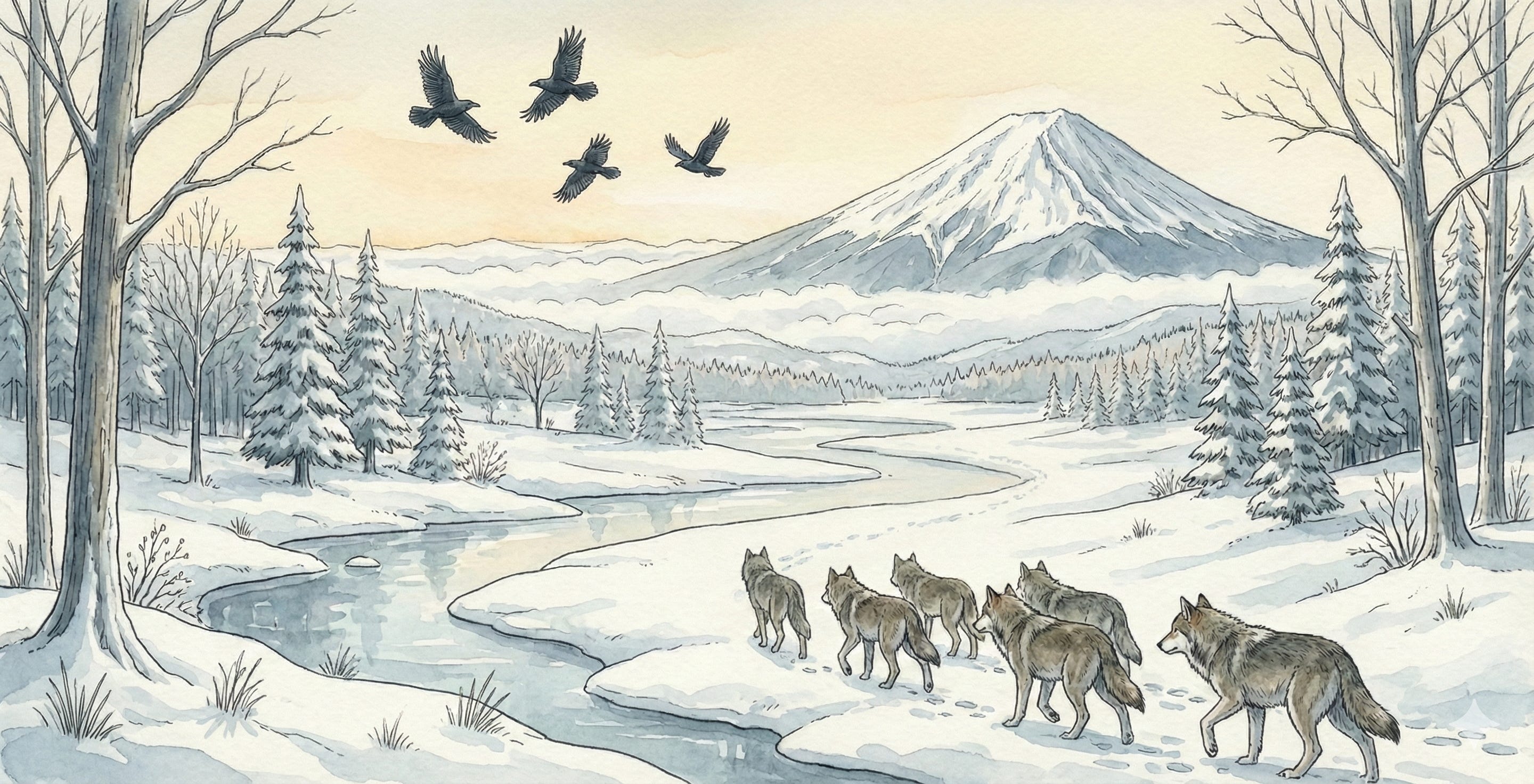
In Yellowstone, researchers found ravens present at wolf activity 99.7% of the time in winter—not just at kill sites, but while wolves traveled, rested, and hunted. Why?
Neither needs the other to survive—but together, they’re dramatically more successful.
Ravens lead wolves to food sources they would otherwise miss. Wolves tear open what ravens never could. Together they create a surplus that cascades outward: magpies, foxes, insects, and soil all benefit from a single partnership between two species that chose proximity over independence.¹
It’s not a frictionless relationship. Ravens steal up to a third of a wolf pack’s kill. Some biologists believe wolves evolved pack hunting partly to defend against that loss.²
Real mutualism involves ongoing negotiation, not harmony. The relationship works not because it’s easy, but because what each partner uniquely contributes outweighs the cost of sharing.
If ravens and wolves (and insects, protozoa, fungus…) can get this right, why does it seem humans cannot?
Thank you for reading or listening. Each week, my goal is to help build the knowledge and tools we need to create the regenerative future. I’d love to hear what the piece sparked for you.
Go Seahawks!
Register for our live monthly webcast at www.regenerouslabs.com/innovatingoutloud
Our next guest is Juliana Tioanda from Xbox. February 26th at 9 AM PT / 12 PM ET.
AI Disclosure: Researched with Perplexity. Written and edited with the help of my custom Claude assistants. Header image generated by Gemini Nano Banana.
Sources:
* Stahler, D.R., Heinrich, B., & Smith, D. (2002). “Common ravens, Corvus corax, preferentially associate with grey wolves, Canis lupus, as a foraging strategy in winter.” Animal Behaviour 64(2): 283–290. See also: Heinrich, B. (1999). Mind of the Raven: Investigations and Adventures with Wolf-Birds. HarperCollins.
* Vucetich, J.A. & Peterson, R.O., Isle Royale Wolf-Moose Study, Michigan Technological University. 50+ year longitudinal study.
* Hoek, T.A., Axelrod, K., Biancalani, T., Yurtsev, E.A., Liu, J., & Gore, J. (2016). “Resource Availability Modulates the Cooperative and Competitive Nature of a Microbial Cross-Feeding Mutualism.” PLOS Biology 14(8): e1002540.
* The Allegory of the Long Spoons appears independently across Jewish (attributed to Rabbi Haim of Romshishok), Hindu, Buddhist, Christian, and Middle Eastern traditions. In the Chinese version, the utensils are long chopsticks.
* Raworth, K. (2017). Doughnut Economics: Seven Ways to Think Like a 21st-Century Economist. Chelsea Green Publishing.
* Image, Parable of the Long Spoons, https://www.iciclefund.org/founding-parable