Who taught you what a director does?
This is one of those pieces of knowledge that used to come through cultural osmosis—some assembly required.
Based on conversations with peers (and the discussion on the latest Blank Check series), I learned about directors the same way a lot of kids who grew up in the ‘90s learned.
First there was Tim Burton. Batman was everywhere, and when I saw Edward Scissorhands on hotel cable during a family trip, I could understand that the same person made both movies. Twin Peaks was on TV, too, and I knew to associate David Lynch with an eeriness and imagery I didn’t understand. This is how I learned about the director as an artist.
The only Spike Lee productions I had seen as a kid were Nike ads, but he was about as famous as a director could be, especially during the marketing of Malcom X. Stephen Spielberg was on Animaniacs and he made Jurassic Park and E.T. This is how I learned about how directors existed as artists in the public eye.
When Fargo came out, adults around me sprinkled their conversations with Minnesota nice—“you betcha” and “ohh yah?” especially—and so the Coen Brothers entered my cultural lexicon. My oldest brother had posters for The Doors and Dazed and Confused in his room, and he talked about Boogie Nights and Casino, so I knew the names Stone, Linklater, Anderson, and Scorsese. My mom had previously rented 2001 for me, and I picked up on Kubrick references on The Simpsons. This is how I learned about directors and audience taste.
Around the time TV ads hyped The Big Lebowski as coming from “the guys who brought you Fargo,” I latched on to a director for myself. The TV spots for Rushmore had funny jokes and my favorite song (The Who’s “A Quick One While He’s Away”).
My brother said he had seen the director’s first movie, Bottle Rocket, and liked it. I fixated on seeing Rushmore the way a thirteen year old fixates on anything that seems to be part of a slightly more grown-up world. When it finally landed on cable, I studied it, trying to figure out what made the movie the work of that particular director. The music? The visuals? The editing?
A couple years later, my mom came home with the just-released DVD of The Royal Tenenbaums. Now I understood what a director did.
By college, I had seen enough movies, watched enough Siskel & Ebert, and read enough newspaper critics’ columns to understand directors (and to have a loose opinion on auteur theory, which my proximity to film majors soon solidified). Sophomore year, my school got a sneak preview of The Life Aquatic. The screening was packed. The giveaway promotional red stocking caps were prized possessions on campus.
Walking out, I was among the disappointed. The general consensus from my friends was that the movie was too heavy on style and too light on substance. Classmates used terms like real and raw to describe what they liked about the earlier Anderson movies, and they used the word twee to describe The Life Aquatic. The red caps were no longer cool. Like Richie Tenenbaum’s red-white-and-blue headband, they were the mark of a style-over-substance hipster instead of a true aesthete.
A few months later, I watched The Life Aquatic again on DVD with friends and saw all the realness and rawness of the movie’s broken heart. I understood how Anderson’s style might appear to hold certain ideas and emotions at a distance, when in fact the emotion is right there in front of us.
I’m a solid Anderson defender now. The accusations of twee are constant, though. And I see the point. His movies have become so stylish and singular, it’s overwhelming to follow what’s on the screen. At the same time, the movies have taken on deeper, heavier, more existential topics.
(I wrote about the shallow accusations of “quirk” at Together Alone.)
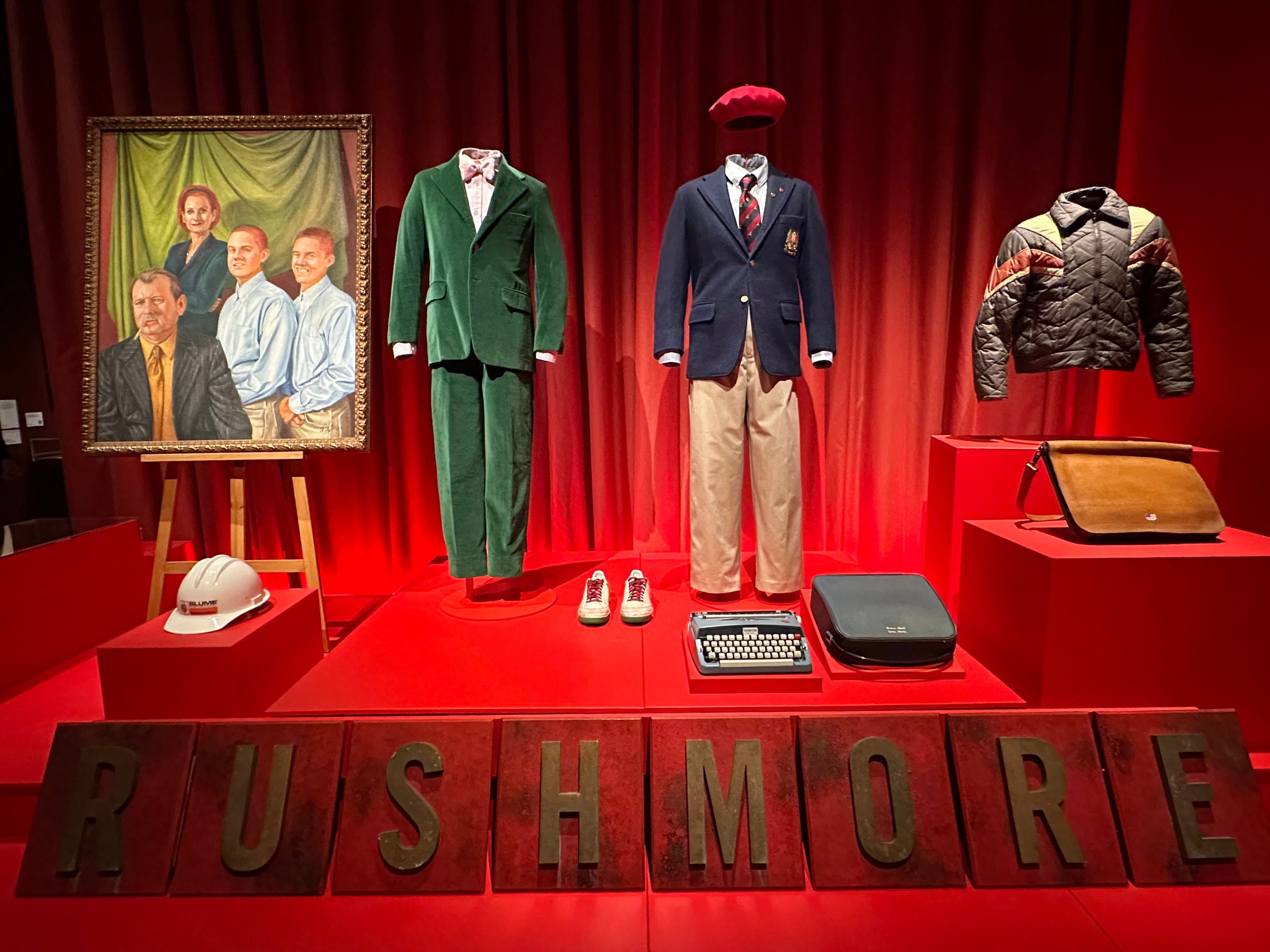
On a trip to London last week, Linda and I saw The Wes Anderson Archives at the Design Museum. It was beautiful. (As she wrote, one of our early relationship highlights was seeing shooting locations of Rushmore while visiting her parents in Houston.)
The exhibit opens with handwritten script pages and on-set Polaroids. It moves into the Sundance posters for Bottle Rocket (then a short film) before exploding into color with the Rushmore costumes. Walking through, you see how Anderson used greater and greater budgets to realize the most meticulous details of his visions. You see scouting photos of the Tenenbaum’s house, costume sketches for the Zissou crew, the prop books made for Moonrise Kingdom, and the precisely detailed miniatures for The Fantastic Mr. Fox. The placards describe how Anderson worked with designers, prop specialists, and a seeming army of collaborators to make every frame exactly how he imagined it. I spent a good fifteen minutes studying the editorial board from The French Dispatch, which appears on screen for a few seconds and isn’t even readable then.
While I was studying the wale of Mr. Fox’s corduroy suit, I overheard another visitor. “I appreciate the design, but it’s just too much fluff,” he said. “Give me something real.”
I’ve been turning that over for a while. My main criticism of Anderson’s latest movies is what I mentioned earlier—they’re overwhelming in their detail. This and the brisk plots makes repeat viewings necessary to take it all in, and it can be hard to know what to focus on in the moment. But as a problem to have, that’s pretty minor.
What could be more real than this? We’re in a gallery hall full of ideas made manifest. No production still showed even a hint of green screen. I never saw the letters CGI in their all-caps succession. Yes it’s incredibly fussy, but isn’t this perfect for the age of streaming, when you can pause and study each frame? Isn’t this exactly what’s lacking from so many movies today?
This month, the wrong files for Mad Men were uploaded to HBO’s servers, and special effects shots were missing. A Starbucks cup appeared in Game of Thrones. These are understandable if embarrassing mistakes, but given how often these things happen (there are hundreds of thousands of words dedicated to “bloopers” like this on IMDB), isn’t a carefully constructed screen world something we should celebrate? Or is “good enough” ok, and reality is judged by how little attention an artist can appear to pay?
Look at the examples of directors I mentioned in the opening. Notice how each one is still a notable name today. They were artists who millions of people knew, who a kid growing up in a tiny rural town could aspire to learn about, to sharpen his taste against. They were artists who made mainstream works that became part of popular culture. I’ll take an indelible but obviously constructed world over whatever seems real on streaming today.