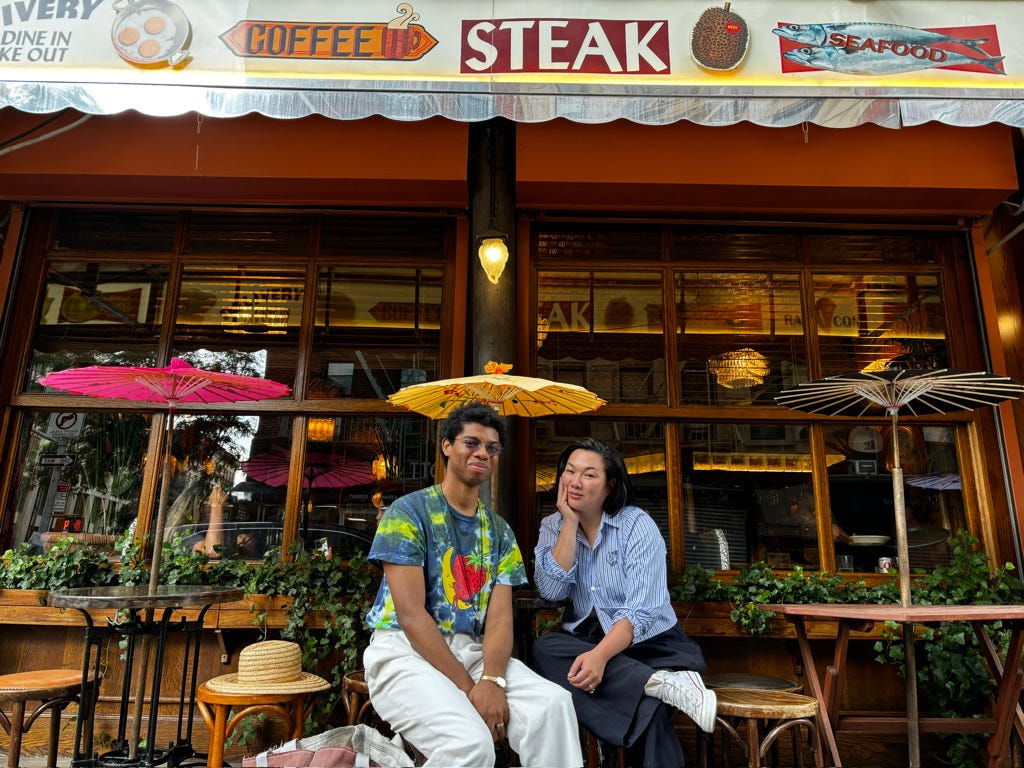
During my first season at Saks, Vogue released an article titled “Fashion Week’s Coolest Street Style Stars are Behind-the-Scenes.” That piece marked the first time I laid eyes on Daphne Seybold. Although I had previously met her virtually while interning at V Magazine, and even made several trips to the Comme des Garçons office for pickups and drop-offs, I never managed to catch a glimpse of her in person. But there she was in the Vogue article, wearing what I can only assume was one of her many Comme des Garçons pieces. With one hand tucked casually in her pocket and the other tousling her hair, she exuded a serene aura, no doubt influenced by her idyllic surroundings.
One line from the piece that truly captivated me was her description of her signature style: "Katherine Hepburn à la Comme des Garçons. Oversized, layered, and easy, with vintage jewels from my mama, and always a flat: slippers, brogues, or creepers." The phrase 'Katherine Hepburn à la Comme des Garçons' immediately captivated me—how could I resist? I rarely use this word, but in this case, it's the only one that fits: chic. So, when I had the opportunity to sit down with Daphne to discuss her current role at Sky High Farm Universe and her 14-year tenure at Comme des Garçons, I knew I would walk away feeling even more inspired and enriched.
After leaving CDG in 2022, Daphne transitioned to Sky High Farm Universe as their Co-CEO and also serves as co-founder and CMO. In our conversation, we delved into her remarkable career at CDG, including the all-important question: what does one wear when meeting Rei Kawakubo for the first time? And perhaps even more critically, how does one leave a lasting impression.
As is my usual style, I won’t delve too deeply into my guest’s background here—I encourage you, dear reader, to listen to the episode or read the transcript for the full experience. Sky High Farm’s mission is incredibly close to my heart, and I find Daphne to be so intelligent and insightful that it would be a disservice not to make this episode accessible to as many people as possible. (After listening to this episode, I highly recommend going back to my conversation with Danielle DuBois of Sakara Life, where we also explore important topics about the food landscape.)
On a side note, as i mentioned yesterday I’ve extended the discount promotion through tomorrow. So if you enjoy listening to or reading these full-length interviews and don’t want to miss a single moment, consider becoming a paid subscriber.
One more thing before we dive into Daphne’s episode: Sky High Farm Universe just launched their F/W '24 collection, co-created with Jen Brill of Homme Girls, and they’ve also released an all-purpose tallow balm that is simply divine! I’ve been obsessively rubbing it into my hands, and it’s an absolute must-have.
Jalil Johnson (00:00:00): Alrighty. Daphne, would you please introduce yourself and what you do?
Daphne Seybold (00:00:07): Okay. I'm Daphne Seybold. I am the co-founder, co-CEO, and the CMO. We're a startup called Sky High Farm Universe, which is a brand that we built to generate advocacy and revenue for the food equity work of the nonprofit Sky High Farm, which is a farm that's based in the Hudson Valley.
JJ (00:00:29): Amazing. So the first time I met you—and we didn't even really meet, it was over email—was when I was still assisting in the styling world, and you were at Comme. So it was probably when I was assisting Scott Shapiro when he was at V Magazine. That was my first encounter with you, and I think the first time I actually got to meet you in person was via Sidney Munch, who I used to work with as well when she was in the styling world as well. And so it's been really amazing to see the growth of Sky High Farm; it has been really fantastic. And so before we get into Sky High Farm and what you're doing right now, I would just love to know where you came from, what brought you here, and what were you doing before Sky High Farm?
DS (00:01:16): So I consider myself to have a pretty intersectional identity. I was born in Canada, grew up in Hong Kong, was educated at British schools in Hong Kong, then went to UCLA for undergrad, and then eventually moved to New York because it was always my dream. Just having lived in all of these different places, it's really informed, I think, not only my identity but hopefully my ability to empathize with people of all different stripes wherever I go. I want to be in places that are densely populated, surrounded by people that are different from me, but also eat different food, look different, dress differently. And so eventually, when I moved to New York, which was, I think, 2005, I thought I wanted to be a fashion journalist. At the time, I was really inspired by Cathy Horn, and I just loved the sort of frankness of her delivery. I thought, okay, maybe I should—I had an English degree—and I was like, maybe I should try to get my start out there. So I moved.
JJ (00:02:31): Were you writing when you were in school? Were you writing fashion critiques or...?
DS (00:02:35): No, I was just reading. And most of our friends and peers in fashion, I devoured magazines. And growing up in Hong Kong, it wasn't always clear what would get imported, but also you’d get the latest issue of Vogue or Self Service or whatever months and months later. They'd come out when the next issue was hitting over here in Europe. So I really kind of clung to what I saw in those issues, and they really kind of informed me of what the industry could look like or what kind of role I could have in it. When I came out here, I decided that in order to convincingly write about fashion, I needed to go to school to learn how clothes were made. And so I did a degree at Parsons—a Fashion Design degree—just to understand construction and hopefully some of the history. And during that time I interned like crazy. I think my first internship was at Mayle, which is Jane Mayle's brand, but I also interned at Alexander McQueen. I did a wholesale internship there, I did a knitwear internship at TSE, I did a brief internship at V Magazine, and I interned at Comme des Garçons.
(00:04:05): I made it sort of my business to try to understand every facet of the industry because I don't really think you can figure out what you don't want to do without having actually tried it. So it's funny because a lot of those experiences were formative, and they ended up bleeding over into the job that I would take on at CDG, which at the time I sort of landed there as an intern in the press department, and it was only a press department of one in the U.S. We were still communicating with faxes. It was crazy.
JJ (00:04:37): Oh, in 2005 or what year?
DS (00:04:40): 2007.
JJ (00:04:44): Wow. But I think that's another interesting thing too, in terms of during the internships and terms are very important. And it's also funny that you interned at V because I was at V as well, but when you were interning, were you also working another job, or how were you able to intern? Because I think that's another thing people often think about. I have questions about, it's like, okay, you're interning. And especially, I think pre-2000—I don't know when the lawsuit happened—a lot of interns weren't paid. You’re just really just unpaid labor.
DS (00:05:18): That all happened, that stuff at Harper's Bazaar and elsewhere, happened when I was at CDG. And I'd been there for a long time. It's interesting because I actually interned while I was at school because I knew immediately when I graduated that I had to get a job because I was Canadian. And so I really kind of hustled and did as much as I could and then very quickly realized that it was actually going to be much harder than I had expected. And I remember this acutely. I was sitting in Parsons at their computer lab, and I applied to Vanity Fair thinking, okay, now's the time for me to really start building those journalistic credits. And I ended up gettin…