There are days when faith feels heavy to carry. Days when you look at the world—or your life—and wonder where the Jesus you once trusted has gone. Days when you feel like you’re quietly slipping away from what used to anchor you. Not because you stopped believing, but because you’re tired, disappointed, or just unsure of where God is moving in the fog of it all.
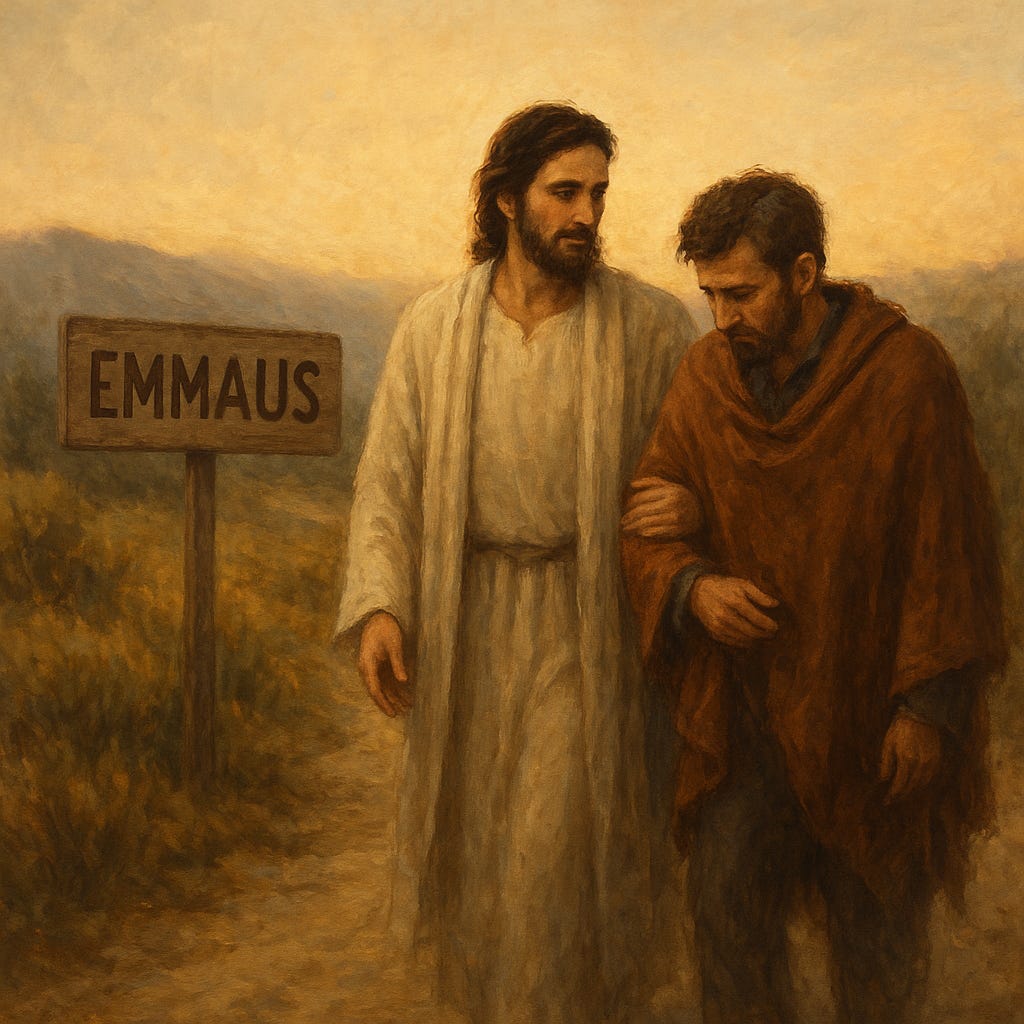
The two disciples on the Road to Emmaus knew that feeling better than anyone. They weren’t walking toward a miracle; they were walking away from heartbreak. In Luke 24, we meet them on a seven-mile stretch of road heading out of Jerusalem, away from the place where their hope had died. Their grief was still fresh. Their disappointment still raw. Even the rumors of resurrection felt like too much to hope for.
The Table with Timothy Hundley is a reader-supported publication. To receive new posts and support my work, consider becoming a free or paid subscriber.
And yet, even in their confusion, Jesus came and walked with them—not waiting for them to return to the “right” place, not insisting they believe correctly first, not demanding they fix their theology before He drew near. He simply joined them where they were.
This is the mercy of God Paul talks about when he writes, “My grace is sufficient for you, for My power is made perfect in weakness” (2 Corinthians 12:9). Weakness is not a disqualifier in God’s economy. It is an invitation. A place where grace slows down to walk beside us.
And on the Emmaus Road, grace was walking at their pace.
The Road of Disappointment
The disciples’ words break the heart: “We had hoped…” (Luke 24:21). There is so much humanity in that one line. So much grief. So much unmet expectation. It is the prayer many of us have whispered in hospital rooms, in quiet living rooms after loss, in church pews that felt more like holding cells than havens.
There are seasons when we walk away from what we once believed because the story didn’t unfold the way we were promised. We prayed, and the healing never came. We trusted community, and community failed us. We believed God was moving, and the ground gave way under our feet. Sometimes we walk away not because we doubt Christ, but because we don’t know how to reconcile Christ with what just broke our heart.
This is exactly the kind of place where God does His most tender work.
Psalm 34:18 says, “The LORD is near to the brokenhearted and saves those crushed in spirit.”Not the strong.Not the confident.Not the people performing faith well.The brokenhearted.
That’s who Jesus meets on the road.
You Still Belong
In the song I wrote yesterday, I penned the line:
In the shadows of my doubting,You whispered, “Child, you still belong.”
I didn’t write that line to sound poetic. I wrote it because it has been true in my life more times than I can count. There were seasons when my faith felt more like a bruise than a blessing—when I didn’t know what to pray, or whether prayer was even doing anything. And yet, even in that doubt, there were moments I felt God tug my heart like a gentle hand: not pulling me back in shame, but inviting me closer in love.
Jesus does that on the road to Emmaus.He listens.He asks questions.He lets them vent their confusion.He honors the pain they are carrying.
Belonging doesn’t begin when belief becomes perfect.Belonging begins when grace steps toward us in our imperfection.
This is the spirit of Romans 8:38–39—nothing can separate us from the love of God. Not doubt. Not disappointment. Not the long walk away from Jerusalem. Not even the parts of us that don’t recognize Jesus when He’s standing right beside us.
When Scripture Begins to Burn Again
As the disciples walk, Jesus begins to open the Scriptures to them—not as a lecture, but as a reweaving of hope. He takes the pieces they couldn’t understand and sets them gently back into the larger story. They later say, “Did not our hearts burn within us…?” (Luke 24:32). That burning wasn’t conviction; it was resurrection warming their grief.
Sometimes the heart begins to burn long before the eyes begin to see.
Years ago, I sat with someone who had been deeply wounded by their church. They told me, “I still believe in Jesus, but I don’t know if He believes in me anymore.” They had been walking their own Emmaus Road for years—carrying disappointment, carrying rejection, carrying the quiet fear that they no longer belonged.
We talked for a long time. And somewhere in that conversation, I watched something shift in them—not a full healing, not a sudden breakthrough, but the faint warmth of hope beginning to flicker again. It reminded me of the disciples: sometimes the Spirit rekindles our hearts in quiet ways long before revelation arrives in full light.
That burning is grace.That burning is resurrection drawing near.That burning is the whisper that you are not abandoned.
The Table Where Eyes Are Opened
The moment of recognition comes not through miracles or teaching, but through something much simpler: bread. Jesus takes it, blesses it, breaks it, and suddenly the disciples see Him. The same pattern appears in every moment Jesus reveals Himself—He blesses what is whole and breaks it so it can be shared. It is the rhythm of the cross and resurrection. It is the rhythm of grace.
Luke tells us, “Then their eyes were opened” (Luke 24:31).And don’t we all have moments like that?
When the prayer you prayed in exhaustion suddenly becomes clarity.When the Scripture you skimmed becomes revelation.When something small—a kindness, a word, a song—opens a door you didn’t know needed opening.
Jesus reveals Himself at the table because the table is where barriers fall.Where we stop performing.Where we rest.Where we receive.
It is no small thing that He opens their eyes over a meal. The table is where God makes strangers family. It’s where grace removes the walls we thought were permanent.
Your Love Is Stronger Than the Walls They Raise
One of the lyrics in the song says:
Your love is stronger than the walls they raise;Jesus, You welcome every heart You’ve made.
There were many walls on the Emmaus Road: fear, confusion, sorrow, shame, disillusionment. But walls have never stopped Jesus. Not the temple veil. Not death. Not unbelief. Not hurt. Not the opinions of the powerful.Certainly not the weary road of two discouraged disciples.
Ephesians 2:14 says, “He Himself is our peace… and has broken down the dividing wall of hostility.”Emmaus is proof that He still does.
Shame Falls, Hope Rises
When their eyes finally open, the disciples do something remarkable—they run back to Jerusalem. The same road that carried them away in disappointment now carries them back in hope.
When grace is revealed, shame loses its grip.When love breaks through, fear begins to unravel.When belonging is restored, courage rises.
This is why I wrote:
No shame can stand in the way.andYour arms are open the same.
The arms that embraced the doubter, welcomed the outsider, restored the wanderer—those arms have not changed. They didn’t change for the disciples. They don’t change for you.
A Final Word for Your Journey Today
Wherever you are walking—toward faith, away from it, or somewhere in that holy and honest middle—Jesus walks with you. Grace is calling your name. Your doubt does not exile you from belonging. Your disappointment does not push God away. Your confusion is not a threat to the Kingdom.
You are not walking this road alone.And you never will be.
Even in the shadows, even in the wrestling, even when your steps lead away from the familiar places of faith, the risen Christ draws near—still breaking bread, still opening eyes, still whispering through the Spirit:
“My grace is sufficient for you…for My power is made perfect in weakness.”(2 Corinthians 12:9)
And if you listen closely enough, you might hear Him say again:
“Child, you still belong.”
The Table with Timothy Hundley is a reader-supported publication. To receive new posts and support my work, consider becoming a free or paid subscriber.