Every now and then a story appears that is so drenched in irony it almost reads like one of Jesus’ parables. This week brought one of those stories.
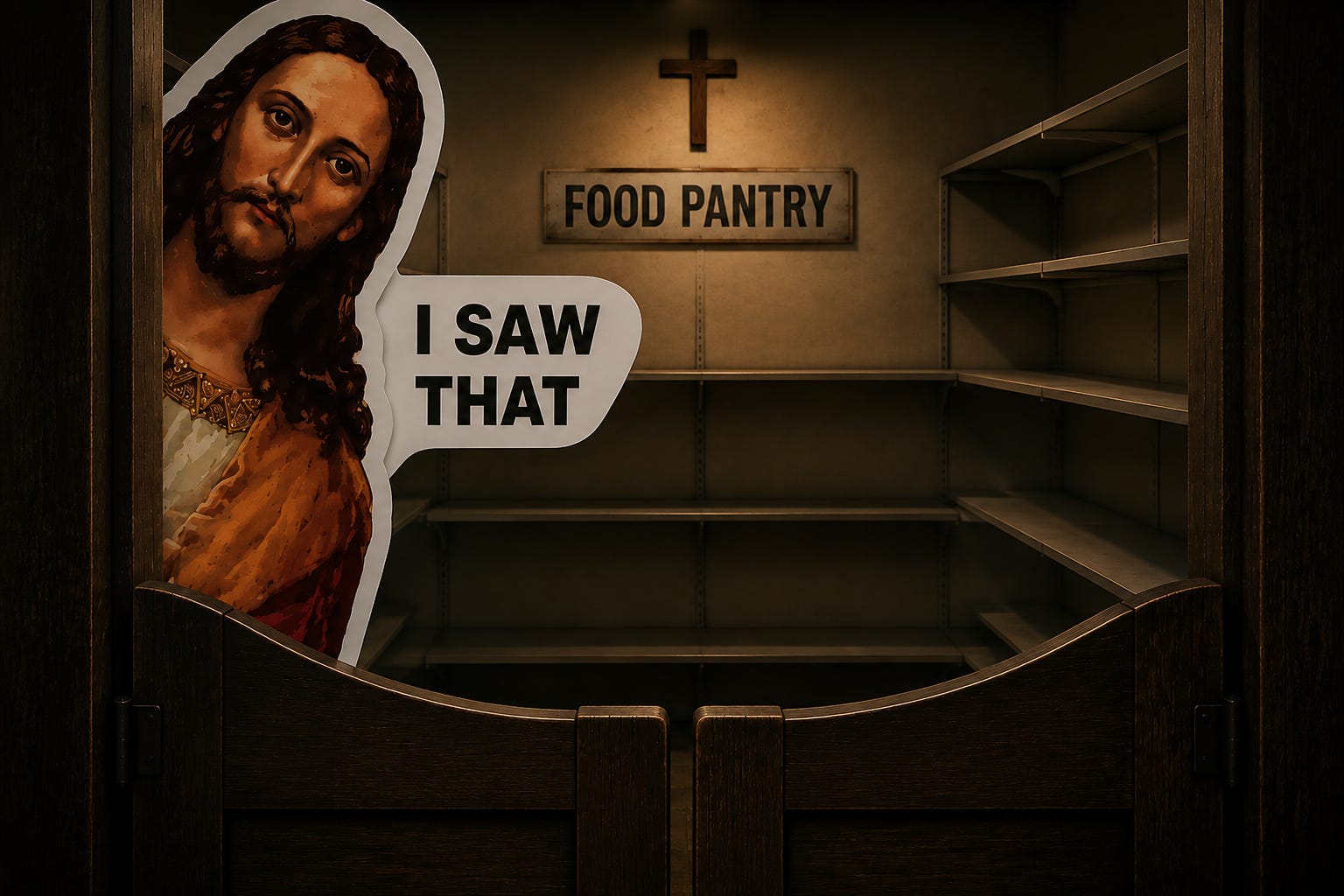
According to the reporting, a Christian food pantry found itself with empty shelves after its pastor rejected supplies connected to organizations that affirm LGBTQ people. Whether one agrees with every detail of that decision is almost beside the point. The image itself should stop Christians in their tracks: hungry people waiting for food while the Church debates whether the hands offering the bread are sufficiently righteous.
If there is a passage of Scripture that deserves to interrupt this conversation, it is Matthew 25.
Jesus’ vision of the final judgment is astonishing in its simplicity. The King does not divide humanity according to denominations, political parties, theological camps, or cultural identities. He gathers the nations before Him and asks questions so ordinary that they almost seem beneath the grandeur of the moment. I was hungry. I was thirsty. I was a stranger. I was naked. I was sick. I was in prison.
Then comes the line that has echoed through two thousand years of Christian history:
I was hungry, and you gave me food.
Notice what Jesus never says.
He never says, “I was hungry, and you first investigated the theology of the people who donated the bread.” He never says, “I was hungry, and you verified the ideological purity of the supply chain.” He never says, “I was hungry, and you made certain no sinner had been involved in feeding me.”
He simply says, “You gave me food.”
The Church, however, has become remarkably gifted at asking questions Jesus never asked while quietly neglecting the ones He never stopped asking.
Who is hungry?
Who needs a meal?
Who needs mercy?
Somehow, we have convinced ourselves that preserving distance from the wrong people is a greater act of faithfulness than feeding the right ones.
How did we get here?
When did suspicion become holier than compassion?
When did refusing bread become a testimony of conviction?
Scripture certainly does not prepare us for such a conclusion. The God of Israel has always displayed a frustrating habit of working through people the religious establishment would rather avoid. Cyrus, a pagan emperor, is called God’s anointed. A Samaritan becomes the hero of Jesus’ most famous parable. Peter is forced to abandon categories he once believed were divinely established, only to discover that God had already gone ahead of him. Again and again, the Bible tells the story of a God who refuses to limit His grace to the boundaries His people so carefully construct.
Perhaps that is because grace has never been primarily concerned with protecting our sense of purity. It has always been concerned with restoring human beings.
That is what makes Matthew 25 so unsettling. Jesus does not merely tell us to care for the hungry. He identifies Himself with them.
The hungry are not a ministry opportunity.
They are Christ.
The thirsty are Christ.
The stranger is Christ.
The prisoner is Christ.
The lonely widow standing in line at the food pantry is Christ.
The exhausted single father wondering how he will feed his children is Christ.
The child whose stomach hurts because dinner never came is Christ.
That changes everything.
It means our theological debates are no longer abstract. Every decision we make eventually arrives at the feet of a real human being bearing the image of God. We are free to wrestle with conscience, conviction, and doctrine—as Christians always have—but we should tremble whenever those debates leave the vulnerable carrying the consequences.
The tragedy of our age is not simply that we disagree. Christians have always disagreed.
The tragedy is that we have become so consumed with determining whom we cannot stand beside that we sometimes forget to kneel beside those who are suffering.
Jesus never seemed particularly anxious about guilt by association. His critics certainly were. They complained constantly about the company He kept, the tables He attended, and the sinners He welcomed. Yet Christ never apologized for proximity to broken people. He seemed far more concerned that mercy reached them than that His reputation remained intact.
Perhaps that is the question the Church should recover.
Not, “Who donated the bread?”
But, “Was the hungry person fed?”
Because if Matthew 25 is to be believed—and Christians confess that it is—the One receiving that loaf is not merely our neighbor.
It is Christ Himself.
And if we can watch His shelves stand empty while congratulating ourselves on the purity of our convictions, then perhaps the question before us is not whether we have defended the faith.
Perhaps the question is whether we have recognized the King.